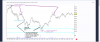
Best to start with a picture from the NQ today. First the 1 minute chart:

And now the 5 second chart:

So leading up to this, you can see how dead the volume is. Based on the 1 minute chart, there seemed to be a level of support forming at roughly 37, and just down below were the daily lows from Feb 27 and Feb 26.
Out of nowhere at roughly 12:25, price spikes down. It barely lasts 30 seconds, and price now starts the steady climb back up.
When traders are looking for trades, there is usually someone on the other side waiting to take that trade. But in this case, it sure seems like we ran out of buyers very quickly. Once we dropped below that first cyan line, the thinner one that seemed to be forming the first level of support, I bet that lots of stops started to get triggered at this point, and once again, there were hardly any buyers to keep prices up, but at the same time, someone was still on the other side of the trade. In fact, price really only dropped about 5 points, from 4337 to 4332.
When we look at the volume, we can see the hundreds of contracts over just several 5 second intervals that exchanged hands. So on the one hand, we have no buyers initially, which is what starts the cascade, but on the other hand, there are plenty of buyers to take those contracts just a few points lower.
The only explanation, from my limited knowledge, that I can come up with is the algo trading. I have no idea what percentage of trading is done by humans sitting at home, by computers, by HFT firms, by other types of funds, etc. And from what I understand about futures, they are supposedly harder to manipulate because there is no accumulation, unlike in stocks, and futures are supposedly spread thinly enough amongst the different parties involved that no one entity can affect the price all that much.
But how else to explain a sudden withdrawal of offers to buy during a very slow time, followed by an immediate buying frenzy to actually buy up all that is offered? I imagine some algos are programmed to buy up the down spikes, but when the cascade continues, as in major news events that actually provide a basis for the selling, and someone therefore realizes that the spike isn't just temporary, this adds to the selling as now those algos start dumping whatever they just bought hoping to make a quick buck.
So when I see these spikes, I can't help but think that perhaps one of the major players pull all offers to buy, and since they knew, having caused it, they start slowly buying all that is thrown at the market for several points less once the stops are tripped, and then when others realize there is nothing to this spike and everyone else gets back to buying, they can start unloading what they just bought for cheap. Why else would anyone buy in a quick down spike unless you know that this spike down isn't anything to worry about?
Any thoughts?
And now the 5 second chart:
So leading up to this, you can see how dead the volume is. Based on the 1 minute chart, there seemed to be a level of support forming at roughly 37, and just down below were the daily lows from Feb 27 and Feb 26.
Out of nowhere at roughly 12:25, price spikes down. It barely lasts 30 seconds, and price now starts the steady climb back up.
When traders are looking for trades, there is usually someone on the other side waiting to take that trade. But in this case, it sure seems like we ran out of buyers very quickly. Once we dropped below that first cyan line, the thinner one that seemed to be forming the first level of support, I bet that lots of stops started to get triggered at this point, and once again, there were hardly any buyers to keep prices up, but at the same time, someone was still on the other side of the trade. In fact, price really only dropped about 5 points, from 4337 to 4332.
When we look at the volume, we can see the hundreds of contracts over just several 5 second intervals that exchanged hands. So on the one hand, we have no buyers initially, which is what starts the cascade, but on the other hand, there are plenty of buyers to take those contracts just a few points lower.
The only explanation, from my limited knowledge, that I can come up with is the algo trading. I have no idea what percentage of trading is done by humans sitting at home, by computers, by HFT firms, by other types of funds, etc. And from what I understand about futures, they are supposedly harder to manipulate because there is no accumulation, unlike in stocks, and futures are supposedly spread thinly enough amongst the different parties involved that no one entity can affect the price all that much.
But how else to explain a sudden withdrawal of offers to buy during a very slow time, followed by an immediate buying frenzy to actually buy up all that is offered? I imagine some algos are programmed to buy up the down spikes, but when the cascade continues, as in major news events that actually provide a basis for the selling, and someone therefore realizes that the spike isn't just temporary, this adds to the selling as now those algos start dumping whatever they just bought hoping to make a quick buck.
So when I see these spikes, I can't help but think that perhaps one of the major players pull all offers to buy, and since they knew, having caused it, they start slowly buying all that is thrown at the market for several points less once the stops are tripped, and then when others realize there is nothing to this spike and everyone else gets back to buying, they can start unloading what they just bought for cheap. Why else would anyone buy in a quick down spike unless you know that this spike down isn't anything to worry about?
Any thoughts?