What constitutes edge / why is my system working?

Some background: I am no quant PhD, and certainly no hedge fund guy. I am just an engineer with decent programming skill.

I have spent a small part of the last 2 years developing and building a pretty simple intra-day trend-following system (fully automated) focussed on currencies. No fancy indicators, just signals based of when price exceeds a simple moving average. After a bunch of backtesting and paper trading, I'm seeing that it actually makes good return and I just started live trading with it.

BT results: Sharpe > 1.7, with tight stop losses.

While I was happy, I was also quite suspicious to see this working as well. Can someone help me intuit how such systems work?

You mention that it's automated and that the wins are super small or something. Maybe it's because it's the discipline (that the automated system forces upon you) of taking a small profit and then staying out until the next "good" entry appears from the system? Perhaps if you were to cast a wider net and increase the profit-taking point, it might not work? Just guessing around here... I don't think anyone can really give you a "for sure" answer.
 
Sharpe 1.7 - returning 100% a year for the last 2 years when trending (it is a trend follower, after all). Around 30% prior to that when the assets I was trading was not trending.

RE: asking on the blog, I would, but was hoping some of the intraday/retail traders here (clearly there are many successful ones) who would offer some perspective.
What is the P&L per trade value? I think in a lot of cases, people make unrealistic assumptions about their transaction costs (slippage, adverse fills, commissions) and that really eats into the results.

PS. In this business, when something is too good to be true, it usually is. So before asking "why does this work?" first question should be "what could I be doing wrong?". Most of the time if you think about it, you will discover that either an assumption you made is incorrect or you have a problem in your backtest and/or paper-trading. Sometimes, you discover that it works in real life but you have chunky drawdowns (i.e. you were selling risk asymmetry in one or another form). Sometimes you discover that the strategy does not scale at all (it's nice to make a grand a month, but is it worth the hassle?). Then, finally, there is a chance that you have stumbled onto something that works.
 
What is the P&L per trade value? I think in a lot of cases, people make unrealistic assumptions about their transaction costs (slippage, adverse fills, commissions) and that really eats into the results.

PS. In this business, when something is too good to be true, it usually is. So before asking "why does this work?" first question should be "what could I be doing wrong?". Most of the time if you think about it, you will discover that either an assumption you made is incorrect or you have a problem in your backtest and/or paper-trading. Sometimes, you discover that it works in real life but you have chunky drawdowns (i.e. you were selling risk asymmetry in one or another form). Sometimes you discover that the strategy does not scale at all (it's nice to make a grand a month, but is it worth the hassle?). Then, finally, there is a chance that you have stumbled onto something that works.
Question: What questions should OP ask if going live continues to get great results but OP still does not know why it works?
 
Some background: I am no quant PhD, and certainly no hedge fund guy. I am just an engineer with decent programming skill.

I have spent a small part of the last 2 years developing and building a pretty simple intra-day trend-following system (fully automated) focussed on currencies. No fancy indicators, just signals based of when price exceeds a simple moving average. After a bunch of backtesting and paper trading, I'm seeing that it actually makes good return and I just started live trading with it.

BT results: Sharpe > 1.7, with tight stop losses.

While I was happy, I was also quite suspicious to see this working as well. Can someone help me intuit how such systems work?
  • What are the market forces making this system work?
  • Is this effectively taking money from less sophisticated traders? Or, am I riding the wave with smart money who just don't mind taking smaller losses which are actually quite meaningful for retail traders?
  • Why haven't hedge funds/smarter people arbitraged or sucked the alpha out of my system?
  • I've read Ernest Chan's books and it seems that this might be related to 'capacity' but I am still not sure why it is actually working.
Thanks in advance.
You are an engineer, so you should understand this:

As a small non professional retail trader, my opinion is for a normally distributed function (approximation of stock price change) noise is a function of the square root of time whereas mean can be any function of time (or an exponential function of time in a bubble) so your sharpe ration of 1.7 may not be that impressive. SPY Sharpe in 2017 is 3.5 and since 2013 is 1.6, if your BT is for 5 year, you just mimic the market on a risk adjusted basis, sorry, not that impressive.

Regards,
 
Maybe you and sle can give us some guidances on how to separate luck from skills. One can easily be delusional.
It's less about delusion and more about things like statistical significance (primarily) and then frictions, asymmetry, excess free parameters (secondarily) etc. Since I know nothing about the strategy, it's hard for me to say what to do exactly. For starters, try to understand if you have a strong directional bias - e.g. if you always been trading long. If so, adding a simple dual population test will answer your question, or, as an alternative (if you are trading something other than index), you can re-test your strategy as market neutral. That would be a start.

PS. We, as humans, are not built to perceive statistical significance, that would be an evolutionary drawback. So bad it is that our Commander in Chief is readily confusing a single day observation with a long term trend.
 
Well, it could be just an artifact of the bull market since 2009?o_O

Maybe you and sle can give us some guidances on how to separate luck from skills. One can easily be delusional.

Thanks.

It was just a funny on the way you typed that line. Reminded me of that movie scene.
 
You are an engineer, so you should understand this:

As a small non professional retail trader, my opinion is for a normally distributed function (approximation of stock price change) noise is a function of the square root of time whereas mean can be any function of time (or an exponential function of time in a bubble) so your sharpe ration of 1.7 may not be that impressive. SPY Sharpe in 2017 is 3.5 and since 2013 is 1.6, if your BT is for 5 year, you just mimic the market on a risk adjusted basis, sorry, not that impressive.

Regards,

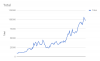
Yes, so in the short term it seems that SPY can beat this system, especially given recent year's gains. But the 10yr SPY Sharpe is 0.38 and mine is around 1 which seems to suggest it might be profitable in the long term. The 2 yr rolling Sharpe for my BT varies between 0.9 and 1.7. There is one particularly nasty drawdown of 35% in the 10 year backtest. But hey, no risk no reward? Attached equity curve over 10 years.
 

Attachments

  • chart.png
    chart.png
    10.9 KB · Views: 47
Back
Top