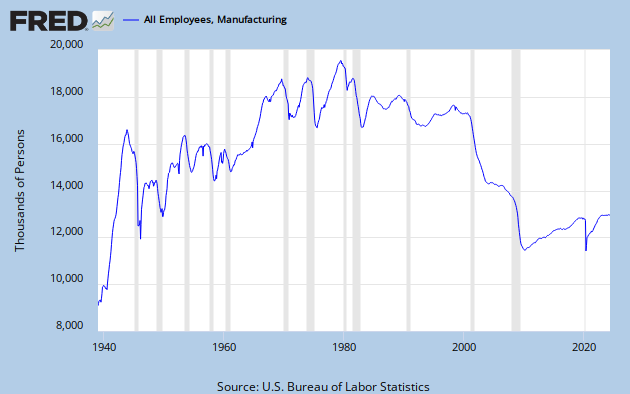
What changed in 1980

I do think the "guns & butter" policy of LBJ was a turning point. Prior to that the dollar was (nearly) as good as gold. That changed quickly and the psychology of this country changed with it. People knock his "Great Society" initiatives and they may or may not be correct. But it is crystal clear in retrospect (and even pretty clear in the moment) that a combination of the Great Society approach and an enormously expensive and draining war was simply too much for even our powerful economy to bear all at once.

Quote from noob_trad3r:

Actually the downfall began the moment we JFK died and we got a Hawk for a president. The moment we entered the Vietnam war was the beginning of our problems.
 
Quote from noob_trad3r:

Actually the downfall began the moment we JFK died and we got a Hawk for a president. The moment we entered the Vietnam war was the beginning of our problems.

I agree. "The day the music died".
 
Quote from StarDust9182:

I don't mean to offend you (or anyone), just to get to the economic truth as I can understand it.

My own first response to your reply was what a silly answer, what can divorce have to do with a major economic change? But I have read past good posts from you, I thought I would check it out. Some research has produced an anomaly.

First, I read a comment years ago about what fundamentally caused the subprime mess. The author claimed it was the Equal Rights Amendment. Of course, digging into the article, it was not the equal rights part (who can logically argue that?) but the implementation of that policy by the government. The article claimed that the government originally mandated 2% of loans be given by banks to people who would not normally qualify. (Banks don't want to lose capital on risky ventures, and governments don't care since they are not spending their own money) Quietly, slowly, but surely that percentage rose to be 20%? of new loans ( if I recall correctly), set by congress in the name of equality. At least that is what the article claimed.

The banks not being stupid, packaged the risk parts and sold it to others who were stupid with the help of a non-functioning (AKA captured) regulatory system and tacit government approval since they followed their policy orders. That is what the article explained. I wish I still had the link.

Now, to quickly disprove Nutmeg's comment, I thought to myself what was the biggest economic factor of a higher divorce rate. My first reply was more women entering the workforce. So I researched for a chart to show no correlation to recessions and found this gem:

http://research.stlouisfed.org/fred2/series/EMRATIO/

There is more at http://research.stlouisfed.org/publications/es/article/9622

This chart seems to show a correlation that something indeed changed around 1975. Digging further I found a section under http://en.wikipedia.org/wiki/Women_in_the_workforce in the section "Laws protecting women's rights as workers" stating that" In 1966, the United Nations General Assembly adopted the International Covenant on Economic, Social and Cultural Rights, which went into force in 1976."

Wowee! Could this be a repeated story? More research needs to be done.

The US St Louis chart shows an anomaly. Less families, more women entering the workforce. I remember women's

rights being a big driver of government policy then and hearing that some western governments had quietly passed laws identifying UN laws as superceeding their own country's laws. Productivity was the big watchword then as I recall - if you want higher wages, then produce more and your pay will go up. That has all changed.

To enforce the UN policies, I think government would have to increase its size. The market would eventually pay for productivity and if wages fell, then socialism would seem to be required - that is "The market is wrong so we will fix it through legislation". That is doomed to failure in the very long run I think.

Is this a similar case as the article I read about the subprime mess - Government policy trying to change

market forces (AKA reality) by passing laws? Has the quality of productivity in workers declined causing a slow but steady bankrupcy due to bad government policy?

Can anyone point to the flaws in my line of reasoning. I find the correlation eerie.

I have seen this claimed many times, i.e., it was government policy to make these sub prime loans. And of course one can then extrapolate back to the equal rights amendment if so inclined.

Actually this policy to make loans more accessible was a very good policy that had nothing whatsoever to do with the subprime crisis, though I wouldn't put it past an entity like Countrywide to try to use that argument as a plaintiff. It's not going to carry much weight in court however.

It was never intended nor directed that loans be made to those obviously incapable of repaying them. What happened is that in some communities banks were simply uninterested in making loans to certain minorities. After the government stepped in, they began making these loans, but to their regular underwriting standards for sub prime, thus these loans were correctly rated as subprime, had a somewhat higher default rate, and a somewhat higher interest rate, though government subsidies may have been involved in some cases.

This was in the early days before the ties between those making loans and those holding the loans were totally severed.

Originally S&P used a rating for securitized loans that properly took into account the subprime content. Experience had revealed the expected rate of default. S&P knew the default rate and the subrpime content of the packaged loans and correctly rated them.

After the major investment banks realized how much more attractive CDO's were than unsecuritized mortgage bonds they got very interested in promoting CDO sales. They were selling like hot cakes as long as they could get a decent rating. The I.B.'s needed more product to sell. They made money available through mortgage closers like Country Wide who would close the loan for a fee and immediately sell it to an entity that was going to package it, i.e., securitize it, like an I.B. for example, with other loans and the various package components, after rating, would then be hawked to eager buyers around the world.

There was tremendous demand and money to be made. When S&P rated the resulting CDO's they assumed incorrectly that the quality of the subprime content was the same as it had been previously. They did not realize that those closing the loans were completely abandoning underwriting standards just to make a quick buck. The closers had no skin in the game and apparently no one told S&P that there were now a bunch of liar loans included in these packages. Naturally the default rate was now above what it should have been for subprime. They should have done due diligence, but they did not. They just assumed those subprimes were the same as subprimes had always been. Big mistake!

The government never asked nor required that anyone make a loan to someone who could not repay, or to someone without documented income. And no reasonable person in government would assume that someone could walk into a closer with no documentation and walk out with a loan!

The government is responsible in one respect however. Greenspan was told, repeatedly actually, two to three years before the crisis hit, that loans were being made without proper documentation, and he did absolutely nothing about it. He was the chief regulator, but he did not believe in regulation. He thought market forces would take care of matters. He also believed in what economists call equilibrium theory. Essentially its the idea that markets spontaneously will tend toward balance or equilibrium. Well, it turns out he was both right and wrong at the same time. Market forces will take care of matters, and in the end they did! But markets don't tend toward equilibrium, they tend to move further from equilibrium! So when the market decided to take care of matters it was far from equilibrium, and then the shit hit the fan. That is of course when the Treasury and Fed stepped in and circumvented the spontaneous path the market would have otherwise taken in "self-correcting". I wasn't pretty, but it could have been much worse if the market had been left solely to its own devices, as Greenspan used to advocate before he got religion.
:D
 
Piezoe
Very well said. Excellent posts.
Late 70's , early 80's I remember two performance reviews/ year for approx 6%
each and that was only cost of living to offset approx 11% inflation.
The great Commonwealth of Massachussetts was home to Wang, Digital Equipment,
Data General, and Prime(all refrigerator size minicomputer makers), defense contractors, Ratheon , GE etc...
$22 an hour on a GM, Ford assembly line with an average 7th grade education.
At the local watering hole I drank with those who made my TV(Sylvania or RCA), radio,
and everyone seemed to work for "the telephone company" , AT&T.
What the hell happened. Sure the pc, $6000 retail for the first PcXT which had a 10 Meg
Hard drive decimated the mini computer industry. My first recollection was pc mother boards from Malyasia, Taiwan, etc...
My only point in that rambling is that as I recall, virtually everything was large, labor intensive and expensive. A Magnavox 25" wooden console color TV was near $500.
Everyone was working. You did not have to be exceptional and it was not that competitive
To get a decent job. Employment stats were more accurate pre-Clinton changes to those stats.
It is hard to convey how different it was then. The rate of college grads was low then and
in previous decades. Some men had " good jobs" and some didn't often with little connection to talent and eduction, much more connections "who you knew". Pensions
For life are part of that. AT&T and GE come to mind first in this regard.
Any man willing to work could afford a house( and pay for it) . Square foot envy had not started then s most houses were in the 960-1200 sq foot range. There was no other debt.
Car.....sure....done at the local bank with your mortgage.
A child could take a passbook savings book to the bank, stand in line, hand over $10
We did this mostly to see the new entry punched in the book calculating the 6% return on
Our "capital".
Middle class was real and well. Corporations/ shareholders were not doing well flatlining from 69-81 and based on the above its not hard to see why. Middle class was not yet watching sp500 and not a shareholder pre 401k days.
Soros in a sentence in "Alechemy" said something's along the lines of "they threw in the towel and outsourced/ took it overseas" or something like that.
This is not really that long ago. The changes are astounding. We in the US have a system
That provides a living wage to the relatively exceptional and a government willing to
Subsidies those that do not quite measure up with unemployment, welfare etc..
Not good. Grateful to have lived in those days that I did.
And I know, the new mantra is "get off your ass and get your PHD" . These days you are a shareholder or you are not. Don't get me wrong....I try like hell to be a shareholder.
I believe the last 30 years pre-Obama was a power grab that became manic, greedy and overshot. The backlash to that is an opposing power grab (masterful) so far and is near complete with the US changing demographics and willingness to subsidize.
Austerity....that will be tough wont it.

Just a rambling opinion
 
Deficits became "structural" in the 80's. Meaning the US economy peaked in the early 80's, and began a slow, accelerating decent, thereafter. To stem that, ever-larger deficits were introduced to offset the growing shortfall in GDP. To "paper over" the real recession in the economy. This is the exact same situation we have today, except on a much larger scale (note the size of the Federal Budget deficit and FED Reserve monetization initiatives = >15% of GDP...).

Why the 80's? What happened in the 80's? That coincided exactly with the peak of US manufacturing employment. As US jobs packed up and went overseas, the US economy contracted and fell into recession. Who woulda thunk it? Fast forward 30 years later, and we're at about a shortfall of 20% GDP, with multiplier considerations. For every one factory worker that goes overseas, there's about .4 - .6 "support jobs" that go along with it (industrial suppliers, financial services, consumer products etc).

Examine this chart carefully. Wow. Looky here! EXACTLY AT 1980 manufacturing employment (total) peaked!!! What happened after? OUTSOURCING. Now, I would add, most of the posters in this thread are old timers, advanced in age, who voted for these slimy carpetbagging politicians who sold offshoring as a great thing. And these dopes fell for it. The US gave the Chinese a gigantic piece of its economy, because these fucking tards wern't minding the shop.

What's worse, this is just the beginning. The US is sustained by debt. The US, like Italy, Portugal, Spain etc has a debt limit. Once the market says no mass, guess what? We're fucked. And if Bernacke prints, say goodbye to your precious dollar reserve status, which is basically the only thing keeping this sinking ship afloat. We're headed for a gigantic depression. See, nobody gives a fuck. Every one is an idiot who buys the spoonfed pap. Look around, only 3 traders on this thread mentioned the trade deficit, which is an around about way of saying offshoring is the problem. TV? Divorce rates? Fuck. Its called JOBS!!!! Anyway, enjoy. Too late now. All done. Good luck to your granddaughter. She'll be growing up in a fucking shitshow.

fredgraph.png


Federal Deficits (note: consistently start ~1980)
fredgraph.png
 
Quote from piezoe:

1980 was Carters last year. His presidency was plagued with problems he was only able to partially overcome by the '80 election which "swept" Reagan into office with 28% of the eligible voters voting for him, versus 22% for Carter, . Only 54% of those who could vote actually did. (There was a third candidate as well, a "liberal" Republican, i.e., an old fashioned Republican.)

Reagan's near decade ('81-89) in office brought an ideological sea change to Washington. Gone were the old fiscally conservative, socially liberal Republicans. A new kind of Republican emerged, one fiscally liberal and socially conservative; inverting as it were 154 years of Republican tradition. Reagan and his army of neocons launched an attack on welfare and other perceived government evils such as "regulation"; annihilating, or ignoring, as much of the government regulatory apparatus as they could while growing the defense industry at a breakneck pace to achieve record deficits, all while battling a non-existent communist menace. (The deregulated Savings and Loan Industry, later collapsed.)

The Reaganites were aided and abetted every step of the way, except for one notable exception, by the Democrats who also enthusiastically supported lowering the upper bracket tax rate, first from 70% to 50%, then later to 28%; thus more or less dismantling what was formerly a progressive tax schedule. The Democrats were there in the wings always happy to overlook this little transgression or that, such as ignoring the "War Powers Act" for instance, and allowing the President "plausible deniability" when it was necessary to shift blame onto hapless underlings.

But even though the Democrats were always happy to lend a hand, they don't deserve any of the glory for the surprising amount of innovation introduced by the Reaganites. It was Reagan and his Chicago School economists who were the true "geniuses". Who else could have come up with the novel idea of reducing revenues to increase them? (We know now, of course, that they must have been counting borrowed money as revenue!:D )

Other than being Bonzo's bedtime buddy, marrying a steadfast believer in astrology, running up unconscionable debt, finding a communist threat everywhere he looked, and having by far the best speech delivery of any U.S. president since the advent of Edison's recording machine, Reagan will always be remembered for his version of "supply side economics" -- an idea that no matter how absurd, refuses to die. Reagan wholeheartedly embraced supply-side economics; though he had no formal training in economics whatsoever, and was without question among the least well-educated of U.S. Presidents. Under Reagan's interpretation of supply-side economics, taxes were slashed. This presumably made them fairer by reducing the gap between rates paid by the rich and the poor, while at the same time having the magical result of increasing revenues! The extra bucks lining the pockets of the rich that would result were expected to spontaneously "trickle down" to the grateful poor, leaving everyone, rich and poor alike, very satisfied.

Of course none of this worked as hoped. Revenues did eventually rise some, after trillions were borrowed and spent on useless military hardware to fight an imaginary communist enemy. The increased revenues, however, came from increased government spending, not tax cuts. The revenues were sadly dwarfed by spending. The huge Treasury shortfall had to be made up by record borrowing. (I can still hear the goings-on in the Oval Office-- "Damn, it seemed to work fine on paper. Well, we can't admit we were wrong. They'll crucify us. Only thing to do is to carry on as though it were a great success.")

Whereas American style capitalism has never been kind to the poor, under Reagan it began to be unkind to the middle class as well! It was Reagan-nomics that began the slow slide of the middle class toward a progressively smaller piece of the prosperity pie. So for example, when Reagan took office the average CEO salary was about forty times that of a typical factory worker. But by the time he left office that ratio had grown from 40 to 99 --more than doubling! In the decade of the '80s, before tax income of the wealthiest 1 % rose 75% while the income of the bottom 40% declined slightly. Meanwhile Reagan was faced with depletion of the Social Security Trust Fund, a buffer against hardship in old age for the lower classes, but a feature of little interest to the wealthy. This was fixed, and resulted in the approximate 3 trillion surplus in the fund today. However by the end of Reagan's time in office, a middle income family making 40K paid about 7.5 % into Social Security and a family making 400K paid about 1.5%.

This is the path that both Republicans and Democrats launched us on during the 1980's. But let's be fair, Reagan deserves all the credit. We continue on that same path today -- with only a little respite having occurred during the Clinton years. And now, with the Republicans fixated on "ruining" the Obama presidency, who knows when these tireless efforts might come to fruition; efforts, unwittingly evil, to turn a once prosperous nation into something resembling the crackpot religious colony it began as, or worse, a plutocracy with many desperate poor, as it was in the early days of the Republic.
well piezoe, you know I like you, but your last ditch effort as a partisan hack is a little pathetic

by the way, I watched Krugman's interview on Charlie Rose tonight. He is not the crackpot the right wing makes him out to be. As a matter of fact, it's starting to get embarrasing to be a conservative.

But geting back on track, the first national election I ever (and my wife) voted in went for Jimmy Carter, (seemed like a no brainer at the time.)

After 4 years of that crap I enthusiastically voted for Reagan. I was never politically active, just a werkin stiff, but I knew I felt horrible about my life, my future and the economy after four years of Carter (who I voted for.)

Then came 8 years of positive feelings. In spite of the fact Reagan deregulated two industries which hurt me personally financially.

Sometimes it aint so much about facts, but more about rhetoric. And your side has a very offensive rhetoric which demoralizes the American Spirit.
 
Quote from StarDust9182:

I don't mean to offend you (or anyone), just to get to the economic truth as I can understand it.

My own first response to your reply was what a silly answer, what can divorce have to do with a major economic change? But I have read past good posts from you, I thought I would check it out. Some research has produced an anomaly.

First, I read a comment years ago about what fundamentally caused the subprime mess. The author claimed it was the Equal Rights Amendment. Of course, digging into the article, it was not the equal rights part (who can logically argue that?) but the implementation of that policy by the government. The article claimed that the government originally mandated 2% of loans be given by banks to people who would not normally qualify. (Banks don't want to lose capital on risky ventures, and governments don't care since they are not spending their own money) Quietly, slowly, but surely that percentage rose to be 20%? of new loans ( if I recall correctly), set by congress in the name of equality. At least that is what the article claimed.

The banks not being stupid, packaged the risk parts and sold it to others who were stupid with the help of a non-functioning (AKA captured) regulatory system and tacit government approval since they followed their policy orders. That is what the article explained. I wish I still had the link.

Now, to quickly disprove Nutmeg's comment, I thought to myself what was the biggest economic factor of a higher divorce rate. My first reply was more women entering the workforce. So I researched for a chart to show no correlation to recessions and found this gem:

http://research.stlouisfed.org/fred2/series/EMRATIO/

There is more at http://research.stlouisfed.org/publications/es/article/9622

This chart seems to show a correlation that something indeed changed around 1975. Digging further I found a section under http://en.wikipedia.org/wiki/Women_in_the_workforce in the section "Laws protecting women's rights as workers" stating that" In 1966, the United Nations General Assembly adopted the International Covenant on Economic, Social and Cultural Rights, which went into force in 1976."

Wowee! Could this be a repeated story? More research needs to be done.

The US St Louis chart shows an anomaly. Less families, more women entering the workforce. I remember women's

rights being a big driver of government policy then and hearing that some western governments had quietly passed laws identifying UN laws as superceeding their own country's laws. Productivity was the big watchword then as I recall - if you want higher wages, then produce more and your pay will go up. That has all changed.

To enforce the UN policies, I think government would have to increase its size. The market would eventually pay for productivity and if wages fell, then socialism would seem to be required - that is "The market is wrong so we will fix it through legislation". That is doomed to failure in the very long run I think.

Is this a similar case as the article I read about the subprime mess - Government policy trying to change

market forces (AKA reality) by passing laws? Has the quality of productivity in workers declined causing a slow but steady bankrupcy due to bad government policy?

Can anyone point to the flaws in my line of reasoning. I find the correlation eerie.

+1
 
Quote from oldtime:

well piezoe, you know I like you, but your last ditch effort as a partisan hack is a little pathetic

by the way, I watched Krugman's interview on Charlie Rose tonight. He is not the crackpot the right wing makes him out to be. As a matter of fact, it's starting to get embarrasing to be a conservative.

But geting back on track, the first national election I ever (and my wife) voted in went for Jimmy Carter, (seemed like a no brainer at the time.)

After 4 years of that crap I enthusiastically voted for Reagan. I was never politically active, just a werkin stiff, but I knew I felt horrible about my life, my future and the economy after four years of Carter (who I voted for.)

Then came 8 years of positive feelings. In spite of the fact Reagan deregulated two industries which hurt me personally financially.

Sometimes it aint so much about facts, but more about rhetoric. And your side has a very offensive rhetoric which demoralizes the American Spirit.

Jeezus you've been hard on me lately, oldtime. You know you go to the bank and take out that home equity loan, and turn around and buy that bass boat you've been salivating over. Then you start getting those "positive feelings"; just like when "Dutch" was our president, except the feelings only stay positive until the first payment comes due. It doesn't last like those 8 feel good years under Reagan did. But the bill comes due the same way. Only difference, Reagan's bill isn't delivered until years later in the form of inflation that never ends, and ill will against Americans in all those Latin American countries we got Ollie and the CIA to screw over at our expense. I'll tell you one thing: those villagers in Nicaragua didn't get positive feelings when Ollie's Contras began the slaughter.

And there is another similarity too between buying the bass boat and those Reagan feel-good-years. In both cases what was bought depreciated rather rapidly. Neither the bass boat nor the missiles were worth a damn ten years later, but at least the boat is paid off.
 
Quote from piezoe:

Jeezus you've been hard on me lately, oldtime. You know you go to the bank and take out that home equity loan, and turn around and buy that bass boat you've been salivating over. Then you start getting those "positive feelings"; just like when "Dutch" was our president, except the feelings only stay positive until the first payment comes due. It doesn't last like those 8 feel good years under Reagan did. But the bill comes due the same way. Only difference, Reagan's bill isn't delivered until years later in the form of inflation that never ends, and ill will against Americans in all those Latin American countries we got Ollie and the CIA to screw over at our expense. I'll tell you one thing: those villagers in Nicaragua didn't get positive feelings when Ollie's Contras began the slaughter.

And there is another similarity too between buying the bass boat and those Reagan feel-good-years. In both cases what was bought depreciated rather rapidly. Neither the bass boat nor the missiles were worth a damn ten years later, but at least the boat is paid off.
well, I will say this, he had rather questionable taste when it came to dictators to prop up
 
Back
Top