

Baron
ET Founder
The more foods you consume that have been manufactured by the food industry, the greater your chance of cancer. French epidemiologists conclude this in a study that was published in BMJ.
Study
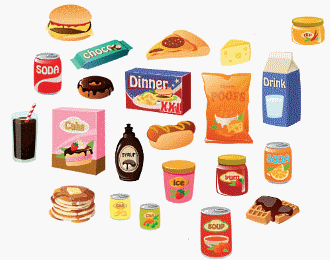
Researchers from the Sorbonne Université followed 104,980 adults from 2009 to 2017. The researchers were knew the diet of the study participants, and therefore knew how many ultra-processed foods they consumed. These are ready-to-eat foods that have assembled in food factories and hardly contain healthy substances. In a number of European countries, such as England, Ireland and Germany, half of the diet consists of these foods. [theguardian.com 2 Feb 2018]
In the US 58 percent of the diet consists of ultra-processed foods. [BMJ Open. 2016 Mar 9;6(3):e009892.]
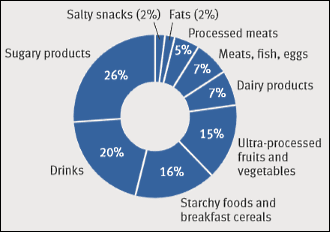
The figure below shows which ultra-processed foods were present in the diet of the participants in the French study - and in what quantities.
Results
The more of their energy the study participants received through ultra-processed foods, the greater the chance that they were diagnosed with cancer. If the proportion of ultra processed foods in the diet increased by 10 percent, the chance of developing cancer increased by 12 percent.
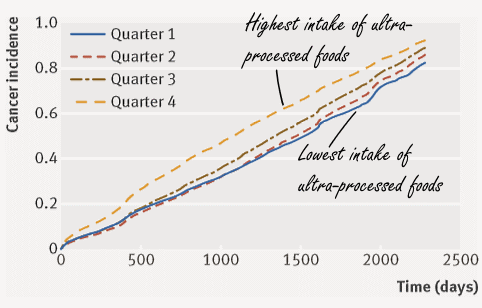
The correlation between ultra-processed foods and cancer was still present when the researchers corrected for "smoking status, educational level, physical activity, height, body mass index, alcohol intake, family history or cancers, intake of fats, sodium, carbohydrates and Western dietary pattern (derived by factor analysis)."
So - although ultra-processed foods do contain a lot of salt, sugar and bad fats, their unhealthy nutritional composition doesn't fully explain how ultra-processed foods induce cancer. Something else is at play here.
If I'm allowed to make an educated guess: I suspect that during the production process of many ultra-processed foodstuffs unhealthy advanced glycation end products [AGEs] are formed.
Conclusion
"To our knowledge, this study was the first to investigate and highlight an increase in the risk of overall - and more specifically breast cancer associated with ultra-processed food intake", the reserachers write.
"These results should be confirmed by other large scale, population based observational studies in different populations and settings. Further studies are also needed to better understand the relative effect of nutritional composition, food additives, contact materials, and neoformed contaminants in this relation."
"Rapidly increasing consumption of ultra-processed foods may drive an increasing burden of cancer and other non-communicable diseases. Thus, policy actions targeting product reformulation, taxation, and marketing restrictions on ultra-processed products and promotion of fresh or minimally processed foods may contribute to primary cancer prevention. Several countries have already introduced this aspect in their official nutritional recommendations in the name of the precautionary principle."
Source:
BMJ 2018;360:k322.
Study
Researchers from the Sorbonne Université followed 104,980 adults from 2009 to 2017. The researchers were knew the diet of the study participants, and therefore knew how many ultra-processed foods they consumed. These are ready-to-eat foods that have assembled in food factories and hardly contain healthy substances. In a number of European countries, such as England, Ireland and Germany, half of the diet consists of these foods. [theguardian.com 2 Feb 2018]
In the US 58 percent of the diet consists of ultra-processed foods. [BMJ Open. 2016 Mar 9;6(3):e009892.]
The figure below shows which ultra-processed foods were present in the diet of the participants in the French study - and in what quantities.
Results
The more of their energy the study participants received through ultra-processed foods, the greater the chance that they were diagnosed with cancer. If the proportion of ultra processed foods in the diet increased by 10 percent, the chance of developing cancer increased by 12 percent.
The correlation between ultra-processed foods and cancer was still present when the researchers corrected for "smoking status, educational level, physical activity, height, body mass index, alcohol intake, family history or cancers, intake of fats, sodium, carbohydrates and Western dietary pattern (derived by factor analysis)."
So - although ultra-processed foods do contain a lot of salt, sugar and bad fats, their unhealthy nutritional composition doesn't fully explain how ultra-processed foods induce cancer. Something else is at play here.
If I'm allowed to make an educated guess: I suspect that during the production process of many ultra-processed foodstuffs unhealthy advanced glycation end products [AGEs] are formed.
Conclusion
"To our knowledge, this study was the first to investigate and highlight an increase in the risk of overall - and more specifically breast cancer associated with ultra-processed food intake", the reserachers write.
"These results should be confirmed by other large scale, population based observational studies in different populations and settings. Further studies are also needed to better understand the relative effect of nutritional composition, food additives, contact materials, and neoformed contaminants in this relation."
"Rapidly increasing consumption of ultra-processed foods may drive an increasing burden of cancer and other non-communicable diseases. Thus, policy actions targeting product reformulation, taxation, and marketing restrictions on ultra-processed products and promotion of fresh or minimally processed foods may contribute to primary cancer prevention. Several countries have already introduced this aspect in their official nutritional recommendations in the name of the precautionary principle."
Source:
BMJ 2018;360:k322.

 ,
, 


