Morning Consult: ‘Declines in Net Approval Ratings’ for Nine of Ten Democratic Senators Running for Re-Election in States Trump Won
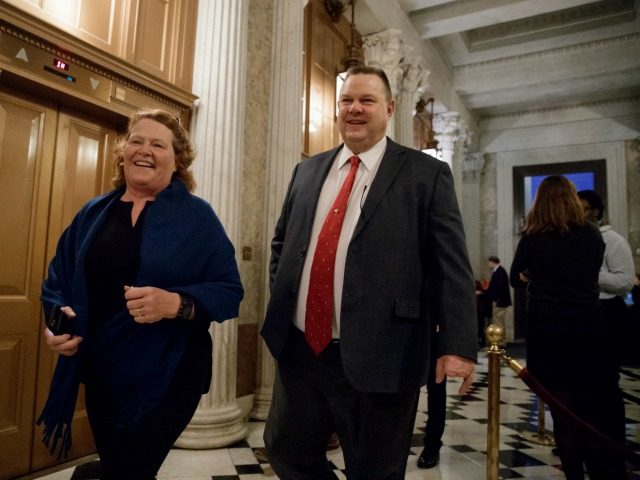
AP/J. Scott Applewhite
by
MICHAEL PATRICK LEAHY23 Jan 2018
317
Nine of the ten incumbent Democratic senators running for re-election in 2018 in states President Trump won in 2016 have seen “declines in net approval ratings” between the first and fourth quarters of 2017, Morning Consult reported on Tuesday.
These nine vulnerable Democratic senators up for re-election in 2018, and their corresponding drop in net approvals, are:
1. Sen. Jon Tester (D-MT) has seen his net approval
drop 18 percentsince the first quarter of 2017, going from +25 in the first quarter to +7 in the fourth quarter.
2. Sen. Heidi Heitkamp (D-ND)has seen her net approval
drop 11 percent since the first quarter of 2017, going from +28 in the first quarter to +17 in the fourth quarter.
3. Sen. Bob Casey (D-PA) has seen his net approval
drop 9 percentsince the first quarter of 2017, going from +20 in the first quarter to +11 in the fourth quarter.
4. Sen. Claire McCaskill (D-MO)has seen her net approval
drop 8 percent since the first quarter of 2017, going from +8 in the first quarter to zero in the fourth quarter.
5. Sen. Joe Manchin (D-WV) has seen his net approval
drop 8 percent since the first quarter of 2017, going from +24 in the first quarter to +16 in the fourth quarter.
6. Sen. Joe Donnelly (D-IN) has seen his net approval
drop 6 percent since the first quarter of 2017, going from +20 in the first quarter to +14 in the fourth quarter.
7. Sen. Tammy Baldwin (D-WI)has seen her net approval
drop 6 percent since the first quarter of 2017, going from +6 in the first quarter to zero in the fourth quarter.
8. Sen. Sherrod Brown (D-OH) has seen his net approval
drop 4 percent since the first quarter of 2017, going from +22 in the first quarter to +18 in the fourth quarter.
9. Sen. Bill Nelson (D-FL) has seen his net approval
drop 2 percentsince the first quarter of 2017, going from +27 in the first quarter to +25 in the fourth quarter.
Sen. Debbie Stabenow (D-MI) is the only Democratic senator up for re-election in 2018 in a state won by President Trump who has not seen a decline in net approval. Neither has she seen an increase in her net approval, however, which remains at +9 in the fourth quarter of 2017, exactly the same level as in the first quarter.
The biggest loser in net approval is Sen. Robert Menendez (D-NJ), who is running for re-election in New Jersey, a state President Trump did not win.
Menendez has seen his net approval drop 20 percent since the first quarter of 2017, going from +4 in the first quarter to -16 in the fourth quarter. The Department of Justice recently announced their intent to retry Menendez on charges of public corruption. Menendez’s first trial on those charges ended in a mistrial in November.
Morning Consult offered this analysis of the declining fortunes of these Democratic senators between the third quarter and the fourth quarter of 2017:
advertisement
Democratic Sen. Jon Tester of Montana—which voted for Trump by 20.5 points in 2016—saw his net approval rating fall by 18 percentage points by the end of the year, the most of any of those Democratic incumbents, with 47 percent approving of him and 40 percent disapproving, as of the end of December.
Much of the decline—13 points—in Tester’s net rating came during the fourth quarter, with a 9-point slide among independents and 27-point drop among GOP voters. (emphasis added)
Other Democrats in Trump country who saw net declines during the fourth quarter include Sens. Joe Donnelly of Indiana (-7 points) and Heidi Heitkamp of North Dakota (-6 points). Donnelly’s net approval dropped 11 points among independents and 12 points among Republicans, while Heitkamp’s fell 7 points among independents and double that amount among GOP voters.
Despite those dips, Heitkamp, with a net approval rating 17 points in the black, and Donnelly, with net approval of 14 points, are still among the top five Senate incumbents up for re-election this year in Trump-won states. Sen. Bill Nelson of Florida remained the most popular in that group, with a 25-point net approval.
Sens. Tammy Baldwin of Wisconsin and Claire McCaskill of Missouri, who are both seeking re-election, remain the least popular Democrats in states carried by Trump, with voters split down the middle over their job performance. . .
Sen. Robert Menendez (D-N.J.) got some good news in mid-November when a judge declared a mistrial in his federal bribery and corruption case, but New Jersey voters continued to sour on him. Net approval for the Garden State Democrat dropped 7 points in the fourth quarter, with 29 percent of voters approving of him and 45 percent disapproving.
Despite that decline, Menendez held with Democrats—43 percent approval over the past two quarters. But with a 32 percent disapproval among those voters in the fourth quarter, he could be vulnerable to a yet-to-materialize primary challenge, especially as the Justice Department said it plans to retry his case.
Among Republican senators, two incumbents who are not seeking re-election—Sen. Jeff Flake (R-AZ) and Sen. Bob Corker (R-TN) fared poorly, as did one who is seeking re-election—Sen. Dean Heller (R-NV), Morning Consult reported:
On the other side of the aisle, Sen. Dean Heller of Nevada—which Democratic presidential nominee Hillary Clinton won by 2.4 points in 2016—remains the most vulnerable Republican up for re-election. Forty-one percent of Nevadans approve of him, while 39 percent do not.
…
Sen. Bob Corker (R-TN) joined fellow retiring GOP Sen. Jeff Flake of Arizona as one of Trump’s most outspoken critics after announcing in September that he wouldn’t seek re-election in 2018. It’s taken a toll on his support in Tennessee, particularly among the Republican base.
The Senate Foreign Relations Committee chairman’s net rating among GOP voters plummeted 39 points in the fourth quarter compared to the prior quarter, while his net rating among Tennesseans as a whole fell 11 points. Meanwhile, Corker burnished his standing with the left, notching an 18-point increase among Democrats. He began 2018 with Tennesseans in favor of his performance, 43 percent approve versus 36 disapprove; Republican voters are more split, with 43 percent approving and 41 percent disapproving.
In contrast, Democratic voters in Arizona seemed loath to back Flake for his candid criticism of the president through much of last year, but it appears the worm finally turned some in the fourth quarter. The junior senator from Arizona got an 8-point bump from Democrats, although 49 percent disapproved of him at the end of 2017.
The ten senators with the lowest approval ratings in their home states, according to Morning Consult are:
- Sen. Mitch McConnell (R-KY): 53% disapprove, 32% percent approve 2% no opinion
- Sen. Jeff Flake (R-AZ): 49% disapprove 32% percent approve 3% no opinion
- Sen. Robert Menendez (D-NJ): 45% disapprove 29% percent approve 4% no opinion
- Sen. John McCain (R-AZ): 44% disapprove 44% percent approve 5% no opinion
- Sen. Claire McCaskill (D-MO): 41% disapprove 41% percent approve 6% no opinion
- Sen. Lisa Murkowski (R-AK): 41% disapprove 45% percent approve 7% no opinion
- Sen. Pat Roberts (R-KS): 40% disapprove 36% percent approve 8% no opinion
- Sen. Ron Johnson (R-WI): 40% disapprove 39% percent approve 9% no opinion
- Sen. Tammy Baldwin (D-WI): 40% disapprove 40% percent approve 10% no opinion
- Sen. Jon Tester (D-MT): 40% disapprove 47% percent approve
The Morning Consult Senator Approval Rankings
are “based on 253,383 surveys with registered voters from Oct. 1 through Dec. 31.”