Volatility

Does anybody actually use historical volatility in option trading? It seems to me that all the emphasis is on implied volatility, and I've looked but see nowhere anybody is actually using HV, although there is a lot of stuff about how to calculate it. :confused:

When the implied volatility is lower than the historical volatility, the option is cheap. IV > HV -> the option is expensive.
 
Maybe someone can help me shed some light on this.

if you use the log of daily close to close to plug into the formula for standard deviation to come up with an annualized volatility number you are

1) assuming that the instrument's range increases with the square root of time (ie hurst exponent of 2)

2) assuming that intra day ranges for any given unit of time decreases with the square of time

Is this roughly correct?
 
Quote from gummy:

It's interesting (to me, at least) that there seems to be little agreement concerning the definition of "historical volatility".

Many define it as the standard deviation of returns over some time period, but neglect to say if the returns are daily, weekly ... whatever.

Further, they neglect to say what time period.

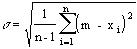
Further, even the definition of "standard deviation" varies. Maybe it's
6336e4c48fd253b7a6f552fa2579525b.png

or maybe it's
aspen00000397.gif


Then (again!) there's that volatility definition in terms of the logarithm of prices:
annualized historical volatility = square root of ( 250 * variance of log differences in daily prices)

... and since variance = (standard deviation)^2, what standard deviation?

Mamma mia!

Historical vol is historical vol. Period. Then you look for a formula to estimate it. There is a finance-world agreement on the fact that volatility could be the variance of the distribution of the (log-)returns. Then, you to estimate (second time...) this variance, you have to determine it statistically. Best estimator is the formula given above. Dividing by N-1 or by N is just a question of convergence in the L2 sense or convergence in probability (something totally inaccessible to people not trained in probs, so don't worry).
 
There is a finance-world agreement on the fact that volatility could be the variance of the distribution of the (log-)returns.
Could be is right :)

William Sharpe prefers standard deviation defined like so:
aspen00000397.gif

his reasoning being that he's calculating the "standard deviation of a population, taking the observations as a sample".

He also notes that, for "the standard deviation of the historic data", the denominator would be n rather than n-1.

Like I said: Mamma mia!
 
Back
Top