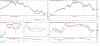
Happy to see ET has offered a refuge for longer term traders – and happy to post up the current guidelines I’m using to set up trend-following trades.
I say current guidelines as they may never be perfect and complete – they are profitable but there’s always room to learn and improve.
However, I’m opposed to indicators that generate an additional chart.
My guidelines use only daily and weekly TF candlestick / bar charts, refer to daily EOD unless weekly is stated.
Some of the factors below might seem to replicate each other – but in practice they rotate at different points in the chart’s life cycle – so one of these will change before the others as a strong trend starts to decay, or as a ranging price starts to trend.
Comments below are given with reference to setting up to buy in an uptrend, just reverse the instructions for a short set-up in a downtrend.
1. last Close must be above 200EMA
2. vertical sequence on chart must read, from high to low – price, 50EMA, 100EMA and finally 200EMA
3. swing phase using 3-bar reversal chart must be bullish (i.e. last swing, low or high, is higher than previous)
4. Trend Strength Indicator must score 70 or more (my TSI is total weekly Closes + Highs + Lows above 50EMA in last 33 complete weeks)
5. how many consecutive weekly Closes are above 50EMA, counting back from the most recent? (the more the better)
6. is last full week’s bar completely above 50EMA? (caution if it straddles it or is completely below)
7. how many adjacent weekly bars overlap the last full week’s range? (caution if more than 3)
Once targets are graded using the above guidelines, entry is at EOD. The entry day can be selected using a variety of TA – I don’t find choice of entry trigger pattern is critical but it must indicate some confirmation of trend and point to a meaningful TA-based stop level.
Handling correlation, risk management, money management etc. are up to the individual. So is choice of market sector I’m using this approach in forex but delighted to hear how it might work (or fail) elsewhere.
I hope this can be an alternative to day-trading for new traders.
But my main reason for posting would be to hear how this approach might work elsewhere / could be improved. Comments welcome.
I don't know if it is am getting older or losing patience, but in my mind of waiting for all the EMAs to line up right, I be in earlier for medium term trade and if I want to be in longer term trade I would use monthly and enter weekly. I been working on last three years of trying to find extreme highs/lows in stocks and ETFs so I have a chart of weekly and using Price and Volume Trend (PVT) is a variation of On Balance Volume, used to determine the strength of trends and warn of reversals. I like it as it gives few divergence signals on weekly as I want to be able to stay in longer, Then use Daily charts for enter. Many ways to enter, but I am using PVT the notify me when to stop taking trades and only look for different directional signals. I prefer to look for John Hill's "Thrust Bar" to define daily trend beyond 18 ema, and just using the 18ema for entry. Once I get to breakeven stop, I don't trail it. I will look for "thrust bar" pattern going other way then next day put protective stop little further than that, often times price won't down more than this saving me from getting out. I think best way to trade in people's beginnings are first doing long term trading, getting good at chart reading and speed. Day trading would be last thing to learn and work at as it takes great deal more time to get good.