the pictures speak for themselvesOmg. Drama queen? The isles looked like that for 40 years in East Germany according to eye witnesses (I never lived in East Germany) so did they in every Eastern Block and Russia and Cuba and.....and....and....and people still survived. Give it a rest pal....

You are using an out of date browser. It may not display this or other websites correctly.
You should upgrade or use an alternative browser.
You should upgrade or use an alternative browser.
Venezuela: If not pathetic (the cause) & tragic (life), this is comedy
- Thread starter deucy28
- Start date
Are you serious? Geez. Maybe you should venture out into the open world. This is nothing special or extraordinary whatsoever. Travel through India or Bangladesh or vast areas of Africa, Asia or Latin America.
the pictures speak for themselves
Omg. Drama queen? The isles looked like that for 40 years in East Germany according to eye witnesses (I never lived in East Germany) so did they in every Eastern Block and Russia and Cuba and.....and....and....and people still survived. Give it a rest pal....
Unfortunately, that's not true. Millions didn't.
For example, in the early years of the USSR, collectivization of agriculture caused a massive famine in the early 1930s, killing several million people.
Things went even worse in China during the so called 'Great Leap Forward', the most devastating economic experiment of all time. According to most estimates, about 40 million(!) people died at that time from hunger. Some even think it's more like 80 million, a death toll higher than both world wars combined.
In the 1970s, the USSR could only avert a massive famine by importing grain from... guess who? Yes, the United States.
And the most recent famine in North Korea from 1994 to 1998 killed at least several hundred thousand people. Up to this day, malnutrition seems to be a major problem in North Korea.
East Germany, especially East Berlin was a special case. Due to its geographic location, the USSR used it as some kind of store front, trying to put socialism in best light. As a result, the supply situation in East Berlin and GDR was much better than in other countries of the Eastern Block. But it was still very bad in comparison to West Germany.
Last edited:
That's exactly what I said. You may have misunderstood. I never said the isles in East Germany looked worse than the ones in Russia. I said the current situation in Venezuela is nothing all too special in proper context.
Unfortunately, that's not true. Millions didn't.
For example, in the early years of the USSR, collectivization of agriculture caused a massive famine in the early 1930s, killing several million people.
Things went even worse in China during the so called 'Great Leap Forward', the most devastating economic experiment of all time. According to most estimates, about 40 million(!) people died at that time from hunger. Some even think it's more like 80 million, a death toll higher than both world wars combined.
In the 1970s, the USSR could only avert a massive famine by importing grain from... guess who? Yes, the United States.
And the most recent famine in North Korea from 1994 to 1998 killed at least several hundred thousand people. Up to this day, malnutrition seems to be a major problem in North Korea.
East Germany, especially East Berlin was a special case. Due to its geographic location, the USSR used it as some kind of store front, trying to put socialism in best light. As a result, the supply situation in East Berlin and GDR was much better than in other countries of the Eastern Block. But it was still very bad in comparison to West Germany.
volpunter.... The operative theme of this thread is in the last three paragraphs. That which precedes it--Venezuela-- is drama to prime the pump.
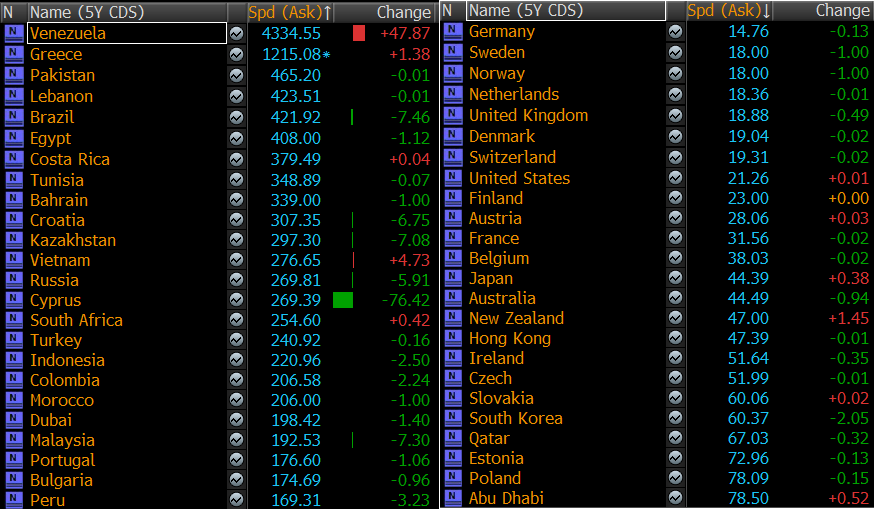
Like the Northern Lights is to nature, I argue the Venezuela story IS special for being in the minority among the known history of sovereigns. This statement is made within the context of a sovereign's SELF INDUCED decline from being on one end of its own quality of life spectrum dramatically moving to the other end of its spectrum of quality of life, perhaps vulnerable that its society reaches a level unrecognizable to its earlier peak of status. The context also includes those few sovereigns that don't owe their demise to foreign attack. And no, you're not allowed to say Saudi's pumping oil relentlessly is an attack on Venezuela.
To the extent one wants to be cavalier about this as relates to the U.S.-- the U.S. clearly in the last three paragraphs of my initial post being the focus of this thread-- making itself vulnerable to the fate described above and described in the next paragraph, then it will be so noted. But I don't know that is your attitude. I think you just missed the point of this thread which is asking you to address the U.S., which to some degree I may be culpable for contributing to by the title for the thread.
Again, to everyone: I would like you to address the high probability or not of serious and continued degradation of quality of life with the U.S.sliding further and further to the nasty end of the quality of life area and the rate with which it is if you think it is on the slide. I have my opinion and it affects my attitude and decisions I make for myself and others. I am looking for more illumination with your inputs to lighten aspects, areas, dynamics I know I am overlooking in full or in part. And even if I am not overlooking these things, I may not be balancing them properly with counter-influences.
You who have posted are of a greater degree informed than the general public. There are others like you who have not posted yet. This environment is the best I have as an arena of exchange of that information. I willingly accept brief statements and occasionally some direction where the groundings of those statements come from in your experience of being informed. I don't expect brilliant sources derived from your research making this a Wikipedia style location.
Civility is asked for. It is personal to me as I know it is for others that this is one of the most important subjects of our time. I am truly thirsty for your input. I hope we are all seeking illumination whether it comes in pieces or some ah-ha moments. Even speculation about the future and a brainstorming for solutions and direction are acceptable. All stripes of people from different origins and countries are welcome and all points of view politically and economically are welcome by me. Remarks and questions to posters, as always on ET, are fair when civil. Do your damnest to keep it civil, please.
Like the Northern Lights is to nature, I argue the Venezuela story IS special for being in the minority among the known history of sovereigns. This statement is made within the context of a sovereign's SELF INDUCED decline from being on one end of its own quality of life spectrum dramatically moving to the other end of its spectrum of quality of life, perhaps vulnerable that its society reaches a level unrecognizable to its earlier peak of status. The context also includes those few sovereigns that don't owe their demise to foreign attack. And no, you're not allowed to say Saudi's pumping oil relentlessly is an attack on Venezuela.
To the extent one wants to be cavalier about this as relates to the U.S.-- the U.S. clearly in the last three paragraphs of my initial post being the focus of this thread-- making itself vulnerable to the fate described above and described in the next paragraph, then it will be so noted. But I don't know that is your attitude. I think you just missed the point of this thread which is asking you to address the U.S., which to some degree I may be culpable for contributing to by the title for the thread.
Again, to everyone: I would like you to address the high probability or not of serious and continued degradation of quality of life with the U.S.sliding further and further to the nasty end of the quality of life area and the rate with which it is if you think it is on the slide. I have my opinion and it affects my attitude and decisions I make for myself and others. I am looking for more illumination with your inputs to lighten aspects, areas, dynamics I know I am overlooking in full or in part. And even if I am not overlooking these things, I may not be balancing them properly with counter-influences.
You who have posted are of a greater degree informed than the general public. There are others like you who have not posted yet. This environment is the best I have as an arena of exchange of that information. I willingly accept brief statements and occasionally some direction where the groundings of those statements come from in your experience of being informed. I don't expect brilliant sources derived from your research making this a Wikipedia style location.
Civility is asked for. It is personal to me as I know it is for others that this is one of the most important subjects of our time. I am truly thirsty for your input. I hope we are all seeking illumination whether it comes in pieces or some ah-ha moments. Even speculation about the future and a brainstorming for solutions and direction are acceptable. All stripes of people from different origins and countries are welcome and all points of view politically and economically are welcome by me. Remarks and questions to posters, as always on ET, are fair when civil. Do your damnest to keep it civil, please.
Drive 'em into poverty and suck up the hot chicks.
Venezuela Liquidating Assets As Economic Crisis Worsens
http://finance.yahoo.com/news/venezuela-liquidating-assets-economic-crisis-214144104.html
http://finance.yahoo.com/news/venezuela-liquidating-assets-economic-crisis-214144104.html