Using ETFs to trade World Indexes for Argentina

I like to trade indexes by using ETFs.

For instance, I am comfortable trading SPY for SPX index.

I am looking to diversify and back test on these Indexes and trade their ETFs if successful:

I am specifically looking at:
^MERV Merval (Argentina) use ETF ARGT which has small volume.


ARGT has such a small volume, can I trust to get in because I want to trade on Merval?

My major concern is being able to get in and out of these ETFs daily on a buy or sell signal and not have to worry about not able to get out.

Also, these specific ETFs have small history compared to their Indexes, if I backtest on the indexes, can I reliably use this testing results to think that these results will be the same on their ETFs.

Thank you,
Larry
 
I guess my question is that 5,000k is very small. However, since it is based on the index would I be getting filled based on Index prices or would the small volume be impacted by say 2000 share buy?
 
I like to trade indexes by using ETFs.

For instance, I am comfortable trading SPY for SPX index.

I am looking to diversify and back test on these Indexes and trade their ETFs if successful:

I am specifically looking at:
^MERV Merval (Argentina) use ETF ARGT which has small volume.


ARGT has such a small volume, can I trust to get in because I want to trade on Merval?

My major concern is being able to get in and out of these ETFs daily on a buy or sell signal and not have to worry about not able to get out.

Also, these specific ETFs have small history compared to their Indexes, if I backtest on the indexes, can I reliably use this testing results to think that these results will be the same on their ETFs.

Thank you,
Larry

(1).15-.20 spread on 31 price (.4-.6%)(might be different earlier in the day)
(2)300 size on bid/ask (would want to scale in/out with 300 or less)
(3)weekly chart is decent (tradable)
(4)5-minute chart is untradeable (still able to exit/enter if willing to give up .15-.20)
(5)comparison chart (ARGT-^MERV) similar pattern but different results the longer you hold (compare on tradingview.com)

argt.W.png
argt.5.png
 
Bkr,

Let's say the Index is at 150, 000 and the ETF is at 31. So if I placed a large trade on the ETF the asset (based on it's low trading volume) will the ETF increase significantly because of slippage for the buy. So would I get maybe filled at 31.20 or could it go crazy to 32 or 33? When does the ETF go back to the index price?

PS. I am a position trader and keep my trades usually for 2-6 months. If I put a limit buy in at 31.20 when the current price is at 31.20, would it take all day to get filled?

Thank you,
Larry
 
Here is an article that might help.
https://am.jpmorgan.com/us/en/asset...s/etf-investing/education/true-etf-liquidity/
ETF Liquidity: Trading during volatile markets
Exchange-traded funds (ETFs) offer many benefits to investors, including flexible intraday trading, efficient market access and potentially lower costs. But one of the most important ETF features—their liquidity—is also one of the most widely misunderstood.

Dispelling the myths surrounding liquidity and ETFs

Liquidity refers to the ability to buy or sell a security quickly, easily and at a reasonable transaction cost. ETFs and individual stocks both trade on a stock exchange, leading many investors to believe that the factors that determine the liquidity of the two securities must also be similar. They’re not. ETF liquidity can often be far greater than most investors assume.

ETFs actually operate in a fundamentally different ecosystem to other instruments that trade on stock exchanges, such as individual stocks or closed-end funds. Whereas these securities have a fixed supply of shares in circulation, ETFs are open-ended investment vehicles with the ability to issue or withdraw shares on the secondary market according to investor supply and demand.

This unique creation and redemption mechanism means that ETF liquidity is much deeper and much more dynamic than stock liquidity. It also explains why an ETF‘s liquidity is predominantly determined by the liquidity of its underlying individual securities, rather than by the size of its assets or by trading volumes.

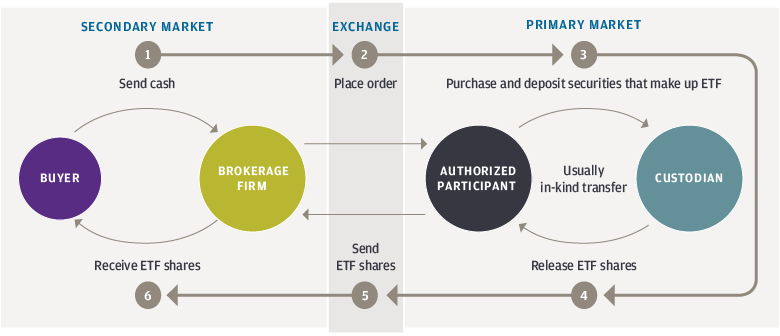
The ETF ecosystem: Trading occurs in the secondary market; creation and redemption occurs in the primary market

ETFExhibit_1_web_780px.png


Source: J.P. Morgan Asset Management, for illustrative purpose only.

Guidelines for determining liquidity and trading ETFs

Although ETFs have many characteristics that are similar to stocks, liquidity is not one of them. Therefore, it‘s important to look beyond trading volumes and on-screen indicators when assessing ETF liquidity. Here are some of the dos and don’ts of ETF liquidity.

1. Don’t use trading volumes or fund size as a guide.

Perhaps the most common ETF misconception is that funds with low daily trading volumes or with small amounts of assets under management will be difficult or expensive to trade. This is not the case. Thanks to the ETF creation and redemption mechanism, small- or low-trading-volume ETFs are usually able to absorb large buy or sell orders while continuing to trade at prices that are typically close to the net asset value of their underlying securities.

2. Look at total ETF liquidity in the secondary and primary markets.

Because market makers—who maintain continuous two-way ETF orders and are a key input to exchange order books—typically display only a small fraction of the volume they are willing to trade, investors may find that secondary market liquidity is actually much higher than on-screen indicators suggest. Investors with large ETF trades can also tap into primary market liquidity by working with an authorized participant to create or redeem ETF shares directly with the fund company.

3. Use limit orders as the default order type when trading ETFs.

A limit order—an order to buy or sell a set number of shares at a specified price or better—gives investors some control over the price at which the ETF trade is executed. By contrast, a market order—an order to buy or sell immediately at the best available current price—may end up being executed at a price that is far higher (or lower) than expected as the order sweeps through standing orders on the order book.

4. Consider the time of day when placing ETF trades.

As a general rule, trading at times when it is difficult for market makers and other institutional investors to hedge underlying securities in an ETF will likely result in wider spreads and less efficient trades. This is typically the case just after U.S. equity markets open and just before they close. U.S. ETFs with underlying securities in international markets are subject to additional liquidity considerations, notably the fact that the stock exchanges on which the underlying securities trade may be closed while U.S. exchanges are still trading. In that interval, the underlying securities are less liquid, which can result in wider bid-ask spreads.

5. Work with your ETF provider, especially when placing large trades.

Don’t go it alone. Most providers have capital markets desks whose role is to work with portfolio managers, APs, market makers and stock exchanges to help assess true ETF liquidity and assist investors with efficient trade execution.

 
I like to trade indexes by using ETFs.

For instance, I am comfortable trading SPY for SPX index.
I am looking to diversify and back test on these Indexes and trade their ETFs if successful:

I am specifically looking at:
^MERV Merval (Argentina) use ETF ARGT which has small volume.
ARGT has such a small volume, can I trust to get in because I want to trade on Merval?

My major concern is being able to get in and out of these ETFs daily on a buy or sell signal and not have to worry about not able to get out.

Also, these specific ETFs have small history compared to their Indexes, if I backtest on the indexes, can I reliably use this testing results to think that these results will be the same on their ETFs.

Thank you,
Larry
%%
NO\ not a good idea to trade that wide a bid \ask+ small volume;
+ same reason a realty apraiser NEVER gets just one home comp[small volume of comps.]
OK for an investment; no problem on exit just plenty of slippage to the max.
ILF is tradable,20 year data; SPY= liquidity leader.
Wisdom is profitable to direct;
but easy to get a good fill if market reverses on our order:caution::caution:
I did an exit on semi liquid[ 444k av day volume] DRLL today/ good uptrend but plenty of intra day gaps/bid /ask gaps:D:D
 
Bkr,

Let's say the Index is at 150, 000 and the ETF is at 31. So if I placed a large trade on the ETF the asset (based on it's low trading volume) will the ETF increase significantly because of slippage for the buy. So would I get maybe filled at 31.20 or could it go crazy to 32 or 33? When does the ETF go back to the index price?

PS. I am a position trader and keep my trades usually for 2-6 months. If I put a limit buy in at 31.20 when the current price is at 31.20, would it take all day to get filled?

Thank you,
Larry

This is tradable as a swing trader (which you are) but you need to use limit orders on thinly traded markets. No reason to push the price to 32, 33, etc... by using a market order.

So if the current bid/ask is 31/31.20 I'd start by placing a limit buy for 100-300 shares at 31.10. Adjust to 31.20 if not filled. There are times when they won't even fill a buy order on the ask. I had screenshots to prove it. If they fill the first order, watch what happens to the bid/ask. Sometimes they'll bump it higher even if the underlying index didn't rise. Depending upon how much you want to buy/sell, this can take several/many trades to get your desired position. If they bump the price higher after the 1st fill you may want to set limit orders @ market and lower and walk away. The index may drop & get you filled. Try it for a few days until filled unless you want to get all filled TODAY then you may have to pay up a bit depending upon how much your broker is willing to fill.
I usually take a partial position to get started then place multiple limit orders a bit lower. May adjust higher the following day if I think the market is moving away from me without a pullback.
Stop losses cannot be used.
 
Back
Top