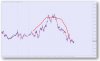
For the purpose of his journal I will be referring to the system’s MAs as the bumblebee, crimson, sea green, and black moving averages.
I shorted AUDJPY with the intention of making a “longer-term” trade (hours rather than minutes) following a reversal in the bumble bee moving average after price almost made contact with the corresponding statistical resistance level, due in large part to the fact that the general overall longer-term trend was headed south.
Price bounced north about 40 minutes later, but resumed it southward trajectory “for good” about 20 minutes after that as the crimson moving average reversed direction as well. (The sea green moving average did not turn south until about an hour later, so it is extremely lagging.)

I probably jumped the gun on the second and third trades by using Heiken Ashi moving averages as a trigger instead of the bumblebee moving average. I reentered a short position with respect to NZDUSD as soon as there was a reversal in the bumblebee moving average, but price is bouncing around, and the crimson, sea green, and black moving averages are all bullish now to one degree or another, so I am currently trying to exit the position at about break even, but might have to eat a third loss thanks to this pair.
I also shorted EURAUD a second time as soon as the bumblebee moving average turned south, but in this case the longer-term moving average maintained its neutral aspect and the trade was successful. I neglected to mention that these trades, along with the others on which I have yet to comment, were also executed due to the fact that price was located near (but not actually inside) the reversal zone.
(The one exception was USDCHF, which was entered even though it was not near the reversal zone due to a reversal in the crimson moving average.)
Based on these last six trades, it would seem that, at least during periods of low liquidity, this category of trade requires a minimum of twenty to thirty minutes to separate the rate a comfortable distance from the strike price, with thirty minutes probably making more sense.
In terms of “traditional” trading, there appears of be little need to be so conservative in the amount of profit I was seeking per trade, which I should probably at least double the next time around.
I shorted AUDJPY with the intention of making a “longer-term” trade (hours rather than minutes) following a reversal in the bumble bee moving average after price almost made contact with the corresponding statistical resistance level, due in large part to the fact that the general overall longer-term trend was headed south.
Price bounced north about 40 minutes later, but resumed it southward trajectory “for good” about 20 minutes after that as the crimson moving average reversed direction as well. (The sea green moving average did not turn south until about an hour later, so it is extremely lagging.)
I probably jumped the gun on the second and third trades by using Heiken Ashi moving averages as a trigger instead of the bumblebee moving average. I reentered a short position with respect to NZDUSD as soon as there was a reversal in the bumblebee moving average, but price is bouncing around, and the crimson, sea green, and black moving averages are all bullish now to one degree or another, so I am currently trying to exit the position at about break even, but might have to eat a third loss thanks to this pair.
I also shorted EURAUD a second time as soon as the bumblebee moving average turned south, but in this case the longer-term moving average maintained its neutral aspect and the trade was successful. I neglected to mention that these trades, along with the others on which I have yet to comment, were also executed due to the fact that price was located near (but not actually inside) the reversal zone.
(The one exception was USDCHF, which was entered even though it was not near the reversal zone due to a reversal in the crimson moving average.)
Based on these last six trades, it would seem that, at least during periods of low liquidity, this category of trade requires a minimum of twenty to thirty minutes to separate the rate a comfortable distance from the strike price, with thirty minutes probably making more sense.
In terms of “traditional” trading, there appears of be little need to be so conservative in the amount of profit I was seeking per trade, which I should probably at least double the next time around.