http://www.theguardian.com/world/2016/apr/14/us-corporations-14-trillion-hidden-tax-havens-oxfam
Charity analysis of the 50 biggest US businesses claims Apple have $181bn held offshore, while General Electric has $119bn and Microsoft $108bn
British Overseas Territories
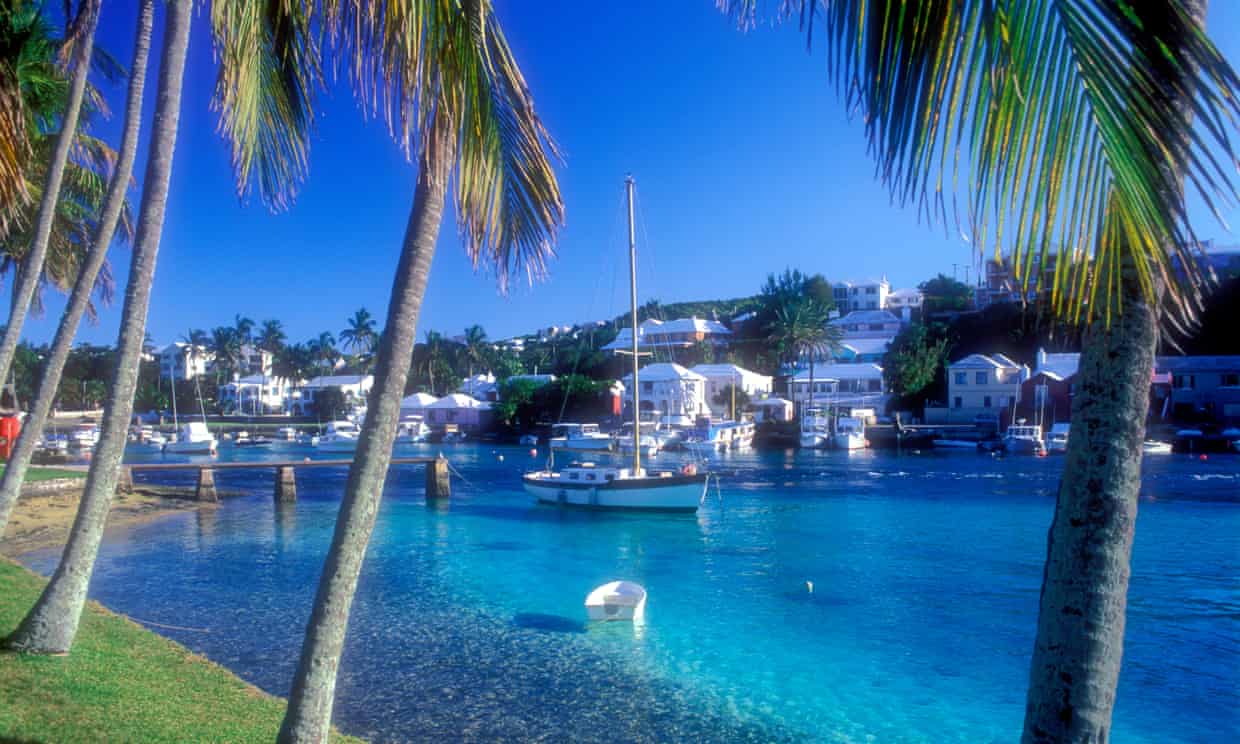
The report singled out British overseas territories such as Bermuda for their popularity with US firms seeking to slash their tax bill by ‘profit-shifting’. Photograph: Alamy
Rob Davies
Thursday 14 April 2016
US corporate giants such as Apple, Walmart and General Electric have stashed $1.4tn (£980bn) in tax havens, despite receiving trillions of dollars in taxpayer support, according to a report by anti-poverty charity Oxfam.
The sum, larger than the economic output of Russia, South Korea and Spain, is held in an “opaque and secretive network” of 1,608 subsidiaries based offshore, said Oxfam.
The charity’s analysis of the financial affairs of the 50 biggest US corporations comes amid intense scrutiny of tax havens following the leak of the Panama Papers.
And the charity said its report, entitled Broken at the Top was a further illustration of “massive systematic abuse” of the global tax system.
Technology giant Apple, the world’s second biggest company, topped Oxfam’s league table, with some $181bn held offshore in three subsidiaries.
Boston-based conglomerate General Electric, which Oxfam said has received $28bn in taxpayer backing, was second with $119bn stored in 118 tax haven subsidiaries.
Computing firm Microsoft was third with $108bn, in a top 10 that also included pharmaceuticals giant Pfizer, Google’s parent company Alphabet and Exxon Mobil, the largest oil company not owned by an oil-producing state.
Oxfam contrasted the $1.4tn held offshore with the $1tn paid in tax by the top 50 US firms between 2008 and 2014.
It pointed out that the companies had also enjoyed a combined $11.2tn in federal loans, bailouts and loan guarantees during the same period.
Overall, the use of tax havens allowed the US firms to reduce their effective tax rate on $4tn of profits from the US headline rate of 35% to an average of 26.5% between 2008 and 2014.
The charity said this had helped firms spend billions on an “army” of lobbyists calling for greater state support in the form of loans, bailouts and guarantees, funded by taxpayers.
The top 50 US firms spent $2.6bn between 2008 and 2014 on lobbying the US government, Oxfam said.
“For every $1 spent on lobbying, these 50 companies collectively received $130 in tax breaks and more than $4,000 in federal loans, loan guarantees and bailouts,” said Oxfam.
Robbie Silverman, senior tax adviser at Oxfam said: “Yet again we have evidence of a massive systematic abuse of the global tax system.
“We can’t go on with a situation where the rich and powerful are not paying their fair share of tax, leaving the rest of us to foot the bill.
“Governments across the globe must come together now to end the era of tax havens.”
Oxfam estimates that tax avoidance by US corporations costs the world’s largest economy some $111bn a year, but said it was also fuelling the global wealth divide by draining $100bn from the poorest countries.
“Tax dodging practised by corporations and enabled by federal policymakers contributes to dangerous inequality that is undermining our social fabric and hindering economic growth,” the report said.
Oxfam also singled out British overseas territories such as Bermuda for their popularity with US firms seeking to slash their tax bill by “profit-shifting”.
In 2012, said Oxfam, US firms reported $80bn of profit in Bermuda, more than their combined reported profits in Japan, China, Germany and France, four of the world’s five largest economies.
The charity called on the US government to pass the Stop Tax Haven Abuse Act, including a requirement for firms to report their tax contribution on a country-by-country basis.
Country-by-country reporting has been recommended by a host of non-governmental organisations and charities to prevent companies from artificially shifting their income out of the poorest countries.

You are using an out of date browser. It may not display this or other websites correctly.
You should upgrade or use an alternative browser.
You should upgrade or use an alternative browser.
US corporations have $1.4tn hidden in tax havens, claims Oxfam report
- Thread starter OddTrader
- Start date
http://www.truthdig.com/eartothegro...s_the_outrage_home_with_expose_on_us_20160414
Oxfam Report Exposes How U.S. Companies Hide Profits and Avoid Taxes
Posted on Apr 14, 2016

Songquan Deng / Shutterstock
After reviewing the material released in the recently published Panama Papers, a new Oxfam report connects the 50 biggest U.S.-based corporations to the widely condemned hidden tax sanctuaries that allow companies to hide profits and avoid paying taxes.
These corporations have been receiving benefits, and in some cases, U.S. taxpayers’ money, and stashing away $1.4 trillion in tax havens. The report found that General Electric, which receives $28 billion in taxpayer money, has $119 billion stored away in tax haven subsidiaries.
The Guardian relayed details about Oxfam’s report Thursday:
"
Oxfam contrasted the $1.4tn held offshore with the $1tn paid in tax by the top 50 US firms between 2008 and 2014.
It pointed out that the companies had also enjoyed a combined $11.2tn in federal loans, bailouts and loan guarantees during the same period.
Overall, the use of tax havens allowed the US firms to reduce their effective tax rate on $4tn of profits from the US headline rate of 35% to an average of 26.5% between 2008 and 2014.
The charity said this had helped firms spend billions on an “army” of lobbyists calling for greater state support in the form of loans, bailouts and guarantees, funded by taxpayers.
The top 50 US firms spent $2.6bn between 2008 and 2014 on lobbying the US government, Oxfam said.
“For every $1 spent on lobbying, these 50 companies collectively received $130 in tax breaks and more than $4,000 in federal loans, loan guarantees and bailouts,” said Oxfam.
"
Not only do the corporations’ actions impact the U.S. economy, but according to the report, they also drain $100 billion from some of the world’s poorest countries.
To put the numbers in perspective, Borgen magazine noted: “According to a 1998 United Nations estimate, providing education, water, sanitation, nutrition and basic health care to the entire population of every developing country would cost $40 billion. Adjusted for inflation, the cost to end global poverty would be approximately $58 billion today.”
Read the complete Oxfam report here. http://www.oxfamamerica.org/static/media/files/Broken_at_the_Top_FINAL_EMBARGOED_4.12.2016.pdf
Last edited:
Since Oxfam are exempted from corporation tax on profits due to their charitable status, it's ironic that they highlight other entities avoidance of taxes. Especially since they themselves have a history of political campaigning, in direct breach of their charitable status:-
http://www.westerndailypress.co.uk/...d-row-banker/story-13503963-detail/story.html
http://www.telegraph.co.uk/news/pol...ked-by-disgraceful-political-campaigning.html
The following quote seems appropriate here:-
"People who live in glass houses shouldn't throw stones"
http://www.westerndailypress.co.uk/...d-row-banker/story-13503963-detail/story.html
http://www.telegraph.co.uk/news/pol...ked-by-disgraceful-political-campaigning.html
The following quote seems appropriate here:-
"People who live in glass houses shouldn't throw stones"
Also they are actively in favour of the FTT
https://www.oxfam.org/en/campaign-with-us/robin-hood-tax
https://www.oxfam.org/en/campaign-with-us/robin-hood-tax