
The $1 QUADRILLION Derivatives Time Bomb
http://seekingalpha.com/article/153555-five-reasons-the-market-could-crash-this-fall
Few commentators care to mention that the total notional value of derivatives in the financial system is over $1.0 QUADRILLION (thatâs 1,000 TRILLIONS).
US Commercial banks alone own an unbelievable $202 trillion in derivatives. The top five of them hold 96% of this.
By the way, the chart is in TRILLIONS of dollars:
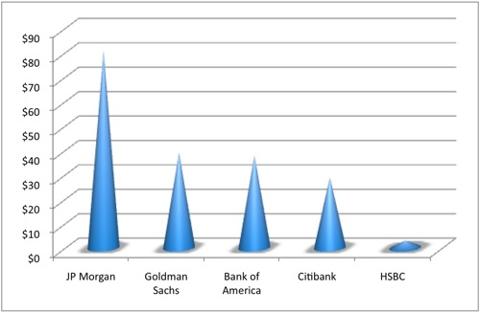
As you can see, Goldman Sachs alone has $39 trillion in derivatives outstanding. Thatâs an amount equal to more than three times total US GDP. Amazing, but nothing compared to JP Morgan (JPM), which has a whopping $80 TRILLION in derivatives on its balance sheet.
Bear in mind, these are ânotionalâ values of derivatives, not the amount of money âat riskâ here. However, if even 1% of the $1 Quadrillion is actually at risk, youâre talking about $10 trillion in âat risk.â
What are the odds that Wall Street, when allowed to trade without any regulation, oversight, or audits, put a lot of money at risk? I mean⦠Wall Streetâs track record regarding financial instruments that were ACTUALLY analyzed and rated by credit ratings agencies has so far been stellar.
After all, mortgage backed securities, credit default swaps, collateralized debt obligations⦠those vehicles all turned out great what with the ratings agencies, banks risk management systems, and various other oversight committees reviewing them.
Iâm sure that derivatives which have absolutely NO oversight, no auditing, no regulation, will ALL be fine. Thereâs NO WAY that the very same financial institutions that used 30-to-1 leverage or more on regulated balance sheet investments would put $50+ trillion âat riskâ (only 5% of the $1 quadrillion notional) when they were trading derivatives.
If Wall Street did put $50 trillion at risk⦠and 10% of that money goes bad (quite a low estimate given defaults on regulated securities) that means $5 trillion in losses: an amount equal to HALF of the total US stock market.
This of course assumes that Wall Street only put 5% of its notional value of derivatives at risk⦠and only 10% of the derivatives âat riskâ go bad.
Do you think those assumptions are a bit⦠low?
http://seekingalpha.com/article/153555-five-reasons-the-market-could-crash-this-fall
Few commentators care to mention that the total notional value of derivatives in the financial system is over $1.0 QUADRILLION (thatâs 1,000 TRILLIONS).
US Commercial banks alone own an unbelievable $202 trillion in derivatives. The top five of them hold 96% of this.
By the way, the chart is in TRILLIONS of dollars:
As you can see, Goldman Sachs alone has $39 trillion in derivatives outstanding. Thatâs an amount equal to more than three times total US GDP. Amazing, but nothing compared to JP Morgan (JPM), which has a whopping $80 TRILLION in derivatives on its balance sheet.
Bear in mind, these are ânotionalâ values of derivatives, not the amount of money âat riskâ here. However, if even 1% of the $1 Quadrillion is actually at risk, youâre talking about $10 trillion in âat risk.â
What are the odds that Wall Street, when allowed to trade without any regulation, oversight, or audits, put a lot of money at risk? I mean⦠Wall Streetâs track record regarding financial instruments that were ACTUALLY analyzed and rated by credit ratings agencies has so far been stellar.
After all, mortgage backed securities, credit default swaps, collateralized debt obligations⦠those vehicles all turned out great what with the ratings agencies, banks risk management systems, and various other oversight committees reviewing them.
Iâm sure that derivatives which have absolutely NO oversight, no auditing, no regulation, will ALL be fine. Thereâs NO WAY that the very same financial institutions that used 30-to-1 leverage or more on regulated balance sheet investments would put $50+ trillion âat riskâ (only 5% of the $1 quadrillion notional) when they were trading derivatives.
If Wall Street did put $50 trillion at risk⦠and 10% of that money goes bad (quite a low estimate given defaults on regulated securities) that means $5 trillion in losses: an amount equal to HALF of the total US stock market.
This of course assumes that Wall Street only put 5% of its notional value of derivatives at risk⦠and only 10% of the derivatives âat riskâ go bad.
Do you think those assumptions are a bit⦠low?


