Pakistan Taliban chief Mullah Fazlullah 'killed in drone attack'
Afghan defence ministry says Mullah Fazlullah, leader of Pakistan's Taliban, died in attack in northeastern Kunar.
19 hours ago

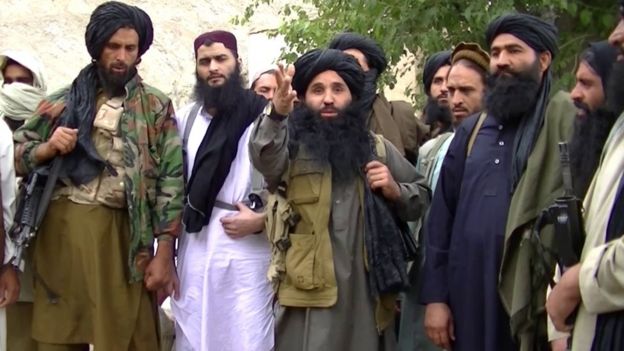
Fazlullah (centre) became the TTP leader in November 2013 following the drone attack killing of Hakimullah Mehsud [EPA]
MORE ON PAKISTAN TALIBAN
Mullah Fazlullah, believed to have been operating from hideouts in the forests of eastern Afghanistan, has been at the top of Pakistan's most wanted list and has been falsely reported killed on numerous occasions.
"I confirm that Mullah Fazlullah, leader of the Pakistani Taliban, has been killed in an joint air operation [with the US] in the border area of Marawera district of Kunar province," Mohammad Radmanish, spokesman for Afghan defence ministry, told Reuters news agency on Friday.
He said the air attack was carried out at about 9am local time on Thursday.
In a separate statement to The Associated Press news agency, Radmanish said that two other armed fighters were killed alongside Fazlullah.
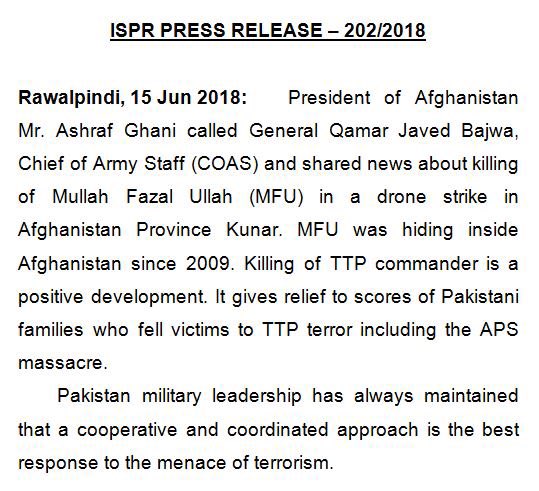
Later on Friday, the Pakistani army said that Afghan President Ashraf Ghani called Pakistani army chief Qamar Javed Bajwa to share the news of the Tehreek-i-Taliban Pakistan (TTP) leader's death.
"Killing of TTP commander is a positive development," the Pakistani army said in a statement.
"Pakistan military leadership has always maintained that a cooperative and coordinated approach is the best response to the menace of terrorism."
View image on Twitter

Maj Gen Asif Ghafoor
✔@OfficialDGISPR
https://twitter.com/OfficialDGISPR/status/1007670089192214530
President of Afghanistan Mr Ashraf Ghani called COAS and shared news about killing of Mullah Fazal Ullah (MFU) in a drone strike in Kunar Province of Afghanistan. MFU was hiding there since 2009 and masterminded scores of terrorist attacks against Pakistan including APS.
1:04 PM - Jun 15, 2018
Twitter Ads info and privacy
TTP acknowledged that its leader had been killed, according to Turkey's Anadolu Agency.
The group accused the Afghan intelligence service NDS, which has long been suspected by Pakistan of harbouring Fazlullah, of providing information for the drone attack.
According to a statement attributed to US Forces-Afghanistan spokesman, Lt Col Martin O'Donnell, the US carried out a "counterterrorism strike" near the border region between Afghanistan and Pakistan targeting "a senior leader of a designated terrorist organisation".
O'Donnell said the US and NATO "continue to adhere" to Afghanistan's ceasefire declaration with the Afghan Taliban.
But he said the ceasefire "does not include US counterterrorism efforts" against other armed groups in the region.
In March, Fazlullah's son, Abdullah, was among 20 TTP armed fighters killed in a US drone attack also in Kunar.

Afghanistan's Kunar Province is located at the northern border with Pakistan [Al Jazeera]
Fazlullah became the leader of TTP in November 2013 following the death of Hakimullah Mehsud, who was killed in a US drone attack in North Waziristan.
Fazlullah had been described as a "ruthless fighter" who was vehemently anti-state and against peace talks.
Pakistan Taliban picks new leader
He was the first commander of the TTP not to come from the Mehsud tribe in Pakistan's tribal areas, hailing instead from the northwestern valley of Swat, where he waged a bloody war against the Pakistani state from 2007 to 2009.
Fazlullah fled to Afghanistan's Kunar province in 2009 after a major military operation by Pakistan's military forces and was able to regroup there.
As leader of the Pakistani Taliban, he planned a number of attacks, including one at a school in Peshawar in 2014 that killed about 150 people - many of whom were children.
His apparent killing by a US air strike could open the door for stronger cooperation between Pakistan, Afghanistan and the US.
"The US wants to get Pakistan on board; taking out 'Pakistan's Osama bin Laden' really offers quite a strong incentive for Pakistan now to cooperate," said Michael Semple, of Queen’s University Belfast.
What his death will mean for the Pakistani Taliban is unclear, but Al Jazeera's Kamal Hyder, reporting from the Pakistani capital of Islamabad, said the news comes at a time as both Kabul and Islamabad are trying to improve relations.
"Pakistan had already complained to Afghanistan that Fazlullah was operating from Afghan soil; he was able to move from Kunar and Nuristan [province]... Pakistan had demanded from Aghanistan and the US earlier also to target Fazlullah," Hyder said.
"But indeed once confirmed, this is a huge loss to the Tehreek-i-Taliban Pakistan and of course will be considered a major step for Pakistan improving relations with the United States to an extent and also removing the mistrust with the Afghans."
Children massacred in Pakistan school attack
Pakistan has often accused US and Afghan forces of not doing enough to target TTP forces living on the Afghan side of the volatile Pakistan-Afghanistan border, where they fled following a series of military operations by Pakistan.
While violence has dropped in recent years, the TTP and its affiliates continue to carry out sporadic large-scale attacks targeting Pakistani security forces and civilians.
At least 748 civilians and security forces were killed in violence perpetrated by the TTP and other armed groups in 2017, down from a peak of at least 3,739 in 2012, according to the South Asia Terrorism Portal, a New Delhi based research organisation.
Pakistan's military says that it has killed at least 4,000 fighters working for the TTP and its allies since 2013.
In January, US President Donald Trump cut more than $1.1bn in military assistance to Pakistan over allegations that it was providing safe haven to members of the Afghan Taliban and Haqqani Network.
Pakistan denies the charges, alleging that it is being scapegoated for the failure of US-led coalition forces to secure Afghanistan after more than 16 years of war.
Afghan defence ministry says Mullah Fazlullah, leader of Pakistan's Taliban, died in attack in northeastern Kunar.
19 hours ago
Fazlullah (centre) became the TTP leader in November 2013 following the drone attack killing of Hakimullah Mehsud [EPA]
MORE ON PAKISTAN TALIBAN
- Pakistani Pashtun rights activists wounded in gun attacklast week
- Four killed in attack on Christians in Pakistan's Quetta2 months ago
- Bombs, blood and bravery: Defusing IEDs in Pakistan2 months ago
- Six killed in Raiwind explosion claimed by Tehreek-e-Taliban3 months ago
Mullah Fazlullah, believed to have been operating from hideouts in the forests of eastern Afghanistan, has been at the top of Pakistan's most wanted list and has been falsely reported killed on numerous occasions.
"I confirm that Mullah Fazlullah, leader of the Pakistani Taliban, has been killed in an joint air operation [with the US] in the border area of Marawera district of Kunar province," Mohammad Radmanish, spokesman for Afghan defence ministry, told Reuters news agency on Friday.
He said the air attack was carried out at about 9am local time on Thursday.
In a separate statement to The Associated Press news agency, Radmanish said that two other armed fighters were killed alongside Fazlullah.
Later on Friday, the Pakistani army said that Afghan President Ashraf Ghani called Pakistani army chief Qamar Javed Bajwa to share the news of the Tehreek-i-Taliban Pakistan (TTP) leader's death.
"Killing of TTP commander is a positive development," the Pakistani army said in a statement.
"Pakistan military leadership has always maintained that a cooperative and coordinated approach is the best response to the menace of terrorism."
View image on Twitter
Maj Gen Asif Ghafoor
✔@OfficialDGISPR
https://twitter.com/OfficialDGISPR/status/1007670089192214530
President of Afghanistan Mr Ashraf Ghani called COAS and shared news about killing of Mullah Fazal Ullah (MFU) in a drone strike in Kunar Province of Afghanistan. MFU was hiding there since 2009 and masterminded scores of terrorist attacks against Pakistan including APS.
1:04 PM - Jun 15, 2018
Twitter Ads info and privacy
TTP acknowledged that its leader had been killed, according to Turkey's Anadolu Agency.
The group accused the Afghan intelligence service NDS, which has long been suspected by Pakistan of harbouring Fazlullah, of providing information for the drone attack.
According to a statement attributed to US Forces-Afghanistan spokesman, Lt Col Martin O'Donnell, the US carried out a "counterterrorism strike" near the border region between Afghanistan and Pakistan targeting "a senior leader of a designated terrorist organisation".
O'Donnell said the US and NATO "continue to adhere" to Afghanistan's ceasefire declaration with the Afghan Taliban.
But he said the ceasefire "does not include US counterterrorism efforts" against other armed groups in the region.
In March, Fazlullah's son, Abdullah, was among 20 TTP armed fighters killed in a US drone attack also in Kunar.
Afghanistan's Kunar Province is located at the northern border with Pakistan [Al Jazeera]
Fazlullah became the leader of TTP in November 2013 following the death of Hakimullah Mehsud, who was killed in a US drone attack in North Waziristan.
Fazlullah had been described as a "ruthless fighter" who was vehemently anti-state and against peace talks.
Pakistan Taliban picks new leader
He was the first commander of the TTP not to come from the Mehsud tribe in Pakistan's tribal areas, hailing instead from the northwestern valley of Swat, where he waged a bloody war against the Pakistani state from 2007 to 2009.
Fazlullah fled to Afghanistan's Kunar province in 2009 after a major military operation by Pakistan's military forces and was able to regroup there.
As leader of the Pakistani Taliban, he planned a number of attacks, including one at a school in Peshawar in 2014 that killed about 150 people - many of whom were children.
His apparent killing by a US air strike could open the door for stronger cooperation between Pakistan, Afghanistan and the US.
"The US wants to get Pakistan on board; taking out 'Pakistan's Osama bin Laden' really offers quite a strong incentive for Pakistan now to cooperate," said Michael Semple, of Queen’s University Belfast.
What his death will mean for the Pakistani Taliban is unclear, but Al Jazeera's Kamal Hyder, reporting from the Pakistani capital of Islamabad, said the news comes at a time as both Kabul and Islamabad are trying to improve relations.
"Pakistan had already complained to Afghanistan that Fazlullah was operating from Afghan soil; he was able to move from Kunar and Nuristan [province]... Pakistan had demanded from Aghanistan and the US earlier also to target Fazlullah," Hyder said.
"But indeed once confirmed, this is a huge loss to the Tehreek-i-Taliban Pakistan and of course will be considered a major step for Pakistan improving relations with the United States to an extent and also removing the mistrust with the Afghans."
Children massacred in Pakistan school attack
Pakistan has often accused US and Afghan forces of not doing enough to target TTP forces living on the Afghan side of the volatile Pakistan-Afghanistan border, where they fled following a series of military operations by Pakistan.
While violence has dropped in recent years, the TTP and its affiliates continue to carry out sporadic large-scale attacks targeting Pakistani security forces and civilians.
At least 748 civilians and security forces were killed in violence perpetrated by the TTP and other armed groups in 2017, down from a peak of at least 3,739 in 2012, according to the South Asia Terrorism Portal, a New Delhi based research organisation.
Pakistan's military says that it has killed at least 4,000 fighters working for the TTP and its allies since 2013.
In January, US President Donald Trump cut more than $1.1bn in military assistance to Pakistan over allegations that it was providing safe haven to members of the Afghan Taliban and Haqqani Network.
Pakistan denies the charges, alleging that it is being scapegoated for the failure of US-led coalition forces to secure Afghanistan after more than 16 years of war.