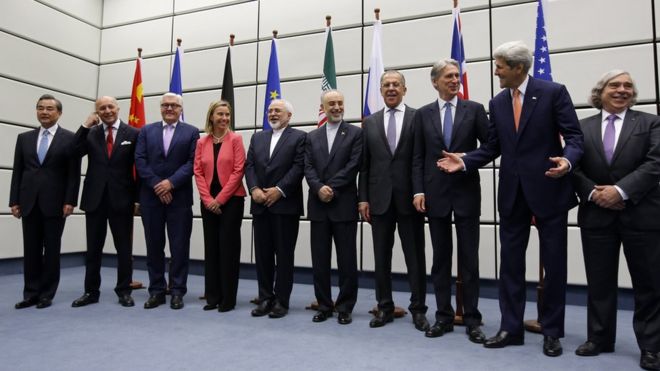
Apparently it does because it was. Technically any executive order can be rescinded or left in place by a subsequent executive unless codified into law by the legislature.
Masterful, historically “greatest of all time” diplomatic agreements should have been approved by 2/3 Senate and formally called a Treaty.
Of course treaties are not statutory law, but they become, nevertheless, "the supreme land of the land" much in the same way a statute is. As a practical matter some treaties do affect domestic law and others do not. Congress may pass laws that are needed to implement a treaty. The President has the power to make treaties but only with concurrence of the Senate. But what is needed to withdraw from a treaty. Does this require Senate concurrence? Apparently not.
The Constitution is silent on this matter. One could not be faulted for thinking that since Senate concurrence is needed to implement a treaty, logically it is needed to withdraw. Apparently this is not the case, however, if we are to use precedence as a guide. One example, the one I cited earlier, is Carter's withdrawal from our mutual defense pact with Taiwan. This defense pact was a formal treaty, and it had the effect of being the "Supreme law of the land." Carter withdrew the United States from the Treaty without Senate approval. Senator Goldwater sued saying Carter had exceeded his constitutional authority. The case quickly made it's way from District Court through the Appeals Court to the Supreme Court The Supreme Court agreed 6 to 3 that the matter was political and should not be heard by the Court. They remanded it back to the District Court with instructions to dismiss. A current Court might very well rule differently, particularly were Congress to first take some definite action, such as adopting a Resolution against the President's unilateral action without Senate approval. There was no formal action taken by the Senate in the example cited, and that was probably a mistake on the Senate's part.
We learn then that a distinction between law created by a treaty and the law created by a statute is that the latter may not be vacated by unilateral action of the President whereas the former can be. Thus executive agreements between the United States and other countries of the type that do not affect domestic law become, in their effect, little different from treaties. The President may use this to make what are in effect treaties without having to get Senate approval, and thus circumvent domestic politics.
I am virtually certain that at some point the issue of whether a treaty may be vacated by the Executive without Senate concurrence will be revisited. The result is liable to be different the next time. If it is, then at that point we are only a small step from recognizing that these extra-constitutional agreements between the executive and another nation are treaties, and therefore Senate approval is needed. ("extra-constitutional" does not mean "unconstitutional.")
Although your point that "Masterful, historically “greatest of all time” diplomatic agreements should have been approved by 2/3 Senate and [be] formally called a Treaty," is well taken, and I completely agree. Nevertheless the magnitude of the achievement of the "Iran Deal" is in no way diminished by what should have been. Regardless, it was, and is, a magnificent and astounding diplomatic achievement, made all the more so in face of the fierce opposition from Netanyahu's Israel at a time when bucking Israel was akin to political suicide. Is it any wonder that the negotiations could not have come to a productive end if the agreement had had to pass through the U.S. Senate in the form of a formal treaty? Sometimes, to do the right thing, a way around the law must be found.