Trump, the wall, and Keynes v Friedman. The ultimate battle.

Damn Achilles, thx for the well thought out response enjoyed reading it.

This is the part that has caused confusion for me, cause the one argument is that a rich U.S. consumer will have more money to buy stuff from the emerging markets, so while, blocking trade will inevitably be good for the U.S. worker, it will be bad for the chinese/mexican/indian worker, So it seems like it will be good for the U.S. market but bad for emerging markets. Globalization has obviously hurt U.S. workers.

But here is where the confusion lies, and where this thing gets complicated, if the U.S. consumer is doing better doesnt that mean that emerging markets will do better given the fact they rely on us in order to buy their shit? Thats the Keynesian argument, and thats where it gets confusing.

IMO there is no such thing as a free lunch, we learned that with Obamacare, but where it gets confusing is this,

If the U.S. worker has more purchasing power technically it means they are going to buy more foreign shit, so at the same time the chinese and mexican worker will make less based on the U.S. worker making more, it also means the chinese and mexican worker will make more cause we are spending more in mexico and china.

This is the paradox that clouds my mind, and this is the reason i still dont know what to make of it.

The thought in my mind is that a strong U.S. is good for the world, The U.S. is basically the index that drives the rest of the world which are stocks tracking us.

On the one hand There could be massive continuity here, as the U.S. consumer makes more money and thus has more to spend, and thus drives emerging markets up, but the pessimist in me knows there is no such thing as a free lunch, so if the U.S. consumer is doing good how can the emerging markets be doing good.

This is where the confusion lies in this, and this has been the single biggest paradox in my eyes.

Good post Max. I get the confusion. It's a totally different paradigm now. The market doesn't even know which end is up, really = keying off Trump tweets. So lots of confused traders out there. Myself included.

As far as international trade goes, it's zero sum. Much like futures. Our loss is Japans gain. Or, Mexico's loss is our gain. It's really that simple. Offshoring coincided with a surging US economy, over the better part of 3 decades. I think this is where the confusion lies. We exported jobs....and got richer? So it seems the Libertarian/Keynesian principles hold true = free trade creates wealth.

Unfortunately, when the onion is peeled back, the real picture becomes clear. As jobs were offshored, America began operating a "structural deficit". Meaning, with exceptional regularity, the Federal Government began running large and growing deficits. This patch was a hole to fill the gap from offshoring. As more jobs left America, more dollars had to be borrowed and/or printed to keep the economy going at a normal level.

Fast forward 30 years later, and we're Greece. Much of America's prosperity over the last 20 years - especially last 8 with Obama - was borrowed prosperity. We can calculate almost exactly how much the US economy is deficient by through the size of the federal deficit = anywhere between 500 Billion to 1 Trillion dollars. Not coincidentally, this is roughly the same size as the US Trade Deficit.

Imagine tomorrow, China ran a 400 Billion trade deficit with America. So that's 400 Billion to even it out and another 400 Billion in the pockets of Americans + spin off effect = ~1.3 Trillion in new wealth, YOY. The economy would absolutely boom. This is the power of export-driven economies / aka mercantile economies. It's all beggar thy neighbor.

So the free traders, Libertarians, Keynesians and Ricardians were wrong. While America *appeared* to enjoy a new level of prosperity with offshoring (more bullshit propaganda fed to us by mainstream media who push the agenda of their advertisers = Fortune 500 (who want offshoring)...), in reality, America was becoming far poorer, and putting the difference on the credit card. That's all that happened.

That's why I, and some others around here, kept crying about the national debt like a little bitch. Can't continue. Trump recognizes that. Sooner or later, international capital markets will balk, dump Treasuries, then we get to find out how great all this offshoring really was without 700 Billion a year to "fill in" those "missing gaps" left by all the factories who moved to China.

Look at the Chinese Yuan. Currency and capital controls in China now. The Chinese are panicking and desperate to get money out of Yuan. The Yuan/Bitcoin rate is almost a perfect correlation. Bloomberg had a decent article - the Chinese are scared. Half their economy is BS (ghost cities), the numbers are lies, and the Chinese are scared of Trump. They know their export-dependent economy is highly precarious...

What I mean to say.....the Chinese economy is fundamentally much WEAKER then people think. Their livelihood are exports. That goes, and it's a house of cards. We're fed BS all day by media. The China 'miracle'. China leading the global economy etc. No, they're not. Without the current existing trade relationship, China is headed for a major downturn. Market ain't lying, as the Yuan is crashing pretty good = vote of no confidence by international capital markets...


So to summarize, China, Japan, Germany and Mexico about to get the gears, in that order..... Their loss will be America's gain. Still waiting for a big correction = 10-20%. Then heavy long. Keeping a close eye on Fed Funds and Fed balance sheet. FED balance sheet is static. They indicated willingness to unwind shortly. That plus higher rates = trouble for S&P going ahead. Until then, it's up up and away.

My 2 cents.
 
Damn Achilles, thx for the well thought out response enjoyed reading it.

This is the part that has caused confusion for me, cause the one argument is that a rich U.S. consumer will have more money to buy stuff from the emerging markets, so while, blocking trade will inevitably be good for the U.S. worker, it will be bad for the chinese/mexican/indian worker, So it seems like it will be good for the U.S. market but bad for emerging markets. Globalization has obviously hurt U.S. workers.

But here is where the confusion lies, and where this thing gets complicated, if the U.S. consumer is doing better doesnt that mean that emerging markets will do better given the fact they rely on us in order to buy their shit? Thats the keynesian argument, and thats where it gets confusing.

IMO there is no such thing as a free lunch, we learned that with Obamacare, but where it gets confusing is this,

If the U.S. worker has more purchasing power technically it means they are going to buy more foreign shit, so at the same time the chinese and mexican worker will make less based on the U.S. worker making more, it also means the chinese and mexican worker will make more cause we are spending more in mexico and china.

This is the paradox that clouds my mind, and this is the reason i still dont know what to make of it.

The thought in my mind is that a strong U.S. is good for the world, The U.S. is basically the index that drives the rest of the world which are stocks tracking us.

On the one hand There could be massive continuity here, as the U.S. consumer makes more money and thus has more to spend, and thus drives emerging markets up, but the pessimist in me knows there is no such thing as a free lunch, so if the U.S. consumer is doing good how can the emerging markets be doing good.

This is where the confusion lies in this, and this has been the single biggest paradox in my eyes.

Sorry for the long-winded reply.

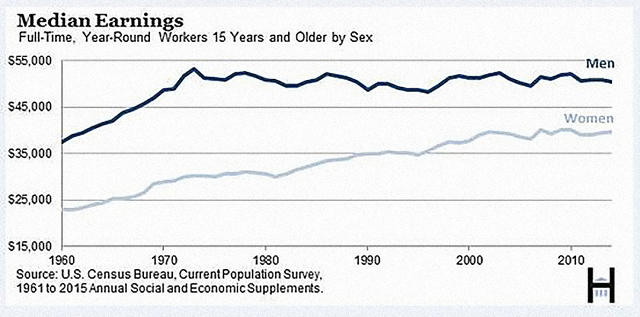
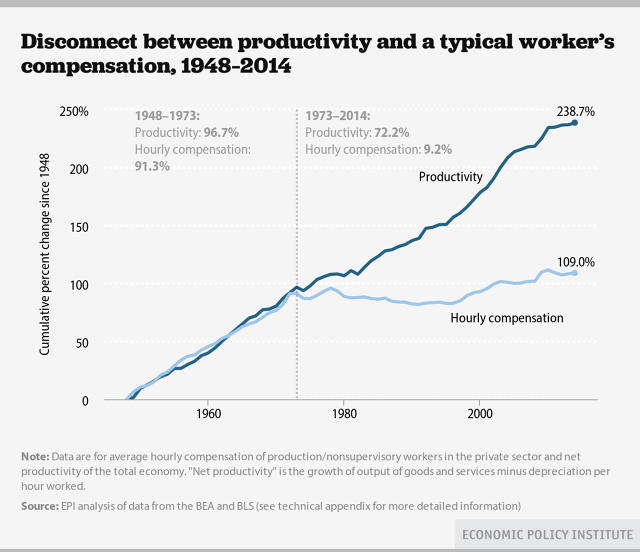
Numbers sum it up well. Since 2000, Chinese wages went up 6 FOLD. Since 1970, American median wages have stagnated. Obviously, offshoring is helping some and hurting others... Even Department of Defense warned the largest threat to national security is the national debt (aka offshoring)(basis of all war is economic = the golden goose from which to tax to raise an army etc)....

The reverse will also hold. As jobs come back from Asia and Mexico, American wages will rise and Asian wages will fall........ same thing man.....

We've just been so used to LOSING ....we're like beaten down housewives. We just can't fathom a happy outcome for us..... It'll happen tho :)

20150314_BBC042.png

3051326-inline-i-2-after-inflation-the-average-american-worker-earns-less-today-than-40-years-ago.jpg
3051326-inline-i-0-after-inflation-the-average-american-worker-earns-less-today-than-40-years-ago.jpg
 
The only way to real wealth accumulation is productivity improvements.
We haven't improved productivity, we put it on our credit card. That's correct. Absolutely right. It was fake prosperity.
But thinking that forcing consumers to pay more money for everything via tariffs and currency manipulation is going to create wealth is just as wrong. It doesn't create any wealth, either. Instead of putting it on a credit card, it just takes the money out of one citizens pocket and puts it in another citizens pocket. That does not create wealth. It's only another illusion, just like putting it on a credit card is an illusion. Instead of putting it on a credit card, we just tax it out of someone else's pocket right here in the US via higher prices.

Did china and germany cheat to gain mkt share? I don't think so. China has a 16% vat on imports? So what? It applies to domestic production there, too. China has a 25% tariff on cars? So what? The US has s 25% import tariff on pickup trucks.

Does china manipulate their currency? In what way? By keeping it at a certain value instead of letting it go up? Anyone that believes in a gold standard thinks that's what they should do. Does the fact that a big mac costs 35% less in china mean their currency is undervalued? Why? What should it cost? They have a buck an hour labor and no epa, osha, etc. If a big mac in china doesn't cost way less, then something is very wrong. Thinking that we can judge whether a currency is over or undervalued based on nothing more than business revenues is deeply flawed analysis.

You only create wealth by one method. Improvements in productivity. Period. Neither putting it on a credit card or taxing it out of a consumers pocket does anything to create real wealth.

China did not cheat. They created real wealth. How? They put people to work at producing goods that are much cheaper in the marketplace than previously existed. You create wealth by either making a better product or by making a cheaper product. Every other way is phony wealth. Tariffs are phony wealth just as much as putting it on a credit card.
 
The only way to real wealth accumulation is productivity improvements.
We haven't improved productivity, we put it on our credit card. That's correct. Absolutely right. It was fake prosperity.
But thinking that forcing consumers to pay more money for everything via tariffs and currency manipulation is going to create wealth is just as wrong. It doesn't create any wealth, either. Instead of putting it on a credit card, it just takes the money out of one citizens pocket and puts it in another citizens pocket. That does not create wealth. It's only another illusion, just like putting it on a credit card is an illusion. Instead of putting it on a credit card, we just tax it out of someone else's pocket right here in the US via higher prices.

Yes and no. They are our jobs. Not China's. Not Mexico's. Not Japan's. OURS. So we get our factory jobs back. And the litany of support jobs that go along with it. Yes, it's zero sum. Yes, no new wealth is created. It's simply transferred. That's all international trade balances are = wealth transference. Except this time, we get whats ours and rightfully belongs to us. To hell with the rest of em. It's not America's job to finance the worlds welfare check via our trade deficit. That's my argument. Many Americans agree, evidently.

Further, wages increase faster then prices in an industrialized economy. Yes, goods will become more expensive in America. However, far more people will be employed, and at higher wages. Thus, in real terms, goods and services become cheaper. It's all relative. If prices go up 20% but wages go up 30%, in real terms, prices just got 10% cheaper. That's exactly what happened in China. Tariffs on US goods = price level goes up = factories move to China = worker wages go up six times in 15 years = far offsets 20% increase in prices from tariffs etc.

Same thing will happen in America..... It's all the same.
 
The problem with saying it's our jobs is that you're making someone else pay to get them. The consumer. Manufacturing jobs are one segment. The consumer is everyone. It's redistribution by gov't from one people to another. I don't think gov't has any business doing that. I think consumers should be free to spend where they want and businesses should be free to invest where they want. When one country, china, has very low wages, it will tip the balance in the US towards consumer gains and business gains and away from manufacturing jobs. That's just a reality that nobody can deny. But by using the force of gov't to tip it back to manufacturing jobs and away from the consumer and business, it will eventually cause growth all the way around to stagnate, because productivity improvements vanish whenever someone can rely upon the gov't to remove competition. Why should anyone ever make a better product at a lower cost when you can just place a tariff or tank your currency? That's how we wound up with steel workers and gm workers making 100k/yr and cars that were full of defects.
It just all breaks down when competition is removed.
 
Not to say I'm completely against Trump's economic plan.

The other parts, cutting taxes and removing burdensome regulations, are major enhancements to productivity gains. I like them very much.
 
natural forces or the invisible hand is a theory. For it to work as expected, the theory presumes the presence of floating exchange rates and the absence of govt interference. In short it presumes are countries are open to trade and the currency will balance the strong economies vs the weak ones. As the weak ones get stronger their exchange rates will cause new balances to happen.

so:

1. What happens is the govt and private central banks screw with the exchange rates?
2. what happens if a private central bank not the govt creates trillions of one currency and spread it around the world buying influence and assets and then pulling manufacturing out of the home country.

this is the big one...

3. Why do you presume that protecting jobs and creating complex goods the world demands in the home country will not result in a stronger economy and thereby a stronger currency. Therefore happy home consumers buying goods from overseas for less currency? It worked in asia. It worked in the US in the past.

I just don't think a weak economy and weak currency helps locals consumers in any time frame but a very short one.


The problem with saying it's our jobs is that you're making someone else pay to get them. The consumer. Manufacturing jobs are one segment. The consumer is everyone. It's redistribution by gov't from one people to another. I don't think gov't has any business doing that. I think consumers should be free to spend where they want and businesses should be free to invest where they want. When one country, china, has very low wages, it will tip the balance in the US towards consumer gains and business gains and away from manufacturing jobs. That's just a reality that nobody can deny. But by using the force of gov't to tip it back to manufacturing jobs and away from the consumer and business, it will eventually cause growth all the way around to stagnate, because productivity improvements vanish whenever someone can rely upon the gov't to remove competition. Why should anyone ever make a better product at a lower cost when you can just place a tariff or tank your currency? That's how we wound up with steel workers and gm workers making 100k/yr and cars that were full of defects.
It just all breaks down when competition is removed.
 
I don't understand why a factory in china builds wealth but one here is a problem. Isn't it better to build wealth here rather than in china?

We've tried the "free trade" route for over 20 years, and there is widespread consensus, outside the C suite of big companies and the Wall Street Journal editorial page, that it has produced uneven results at best and has had a devastating effect on lots of workers. It's great to be able to buy cheap crap at WalMart but it is hardly solace if you have lost your job.

The fact is that these big trade deals were never strictly about economics. They were in fact more about getting china hooked on capitalism, so they wouldn't start a war, and trying to use access to our market to advance diplomatic or security interests.

Priorities change. China is big and powerful now and we don't want them getting any richer until they dial back their aggression. Moreover, as Pat Buchanan says, economic efficiency is not a religious duty. It is a goal, but it is one goal among many.
 
Thanks, Guys. I appreciate the feedback. Constructive criticism always welcome !!!!

Yes, you're right. VIX options, and all products that follow exhibit high theta decay. WC schooled my ass a few months ago on it lol

I retract my VIX call......

I wish you could buy VIX directly. With VIX in the 10.50 range it would be strong strong buy, but unfortunately we can't.
 
The amazing thing about trump is he is actually living up to his campaign promises.
Not really. He is appearing to carry out his campaign promises; telling people what he thought they wanted to hear and making a big show of it. Wait until you actually see the Wall. Wait until you actually see those jobs materialize. He's a showman and a compulsive liar. The only parts of his executive orders that can be actually be carried out so far are meaningless.
 
Back
Top