
Don't worry about it. Trump will take care of climate change.So let's the quote from one of them. Just one publishing CLIMATOLOGIST, you blithering idiot.
The consensus is actually more like 99.9%

You are using an out of date browser. It may not display this or other websites correctly.
You should upgrade or use an alternative browser.
You should upgrade or use an alternative browser.
Trump and climate change
- Thread starter Humpy
- Start date
So let's the quote from one of them. Just one publishing CLIMATOLOGIST, you blithering idiot.
The consensus is actually more like 99.9%
Quantifying the consensus on anthropogenic global warming in the scientific literature
John Cook1,2,3, Dana Nuccitelli2,4, Sarah A Green5, Mark Richardson6, Bärbel Winkler2, Rob Painting2, Robert Way7, Peter Jacobs8 and Andrew Skuce2,9
Published 15 May 2013 • 2013 IOP Publishing Ltd
Abstract
We analyze the evolution of the scientific consensus on anthropogenic global warming (AGW) in the peer-reviewed scientific literature, examining 11 944 climate abstracts from 1991–2011 matching the topics 'global climate change' or 'global warming'. We find that 66.4% of abstracts expressed no position on AGW, 32.6% endorsed AGW, 0.7% rejected AGW and 0.3% were uncertain about the cause of global warming. Among abstracts expressing a position on AGW, 97.1% endorsed the consensus position that humans are causing global warming. In a second phase of this study, we invited authors to rate their own papers. Compared to abstract ratings, a smaller percentage of self-rated papers expressed no position on AGW (35.5%). Among self-rated papers expressing a position on AGW, 97.2% endorsed the consensus. For both abstract ratings and authors' self-ratings, the percentage of endorsements among papers expressing a position on AGW marginally increased over time. Our analysis indicates that the number of papers rejecting the consensus on AGW is a vanishingly small proportion of the published research.
http://iopscience.iop.org/article/10.1088/1748-9326/8/2/024024/meta
= 67% of scientific papers express no opinion on global warming, one way or the other.
= 33% of scientific papers express an opinion and say its man made.
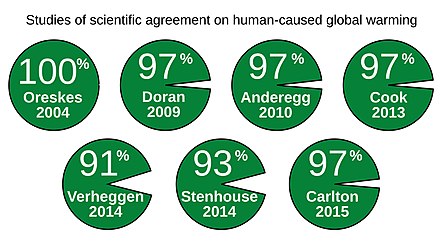
See that picture you posted is a lie.
It's not 97% agreement in cook. Its 97% agreement of 33%. Stop lying. The other 67% of scientists had no opinion. YOu keep omitting that in ur presentation of facts, as you like to call it.

Check out the world's glaciers if you think the planet is not warming up. They are all retreating.
You are incorrect about this. Some glaciers are expanding and some are retreating. No different than any other period in the world's natural history. Go look it up.

See that picture you posted is a lie.
It's not 97% agreement in cook. Its 97% agreement of 33%. Stop lying. The other 67% of scientists had no opinion. YOu keep omitting that in ur presentation of facts, as you like to call it.
Not all Global warming science is setting out to find a link to human influence. If I publish a paper on the temperature record of my town for the next 5 years and it gets hot, it doesn't mean that my position is not that humans had nothing to do with it, just that my measurements showed it got hot. The 33% of those papers explored the human link, hence why they're the ones filtered.
Frankly, what does it matter that a solid state physicist or a molecular biologist or chemist agree on the effects of climate change? Or in your mind is atmospheric physics the same discipline as say astronomy?When 97% of the world's top scientists...
What concerns me is that the opinions of Ph.D atmospheric physicists on whether man is significantly affecting our global climate via CO2 emissions are all over the map. There is no broad consensus among this particular subset of scientists. Shouldn't that be of concern. (See the survey of opinions among meteorologists and physicists engaged in the study of climate and global warming in the 2014 Bulletin of the Meteorological Society.)
Beware of motives, political and otherwise. There is potentially a lot of money to be made brokering and trading carbon futures!Exxon Favors a Carbon Tax
Exxon Mobil supports a carbon tax as the best approach for policy makers because it would ensure a uniform and predictable cost of carbon across the economy, allow market forces to drive solutions and maximize transparency to stakeholders. It would also reduce administrative complexity, promote global participation and easily adjust to future developments in climate science and policy consequences.
The article suggests that Exxon Mobil “has done little or nothing to help put carbon taxes into effect.” Exxon Mobil executives have repeatedly made clear the company’s position in briefings — some 300 in 2015 alone — including with members of Congress and in media interviews as well as in other communications.
We have expressed our position on climate change — that the risk is real and requires action — on many occasions to many audiences.
SUZANNE McCARRON
Vice President of Public
and Government Affairs, Exxon Mobil
Irving, Tex.
interesting... but there are billions being spent on climate change sciene...
so you would expect to find peer reviewed papers concluding man made co2 causes warming would you not?
especially since there are over a thousand peer reviewed papers that could be considered skeptical... for instance they say the sun or the tides are responsible for warming.
http://www.populartechnology.net/2009/10/peer-reviewed-papers-supporting.html
or that change in ocean temperature leads change in atmospherical co2.
---
So... we are ready for one person to present a link to peer reviewed papers stating man made co2 causes warming.
Oddly, none have been produced.
so you would expect to find peer reviewed papers concluding man made co2 causes warming would you not?
especially since there are over a thousand peer reviewed papers that could be considered skeptical... for instance they say the sun or the tides are responsible for warming.
http://www.populartechnology.net/2009/10/peer-reviewed-papers-supporting.html
or that change in ocean temperature leads change in atmospherical co2.
---
So... we are ready for one person to present a link to peer reviewed papers stating man made co2 causes warming.
Oddly, none have been produced.
Not all Global warming science is setting out to find a link to human influence. If I publish a paper on the temperature record of my town for the next 5 years and it gets hot, it doesn't mean that my position is not that humans had nothing to do with it, just that my measurements showed it got hot. The 33% of those papers explored the human link, hence why they're the ones filtered.
Last edited:
There is some debate about what is happening globally. In some places glaciers are declining while in others they are growing. However the important question is whether the Earths Atmosphere is currently warming , or cooling, not locally, but globally. And if we are doing one or the other outside the bounds of natural variation, what is causing the change. (We know, for example that Greenland was once green, and the Thames once froze solid.) We can't answer these questions yet with a reasonable degree of confidence. So far, despite mountains of data, we are still relying on guesswork based on questionable assumptions and seriously flawed models.Check out the world's glaciers if you think the planet is not warming up. They are all retreating.
The most important question du jour, i.e., whether man caused CO2 increases have anything significant to do with the trend, can't be addressed until we know if there is a trend. Are we warming or cooling outside the bounds of normal variation? Since normal daily temperature variation is about 10 deg or more Celsius, and we are trying to detect changes in global temperature two orders of magnitude less than this over hundreds of days, the problem of trying to determine whether the Earth is warming or cooling overall has so far proved intractable. Surface based measurements, even thousands of measurements averaged over long periods, are unreliable because of localized effects that produce anomalies. Attempts to correct for these anomalies are fraught with potential for error. On the other hand, satellite remote sensing data would seem to be the more reliable, but it too is not without error. And to make matters worse, the corrected surface based and satellite measurements don't agree. The surface data shows slight warming but less than predicted by models based on the Hansen hypothesis. This hypothesis requires, it turns out, that there be positive feedback to temperature increases assumed to be caused initially by rising CO2. Sadly for the Hansen adherents, the satellite data shows neither net warming nor cooling over about the most recent twenty years.
Because the direct measurement of temperature over very brief periods of a few decades by any method yet devised is insufficient to conclude with even moderate confidence that we are warming, cooling, or neither. We have been forced to make assumptions, and then build models based on those assumptions in an attempt to predict future temperature. So far, no model has proved correct, and many have proved incorrect. Different models, wildly different in some cases, have produced wildly different results. So far, no one has been able to prove that the Hansen Hypothesis is correct, but evidence is building that it is incorrect. At present we don't even know if we are warming or cooling globally, but we have reliable evidence of local warming or cooling, for example at high latitudes, or over a large continent, for a period of some years.
A serious problem for modelers incorporating positive feedback to CO2 increases, is that systems with positive feedback are inherently unstable. Thus any model incorporating positive feedback predicts eventual runaway temperature, just as adherents to the Hansen hypothesis had predicted very early on based on seat of the pants guesswork. For these modelers, only the power of the exponential function varies according to the details of their particular model. Had positive feedback to climate forcing by increased CO2 existed in our past, however, none of use would be debating climate change today. We wouldn't be here, because negative feedback to temperature perturbation is a necessary requirement for climate stability. Therefore the Hansen adherents must assume that while we have, they say, positive feedback occurring now, we must not have had positive feedback in the past.
This is a difficult position to maintain in the face of ice core data showing that CO2 content in the atmosphere has been much higher at times in the past. The argument of the Hansen adherents would, therefore seem to require, a "tipping point" from negative to positive feedback. So far they have not articulated exactly what features of our climate, or their climate models, will produce such a tipping point. Their models simply assume that we are beyond the tipping point and we are now in a period of positive feedback.
We can all agree that if we are, indeed, in a period of positive feedback, and we don't tip back to negative feedback in a millennium, or much less according to many Hansen hypothesis models, our planet will either get much hotter, or much colder, at an exponentially increasing rate. It won't be long before the Earth is a dead planet and our climate debate will be moot..
Last edited: