Quote from dom993:
Even in that very case you are taking for example, there is no prediction involved, the trade is taken based on:
- the observation of the past,
- the assumption that the future will *statistically* reflect the past.
One has to assume that the outcome of any particular trade is a random event.
You are not taking a particular trade because you are predicting it is going to be win, you are taking it because it is one in a series of hundreds of trades with similar circumstances, which have a statistical edge (taking *all* the trades that have similar circumstances, you will make money - *THAT* is what the prediction is about, *NOT* the current trade)
That's what prediction means.
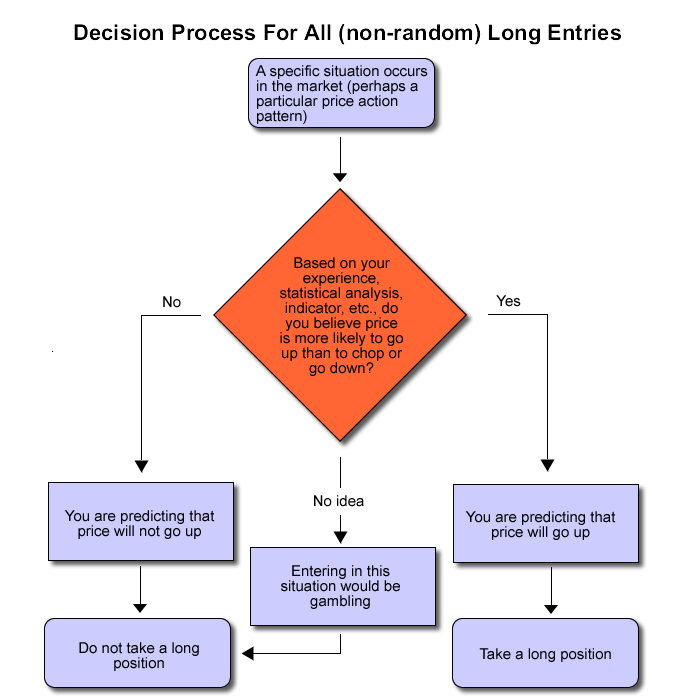
If you know that 70% of the time a certain situation will result in price going up 5 points, then when you see that situation in the future you can predict that price will go up 5 points.
Without that statistical knowledge they would just be randomly trading (ie. gambling).
Why would you open a long position if you couldn't reasonably predict that price was going to go in your favor?
Prediction doesn't mean you have a 100% chance of being right.
If you flip a coin 10 times I predict 5 times it will be heads. It might actually be 0, 1, 2, 3, 4, 5, 6, 7, 8, 9, or 10 times, but I would predict 5 times. If I could make a bet such that the closer the results were to 5 times the more money I would make, I would take that bet because of my prediction.
For example:
Heads 0 or 10 times = -2
Heads 1 or 9 times = -1
Heads 2 or 8 times = 0
Heads 3 or 7 times = +1
Heads 4 or 6 times = +2
Heads 5 times = +3
I would take that bet ever time because of my prediction that you would get heads on 5 out of 10 flips.