Fully agree. On the hindsight chart, it looks so easy, in real time, I have to say that I haven't trained myself yet to be comfortable with buying the smackdown. I wait to see it take off again, and this usually means I'm now getting in a few points higher, and with a tight stop, I have often been taken out. But I know that this is something I need to fix, just saying that my "in the moment" thought patterns aren't quite lined up how they should be.
Well you have to get comfortable with this. To be fair, maybe you don't buy that one specifically, but there were like 3-4 cycles of this right afterward showing a newly defined (temporary) support. Buy anywhere at the bottom of that range. Think about it this way - if price just got smacked down, but not lower compared to where it was 5 minutes ago, why would this be scarier than buying on a breakout? By the time you see the move actually happening it's too late to get in with a reasonable stop. You want to recognize this temporary range being built and the back/forth that is going to happen within it. Here's how crazy this is - buying any of those highs and you'd be right on direction but stopped out every single time but buying any of those lows and you would never had been stopped out. Sometimes it doesn't always go that way and you get stopped out anyway - that's just shit happens.
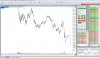
Here is a compressed 5 min chart showing the previous few days. At the red arrow is this area in question, what I call my ONH, but you call it the previous day open PDO? I've got the previous day open at the green arrow, roughly 4413, well below the area in question which is around 4428. Perhaps one of us has something mixed up?
Nope, I'm saying it paused on a prior resistance level which was also the PDO but more importantly it was definitely a resistance level. ONH just doesn't even matter here because the previous session opened, went up like 3 points, and then dumped 30+ points. The ONH in this case is simply an artifact at best. The PDO however happened to coincide with a resistance level that yesterday's day session could not break through. It did it today, but that's what the pause was about. Move that line up to 4430 and you'll see what I mean.
Ah I know what's going on here. Sorry your PDO is correct for the day session, I was using the PDO as measured from the night session (I use the Daily OHLC study in Sierra which doesn't allow me to have separate session levels, it's either day or all). Either way it's not the fact that it's the open that really matters it's mainly that it was a resistance level (4430).what I call my ONH, but you call it the previous day open PDO?
Yes, the 5 sec isn't giving me context, but even in your previous paragraph when you say that the buying to get in on the 20 point move could have been made at any low of the previous consolidation range, I fully agree, and its in this 5 sec chart that the range really stands out for me. On the 1 min chart, its just a few bars clumped together.
I guess what I meant by context is that watching the 5s chart distances yourself from the medium-size picture unless you're constantly going back and forth to the 1m and 5m charts. I use volume based charts so if enough contracts trade to complete a bar, that's what I see. Most of the time the actual shape of the candles doesn't hugely matter at this timeframe, but there are cases where near the top and bottom of ranges seeing a bunch of wicks with price quickly recovering indicates retail stops being hit or other gaming going on (somebody's getting filled).
You've got some really good stuff in this post here i960. This is exactly what I'm looking for when I say that I'm trying to figure out what to be thinking in real time. The key of what to be thinking is to be buying at the lows of range consolidation. (its just that as I said in my video, given the consolidation, I just didn't know if it would break up or down, but I knew at least to either buy at the lows, or sell short at the top of the consolidation... and I also know that buying the breakout of the consolidation is far too risky).
Yep, we all have that problem when it comes down to it (should I buy or sell? will this continue or reverse?), but use the higher time-frames, context, and prior action to go with a direction and put a position on. It won't always be successful. If it looks like a crap setup then don't do anything. If it looked like a good setup but something unexpected happened or your read was wrong it's just a failed trade. If you know you obviously just got your stops run or ticked out, put the position back on.
Oh.. one more question.. when do you consider the Previous Day close to be? 4pm NY time? Or 4:15?
My day session time is set to 0930-1715ET. In this case though the PDC isn't really that important, in fact it probably isn't that important most of the time - just another metric.
Also, if you don't consider the overnight range, what levels do you consider? Is it simply where the market has turned before? The level around which most of the volume happens... the consolidation area? Or would you also say the PDH, PDL and PDC, and even perhaps the PDO (previous day open)?
Well it's not that I don't consider the overnight, I both consider it and sometimes even trade it. It's that the ONH specifically might not have a lot of meaning when a good portion of the European session was traders selling. There's no real meaningful high there whereas the ONL would definitely have more meaning. The way I consider levels is a combination of obvious S/R and volume profile - with the emphasis given to volume profile (both the current day and previous day). The latter shows me peaks and valleys in volume combined with higher volume "value areas" to keep myself out of.
Last edited: