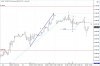
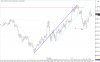
A - So before the open, we broke out of the tighter range, and broke above the previous swing high.
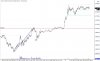
O - Congesting just before the open. The 15 sec chart shows a clear move down, then up again, stopping just before the previous high and then we kept going down. I go back and forth so much between using 15 sec charts to help me see what is going on, but at the same time, being careful to avoid getting sucked into micro trading.
I think here is the critical difference though. The 15 sec chart has been horrible for the middle of the day when the volume is down. This is where the algos do their thing, especially in areas of consolidation. But at the open, when the general move is established, I think watching this lower time frame has huge advantages. It allows you to connect more with the continuous nature of price, so a short appeared here at about 61, way before it showed on the 1 minute chart. For the fluid trader who can get out just as quickly as he can get in, nothing wrong with this approach I think.
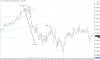
B - Short entry marked here. Tight DL breaks, but we are shorting at the previous high that once broken could be support. I have this marked on my chart, but the market doesn't care about this swing high. Price stopped here once, but when we went through after "A", there wasn't a problem, so this level might just be in my head. Price clearly had no trouble going through this time.
I'm really examining lately what I think of these trades I mark on my chart. It isn't so much of a "here I'm taking this short", its more of a "here is where the short should be". I find that these trades, where they should be, turn out much better than where I "feel" like taking them, and hence where they have been taken in the past, always beyond the actual entry and into "price chasing" territory. I would use a RET on a 15 sec chart as an excuse to get in, but when you look on the 1 minute chart, this trade would have been in the middle of a huge bar, so far away from the previous high or low of a bar that should be setting up the trade. Until I actually take these trades in sim that I mark, complete with an exit, none of this matters much, and hence why I'm getting frustrated.
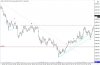
C - 5 min DL breaks here which leads to congestion. ND really gave some insight when she said to track how a trade based on waiting for a RET would work out versus taking the trade at the line break when price comes back up. Of course the RET entry gives you confirmation, but the BO level entry gives you a better price. So often I do see that the BO entry, even if it doesn't allow, allows for a cheaper exit. The RET entry fills often and doesn't go anywhere, so the better price might actually make more money in the long run... but I have no firm stats.
D - The RET entry is here with this bar on top even going up to roughly test this BO level. Its also your standard SLA entry.
Oh.. there is one thing about this that I found interesting while going through really old material last night. Check out this link here were Db discussed the different between a pullback and a RET. It seems to me that the RET only happens after a the breakout. Each subsequent RET is actually a pullback it seems to me now, so I have perhaps been sloppy with my definitions. Here at D, this qualifies more as a pullback because we are already well on our way into this move, and the RET was at B.
http://www.traderslaboratory.com/fo...ading-wyckoff-way-archive-435.html#post164636
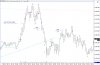
E - Hit a low here of 4142... middle of nowhere really.
F - After breaking the SL, a tight one mind you, here is a RET for a long I would never consider taking now. This is the secret to making SLA work... you gotta know when to skip a mechanical trade because tight lines are bound to break, consolidation is bound to chop you up, and context is king.
G - Getting this high, I quickly mark in my 50% of the down more, and we aren't quite there yet. I mark in a short below this bar, so lets see if it hits. The idea is that if we can't breach the 50% level, this down move is still on, at least to a test of the low at E.
What's interesting is that price comes up again for a micro double top before going down again to fill... this would give even more strength to the short. I wasn't even seeing the DT in real time though, just waiting to see if the trade would fill, which it does, and I notice it now after marking my letters.
H - Having only made it this low, and seeing price come back up, I've got a problem. This congestion to the left gave sellers lots of time to work harder if they were gonna drop this some more. This low here might very well be a test of the low at E, and we stop at the midpoint of this congestion area to the left. So as much as I was loving my short at G, I mark a long above here now, which would be almost the same price level as my short. So do I stop and reverse here?
The long clearly doesn't work, and I should perhaps use the fact that the drop down from G to H was so much faster than the rise up from E to G, so this should give me context, but lets face it, in real time, that H could have very well been a higher low.
J - The double top provided a place to draw the new SL, but this could only happen once we are much lower. If we were still in that short from G, price only moves against me 2 points when we climb up to here before we drop.
K - Finally a LL, so we can draw in that SL.
L - Another LL.
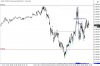
M - We break our SL yet again and end up back in this congestion area of 42-51.
N - Our 50% level of this new down move to include the low at L is now 4150, which we just breach here.
All of the action after this is just crap to me. I know I would get chopped up. I see we couldn't go down, but I also see trouble going back up now.. so better stay clear.
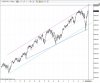
I should also note that we haven't retraced 50% of this up move overnight, nor did we test that previous swing low at 4133, and price is for sure trending up (the 50% of the up move would be about 4130). So hey... perhaps there is strength in this up move after all. If we really do make it to the channel high today or tomorrow and then turn down, I swear I will sell one contract at the first sign of weakness and hold it to at least the mean of the channel!