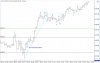
First Trade Example:
I had a strong bias that since the RTL of my previous up-trend was broken on a convincing run of accelerating volume, the market would open with a segment upward that was less severe than the downward rally at the previous close. The first change from long to short after the open would be the third point at which a larger-fractal downtrend could be bounded. From there, I would hold during the trip back to the newly formed LTL and exit if the volatility of the trend was not expanded.
I was early on my first two short trades, but losses can be cut so small that a few re-entries aren't the end of the world. Personally, I've noticed that I usually tend to err on the early side of things during entry rather than later, and it's something that I am continuing to work on optimizing. The resulting volume spike downward failed to reach the LTL, so I exited the trade.
With such a wide, steep channel, and a decently powerful push downward, I was not convinced that the RTL would be successfully broken. As you can see, I even wrote 'FBO?' [Failed Break Out] for Bar 5 of my log, since I was anticipating that the dominant sentiment hadn't changed yet, and was planning to get another short after the non-dominant tape upward concluded.
Keeping a Log:
This brings me to my next point of interest, which is the process of keeping a log. I find that every increment of order and clarity that one can create when dealing with the market is useful and beneficial. I keep a log in order to force myself to solidify my thoughts to a point of decision, and also to be able to review the times when my perception was not parallel to the reality.
I keep track of volume events of tapes, which have all been observed and categorized by Jack Hershey, and I also keep track of how the tapes fit into the larger trend which I typically seek to trade only on the dominant side of in order to have favorable volatility. I am sure many traders have personalized logs quite different from mine, but regardless of what one's log may look like, I believe it to be a very helpful tool for staying focused, enhancing clarity, and especially for reviewing spots of confusion.
Conclusion:
So, I have attempted to share some of the basic concepts and practices that I've found to be helpful towards profitable trading. I do not think any two individuals trade alike, and I am not attempting to share a method to be copied, but rather to introduce some material that individuals may find useful to analyze and adapt to some degree into their own personalized skillsets.
If there's one thing I've found in regards to trading, it's that it much more than a method that can be taught; it's a skill-set that has to be developed individually. I found a lot more success when I stopped looking at other individuals as teachers, but rather people who's contributions can help me learn.
Synopsis:
If I had to summarize a few key take-away points from my post, they would be:
-Develop a comfortable frame-work for yourself. Stay away from subjectivity, guess-work, and don't settle for uncertainty.
-Volume is a key variable in the operation of the market. At least consider observing it and making connections with how the movement of price relates to it.
-Thoroughly define your thought-process in a concrete, yet not overly wordy or complicated way to increase clarity and decisiveness. This also helps immensely with review after the fact.
-Take responsibility for the development of your own skill-set. Do not rely heavily on others; do the work yourself. Be patient as you form your own understanding of the market, and try to avoid getting complacent with a routine. Always seek to make optimizations, changes, and improvements.


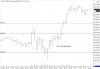
![[9-24] Trend Basics.png](/et/data/attachments/126/126919-3c406b224a498e648bfde2ecff8441b6.jpg?hash=PEBrIkpJjm)
![[9-24] NQ Hour Chart.png](/et/data/attachments/126/126920-b73b0feb0f2076d3ff0e4b15d25f482e.jpg?hash=tzsP6w8gdt)
![[9-24] NQ Hour Trades.png](/et/data/attachments/126/126922-4be3ee96eecff1871514c868356731ff.jpg?hash=S-Pulu7P8Y)
![[9-24] NQ Hour Log.png](/et/data/attachments/126/126923-e76cec64ab97b85a3f29968b0dc00868.jpg?hash=52zsZKuXuF)