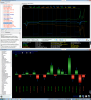
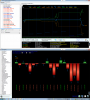
> I see now that options are only used to hedge deltas (thetas neutralized)
That's right. Since, by assumption, we don't want to allow ("memory-less") losses, we are not allowing paying time decay. In case of assignment of some option, the corresponding position will be transformed ("fill projection" facility) into an ordinary player and will only close in profit (as, by definition, all players).
> Does it transmit one and one order
That's right. The app never leaves "presubmitted" orders (in automatic mode): all automated orders are either executed "immediately" (say, within a given reasonably short timeout) or they are discarded (ie., there will never be "several active limit orders ", but only one).
[There is actually the possibility to "presubmit" orders too, but that is a discretionary feature. Or, there is the possibility to "enqueue" orders which will be followed automatically by the app in the future, but this is also another discretionary feature, which we can ignore, for simplicity, for the moment.]
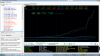
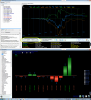
All the colorful squares or circles you see in the "order cloud" (in "order-view mode") are only (already) executed orders (blue=Buy, red=Sell).
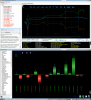
Each order placed is actually the result of the activity of the logic layer created by the superposition of the "virtual players". In practice each player will have its own requests like for instance, "open" some positions, or "close" some positions, and so on. All these multiple requests are "pooled" (algebraically) and channeled into a unique physical order each time (say at each tick, or in between ticks). Then, on execution, or partial execution, the possible fill is "redistributed" to the multiple players accordingly to their requests, thus changing their virtual states.
If it can be more expressive, you can think of this like (mathematically) equivalent to having multiple independent "real" individual traders (they will be "partners") working on different and distinct accounts (possibly using the same financial instrument), but talking continuously to each other, and coordinating their actions for reciprocal "protection", while nevertheless also pursuing an "individual" profit, whenever possible, but assuming they are sharing a financial interest in maximizing the overall profit (say, they will share the sum of individual PNLs) and minimizing the overall risk.