The answer is: You don't do it! Switch to bar charts or use another application which can display bar charts.
Regarding gaps... either:
- Use applications like Ninjatrader, Sierra Charts, etc. which can create a de-gapped chart or display de-gapped bars as indicators.
- Later in the evolution of this method mentally degap.
- Measure the difference between the bars and move your drawn line accordingly up or down.
- Ignore the gaps and simply connect highs and lows. <--- For now this should be fine.
What Frenchfry contributes is accurate and precise. He has sage perspective and has provided clarity for me where there was once confusion.
De-gapping brings up the concept of "Two levels of Awareness".
Each level of of awareness is an arbitrary distinction. We use it to facilitate understanding.
For example consider a coffee table. Through our five senses we perceive the table as solid. This perception has relevance in our immediate environment. Having a solid table provides utility and functionality.
Through the concepts, experiments and tooling of modern physics, we extend our five senses and come to another perception. The table is mostly empty space.
This awareness, though not entirely useful in day to day living, gives a larger context by which a greater understanding of the reality we find ourselves within. It has also allowed for all the modern technological conveniences we take for granted.
The tools at our disposal and that we have facility with determine how we perceive a problem and subsequently our solution to that perceived problem.
We can put aside degapping for the moment and do as FF suggests and focus on connecting the H's and L's to build tapes. Know that it's something one will naturally gravitate towards once some other more general pieces are in place.
Not sure how to do this on regular EOD candlestick charts. The bodies have many gaps and doesn't fit the model exactly, so feel compelled to investigate custom charting for this. Or maybe use number of periods before breaking SYM s/r as a custom "timeframe" (period) reference, but would perhaps also need to search for better SYM starting points.
View attachment 175014
Another attempt, but using HL-ranges thus less gaps (but then not using open and close as it would again complicate stuff):
View attachment 175019
I believe the 10 case geometry model is fine, but not sure how to find it in such charts.
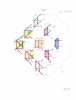
Before we deconstruct the open and closes of a bar, let's utilizes the 10 case model. Doing what you did with the 2nd chart, do that with the model. We are looking at two bar relationships. With that in mind, drawing as you did with the above chart, do that with each two bar relationship. The length of your lines would project past the second bar into empty space. In this model example, it would project out the distance to include the coming third bar (not out to the edge of the sheet). A simple hand drawing would work.
This is the empty space that price on the coming third bar will either:
1) Be within the bounds.
2) Pierce one of the trendlines with it's H or L yet close within the bounds.
3) Pierce one of the trendlines with it's H or L and close outside the bounds.
When one case is true, the others are false.
With this complete, the next task is to color code the two bar relationships. There are four cases that get colored the same. These are the internals. Notice they make a smaller diamond formation as the larger model does. We know that when price is contained with these internals, price is contained by the "Shadow" of the previous bar. The convention is purple lines for the bounds with the interior a shade of yellow.
If we add a third bar that is contained with the bounds, we get the ten case - Laterals.
Laterals are defined as a three bar relationship where the H's and L's of Bar.1 and Bar.0 are equal to or within the H and L of Bar.2
Back to the chart, notice what volume does at Sym. Notice the volume of the bar prior. Notice what volume has to do for price to move directionally past the "lines in the sand" you've created to support a concept known as Laterals.
We are working with EOB atm. The price cases at this level of working does not get defined by us until EOB.
In your second chart notice the rtl of the bars for May 17,18. Notice what price did in relation to this line. In addition, on the 26th, the CW view of support becoming resistance comes into view.