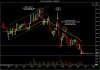
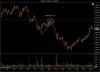
Here are the Cliff Notes version of my plan. Large parts are still in the R & D phase, but the skeleton of the plan is in tact.
I have a handful of entry techniques that I apply at structural parts of the chart, depending on market conditions as I perceive them on the 5 min chart.
Pre-market:
- Note/mark Y-HOD and Y-LOD on the chart with a green dot-dash line
- Note/mark any other nearby day's highs and lows with a green dot-dash line
- Note/mark any significant pivots from the 60 min chart with an orange dashed line
- Note/mark any 60 min trend lines with a red dash line
- Note where the market open will be in relation to yesterday. Make a game plan of possible scenarios for testing key areas
- Note/mark any OVN channels or trends with a green dash line
This defines some boundary areas where I will look to take break out pull back (BOPB) or break out failure (BOF) trades as the market approaches them. This part is still in R & D.
During the market, note the market condition. It will be in a strong trend, trend channel, horizontal channel, or consolidating. Tactics and entries are being developed for each market condition, except consolidation. Consolidation is defined as price contraction (symmetric triangle) or a narrow (under 30 tick or so) horizontal range.
Everything except the trend channel condition is in R & D.
Attempt to draw trend channel lines on the 5 min chart. I'll discuss an ascending channel here. As soon as a low, high, and higher low are put in, I draw a channel. Sometimes the channel needs to be tweaked, since price action isn't always clean. The swings need to be meaningful.
Trade Locations are bottom of the channel, top of the channel, mid line (with caution):
Bottom of the Channel
Only longs can be taken in the bottom half on the channel, the closer to the TL the better.
As price pulls back towards the bottom of the ascending trend line, I look at the 1 min chart, checking for an entry. As price descends, I draw a descending trend line. There are 5 entry techniques that I watch for, starting with the most aggressive:
- Probe - downward momentum pauses, get at least 2 overlapping small bars. The ideal setup is when price probes lower on much lighter volume, doesn't find any, and closes with a tail. Will also enter in a WT IB
- Rejection - Price continues lower, then is rejected on higher volume, leaving a several tick tail
- Strong Reversal - Price breaks the TL with a strong, well formed green bar on higher volume
- Retrace - Price breaks the TL and retraces and closes strong, or if price breaks the TL and drifts sideways, wait for a well formed WT bar.
- 123 - Look for a 123 second entry pattern
Entries are buy stops placed 1 tick above the signal bar. Stops are 10 ticks (Note, I recognize the value of a structural stop, and if a signal bar is large, I will attempt to enter on a limit order 10 ticks above the pivot low. If the pivot low is less than 15 ticks away, I just enter on a stop)
Trade Management:
15 tick hard target, but will go for a structural target if one is within the channel. (Gathering stats on targeting the opposite side of the channel)
Hold the trade for at least 2 minutes. Tighten stop to 7 ticks. Move stop to BE +1 after 10 MFE. If there is a pivot nearby, watch how price behaves. If a level is quickly rejected with a large wick on higher volume, move stop to BE+1 or higher immediately. I have gathered stats on managing the trade using a 1 min TL and using 1 min pivots and don't like either one.
Top of the channel
Shorts can only be taken at or above the top of the channel. Unless there is climactic action, price must have made or is in the process of making 3 pushes up. Price must have 1 bar on the 1 min chart with stopping volume, with subsequent bars displaying multiple signs of diminishing momentum, such as overlapping bars, shrinking bars, very light volume bars, price/volume divergence, and significant wicks with identical/nearly identical tops.
Entries are with the probe and rejection method only.
Middle of the channel
Longs or shorts can be taken in the middle of the channel under the following conditions:
- Longs - must be at least 20 ticks to the top of the channel, cannot be part of a 3rd push, cannot be a late entry from the bottom of the channel
- Shorts - A lower high must have just occurred and the up leg is showing signs of weakness where a HH will not be made
It is usually best not to trade the middle of the channel
If price forms another channel in the opposite direction, this indicates consolidation and no trades are taken until price decides which channel it's going to honor, if any.