
You are using an out of date browser. It may not display this or other websites correctly.
You should upgrade or use an alternative browser.
You should upgrade or use an alternative browser.
This is the end. We are witnessing collapse of the global economy
- Thread starter orbit23
- Start date
Of course the lock downs were too late in the US, we all know that, and even with our lock downs they wont be as good a job as china did.
No flat curve, still spikey spikey.
Looks like China didn't do so great lost 1% of population about 10Mil, check for new threads.
In the UK the people with it, went from 20% to 60% the last 2 weeks, which means over the next 2weeks time for symptoms, a lot of people are going to get sick and die, then hopefully it'll hit 80% soon, then the numbers slow down, as only 20% left.
Sorry but the test of 44000 people in the UK 10 days ago dont support your figures at all.
Sorry but the test of 44000 people in the UK 10 days dont support your figures at all.
We'll have to see, pretty confident.
If the test was 10days ago, that's a long time ago, with this growth. Times 13 in 10 days.
Read this brilliant editorial I read on Bloomberg today. I will put your mind at ease.I am genuinely curious, how the hell will we get out of this mess?
The current economy is heavily consumer based, and pretty much everything that has to do with consumers has literally DIED overnight.
Restaurants DEAD
Pubs DEAD
Aviation DEAD
Travelling DEAD
Cruiseships DEAD
Shopping DEAD
And pretty much every business is running on debt. The cashflow went from the highest it's ever been to 0. ZERO. NULL. NADA!!!!
How can the economy keep running?
I guess the best we can do is try to keep the infections at a minimum and try to restore things to normal, but the outlook is not bright until summer (it seems like the virus is likely to be seasonal), and then it could come back the next year.
It's going to be a tough 1-2 year before a vaccine comes out, i tell you that. And even afterwards... It's going to be very hard to get the economy back on it's feet. I assume governments will start printing enormous amounts of money, potentially causing inflation and at the same time, the assets could be in deflation since the supply could overheat the market(everyone looking to sell at the same time, without any buyers).
Any ideas? How the F# will the economy sustain itself?
The Lives-or-Dollars Debate Is a Waste of Time
Nobody really believes that any cost is worth paying to save just one life, or that the Dow matters above all else.
By
Ramesh Ponnuru
March 27, 2020, 3:13 PM CDT
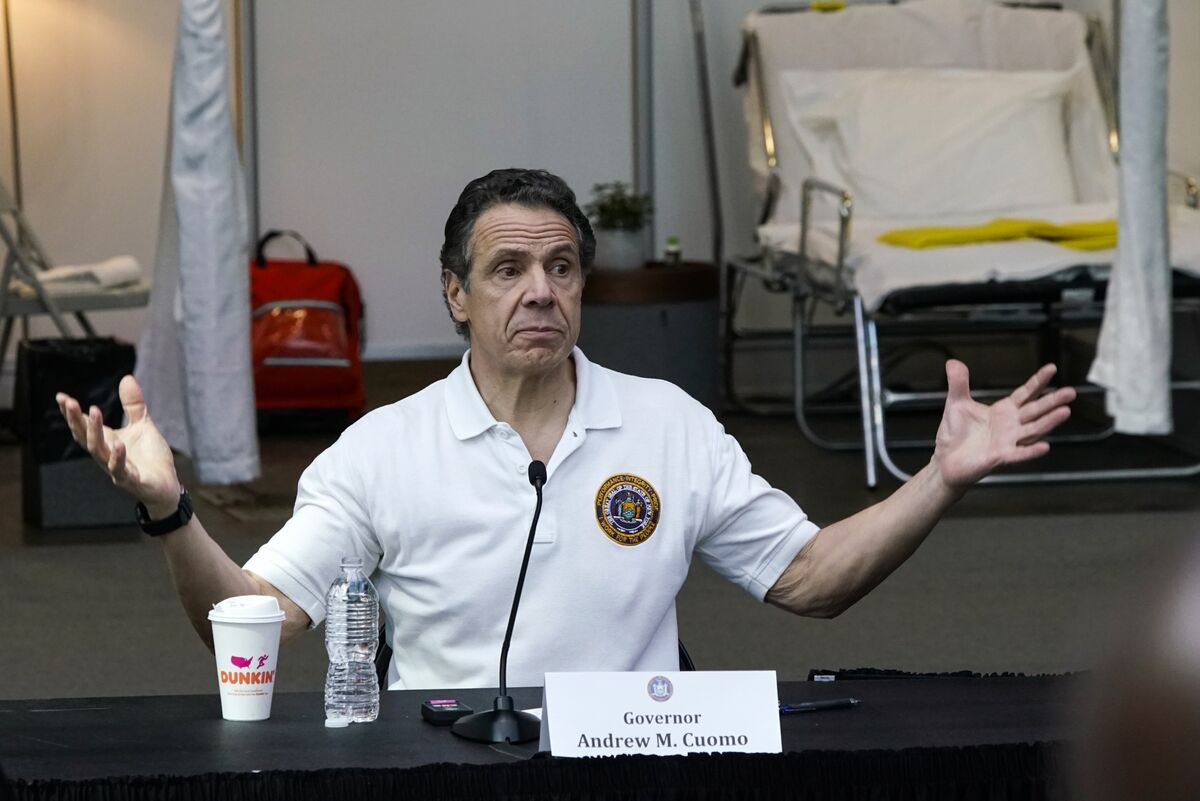
Looking clueless.
Photographer: Eduardo Munoz Alvarez/Getty Images
Ramesh Ponnuru is a Bloomberg Opinion columnist. He is a senior editor at National Review, visiting fellow at the American Enterprise Institute and contributor to CBS News.
Among the critical shortages the coronavirus has revealed is one of a sophisticated vocabulary with which to discuss basic moral questions. It is not as urgent as the shortages of masks and ventilators but it has been just as evident in the news media.
How else to explain the bizarre debate now taking place about whether we should sacrifice our economy to our health, or vice-versa? Those who want to reopen the economy now say that we are putting livelihoods at risk to save a small part of the population, and a part that has disproportionately seen most of its years already. Sometimes they find a class angle: People who can easily work from home, such as pundits, are protecting themselves from tiny risks by forcing real harms on those who can’t. A few people, like Texas’s lieutenant governor, Dan Patrick, have volunteered that they would sacrifice their lives for their countrymen: a stance that might be heroic if it weren’t theoretical.
Those on the other side angrily insist that we shouldn’t abandon grandma for a few points on the Dow. “If everything we do saves just one life, I’ll be happy,” says New York governor Andrew Cuomo. They say that the conservatives who are itching to resume normal life are betraying their allegedly pro-life values.
From the heat of the debate, you might think this question — lives or dollars? — was actually before us. It isn’t. For the time being, at least, there isn’t much of a trade-off. If everyone went to work now, the virus would spread faster and more of us would die or suffer severe and long-lasting bodily damage. (Among the stricken would be people in the prime of life, by the way.) That wouldn’t be good for the S&P 500. Under these circumstances, a lot of us wouldn’t go into work, or ask our colleagues to do it, even if government allowed us.
What makes the debate even more foolish is that nobody actually acts as though they believe that health and other goods can be ranked in some global fashion. Cuomo does not actually believe that any cost is worth paying to save just one life. No health system is or could be designed with that principle in mind, and no government sets speed limits that way. The Catholic Church, well-known for its teaching about the sanctity of life, does not hold that all means to prolong life must be pursued in all situations.
Patrick may be a blowhard, but the idea that he wants to see old people die to satisfy his zeal for higher corporate profits is a straw man. When people refer to “the Dow” in this context, it’s not about actual stocks, but shorthand for real human goods like the ability to provide for our families and do useful work.
The pro-lifers who want to end the lockdowns are making a mistaken prudential judgment. They’re not hypocrites about being pro-life. There’s no logical conflict between letting people try to climb Mount Everest, even knowing some of them will die, and wanting abortion to be illegal.
Very occasionally one runs into a maximalism that is the mirror-image of Cuomo’s. R.R. Reno, the editor of the religious-conservative journal First Things, suggested that we are showing a faithless fear of death by cancelling football games and dinner parties. The error, again, is to insist that various goods — including health, play, friendship, and religion — need to be ranked in order of importance. But this is impossible to do wholesale, and we shouldn’t try.
All of us, Reno and Cuomo included, have to make retail judgments about trade-offs all the time. When a hurricane is bearing down on a city, it will postpone its games. It’s not thereby saying that life must be preserved at all costs, and its Christians need not hang their heads in shame. So too now. The dinner party can wait.
The vast majority of us understand perfectly well how to make judgments in concrete situations that call for choice without thinking in terms of grand abstractions. The argument we are currently having is so pointless that it seems more like a psychological than an intellectual response to quarantine. We should find better ways to keep ourselves occupied.
This column does not necessarily reflect the opinion of Bloomberg LP and its owners.
To contact the author of this story:
Ramesh Ponnuru at rponnuru@bloomberg.net
To contact the editor responsible for this story:
Tobin Harshaw at tharshaw@bloomberg.net

...
Watching " I am Legend " Soon
That movie is great, right up until the point Will Smith has to kill Sam(antha), his dog. Heart-wrenching. Watching pets being killed in cinema is a tough role. Uggg. (And hey, after that point the movie is great. But that scene sucks. :-( )
That movie is great, right up until the point Will Smith has to kill Sam(antha), his dog. Heart-wrenching. Watching pets being killed in cinema is a tough role. Uggg. (And hey, after that point the movie is great. But that scene sucks. :-( )
Prefer the Alternate ending where he lives and all is great, I'll have that ready to switch to on Youtube LOL yeah sad on the dog, Will liked the dog that much, he tried to buy him off the owner for lots of money, owner wanted more LOL

That was the best scene of the movieThat movie is great, right up until the point Will Smith has to kill Sam(antha), his dog. Heart-wrenching. Watching pets being killed in cinema is a tough role. Uggg. (And hey, after that point the movie is great. But that scene sucks. :-( )