Ever been to Georgia? Bump that percentage up a bit.I mean even parking at the movie theater or the grocery store parking lot, there's about a 25% chance you're going to track pine needles into your car.

You are using an out of date browser. It may not display this or other websites correctly.
You should upgrade or use an alternative browser.
You should upgrade or use an alternative browser.
This is shameful, people lost their homes and a town is completely gone.
- Thread starter constitutionman
- Start date

Actually the current number is $60 Billion.
And if you carefully read the articles on the problems with slow disbursement - the government of Puerto Rico can only blame itself. The government entities have been completely uncooperative in filing the required documentation to receive the funds. For some reason the officials in Puerto Rico believe that the federal government should simply send them money with no accountability.
The bottom line - the slow response has nothing to do with Trump. The money is available and guidance on how to file the appropriate paperwork is available, Puerto Rico is simply failing to even do the minimum basics to help themselves receive the designated and budgeted federal aid money.
$60 billion to spend on disaster recovery – what could go wrong?
https://thehill.com/blogs/congress-...pend-on-disaster-recovery-what-could-go-wrong
"Federal grants, like those offered by FEMA and HUD, come with strings attached. Those spending the funds (grantees or sub-grantees) must demonstrate to the federal government that the money is being spent for its intended purposes, that it is not being wasted or spent recklessly, and that any vendors or partners follow suit, among other requirements. Those rules apply to any organization or entity – from non-profit groups to local government authorities and municipalities – receiving and expending federal grant funds. The rules extend to vendors and contractors paid with federal funds, even if they are not the recipient of the original grant.
Compliance with federal grant rules can be challenging: organizations must correctly interpret and apply federal statutes, regulations, and guidance, and adhere to certain cost principles and procurement rules. Grantees must also prepare for and respond to federal agency reviews, audits, cost disallowances, false claim actions and other oversight or enforcement measures. The expected surge of funding in Puerto Rico will carry with it unprecedented demand for accountability across multiple programs administered by several federal agencies. Many future grantees are unprepared for the accompanying level of scrutiny.
Case in point: Congress has already authorized HUD to allocate up to $20 billion in Puerto Rico disaster recovery grants to rebuild homes, restore communities, and meet urgent economic and infrastructure needs. Under the Bipartisan Budget Act of 2018 (Public Law 115-123) (“BBA”), approval of federal grants is conditioned upon proof that policies and procedures (1) ensure effective financial controls and procurement processes; (2) prevent duplication of benefits; (3) guarantee timely expenditure of funds; and (4) detect and prevent waste, fraud and abuse of funds. In addition, Section 21210 of the BBA requires the governor of Puerto Rico to submit an economic and disaster recovery plan that “is consistent with programmatic guidance” issued by FEMA and “promotes transparency and accountability.” This past July, HUD announced the approval of the first disaster recovery plan for Puerto Rico, representing $1.5 billion of initial federal funding.
Few would advocate further delay in putting federal recovery money to good use in Puerto Rico; however, a successful recovery effort requires that all recipients of federal disaster funds understand their new status as grantees (sub-grantees or contractors) and the heightened responsibility that accompanies the big checks. Statistics from Hurricane Maria are grim enough; recipients of grant funding need to heed the cautionary tale of early mistakes. Instead of rushing to disburse funds, pause and plan. The time to start complying with grant conditions is now, before the first dollar of federal money is disbursed."
https://www.axios.com/donald-trump-...ria-c9e4edc8-2365-40be-af36-8d91463578d6.html
Trump wants no more relief funds for Puerto Rico
President Trump doesn't want to give Puerto Rico any more federal money for its recovery from Hurricane Maria, White House officials have told congressional appropriators and leadership. This is because he claims, without evidence, that the island’s government is using federal disaster relief money to pay off debt.
https://www.axios.com/donald-trump-...ria-c9e4edc8-2365-40be-af36-8d91463578d6.html
Trump wants no more relief funds for Puerto Rico
President Trump doesn't want to give Puerto Rico any more federal money for its recovery from Hurricane Maria, White House officials have told congressional appropriators and leadership. This is because he claims, without evidence, that the island’s government is using federal disaster relief money to pay off debt.
Congress & FEMA has set aside $60 Billion dollars of disaster relief for Puerto Rico. All they need to do is properly file the paperwork.

I own 300 acres of relatively untouched land (remnants of a few 1920s tin roof picker's cottages etc. for the citrus farm that surrounded my shady valley) in SoCal.
I don't live there but I pay attention.
Population growth is putting homes in areas that naturally and regularly go on fire, attempts to reduce fires causes buildup of fuel over years. Damned if you do, damned if you don't.
Unless they change the building code to fireproof it will continue. Americans like big cheaply made but still expensive homes, if there was no insurance industry people would build bunkers.
The climate has got way hotter suddenly despite the sun being at is solar minimum etc. in 10 years we are buggered.
I don't live there but I pay attention.
Population growth is putting homes in areas that naturally and regularly go on fire, attempts to reduce fires causes buildup of fuel over years. Damned if you do, damned if you don't.
Unless they change the building code to fireproof it will continue. Americans like big cheaply made but still expensive homes, if there was no insurance industry people would build bunkers.
The climate has got way hotter suddenly despite the sun being at is solar minimum etc. in 10 years we are buggered.
You don’t know much about anything. Stop posting! If you’re permanently on Meds, please get help.I don't know much about forest management, so I can't really say if that would've stopped the fires, but it is weird that these fires only seem to happen in California and not Oregon, Nevada, Arizona or any of the other western states.
I've been to Paradise California though about half a dozen times in my life, and it always did kind of strike me as a firetrap there. Dry pine needles litter nearly every inch of that town and I remember thinking how if someone threw a cigarette butt out the window, it would probably burn a dozen homes on some of the streets there.
I mean even parking at the movie theater or the grocery store parking lot, there's about a 25% chance you're going to track pine needles into your car.
I mean, I'd focus on driving, but these are the people Trump wants cut off

SoCal fire had nothing to do with forest management.
I remember Obama giving an address after a terrorist attack and he was giving shout outs.
BTW, how can you be constitutionman and be an Obama supporter. The two are opposites.
I remember Obama giving an address after a terrorist attack and he was giving shout outs.
BTW, how can you be constitutionman and be an Obama supporter. The two are opposites.
Metamucil, more Metamucil.
I am not sure we are any hotter in CA.
Plus when we do get hotter in frequently means el nino type rains.
If you study our history... cooler is drier... warmer is wetter....
here is an article you may wish to read...
"But the real dirty trick is that they successively added four hot stations over time, which pushed the temperature up on the right side of the graph. Brawley was added in 1910, Blythe was added in 1913, Needles was added in 1940, and Death Valley was added in 1961. If those stations are removed, then California maximum temperatures show no trend."
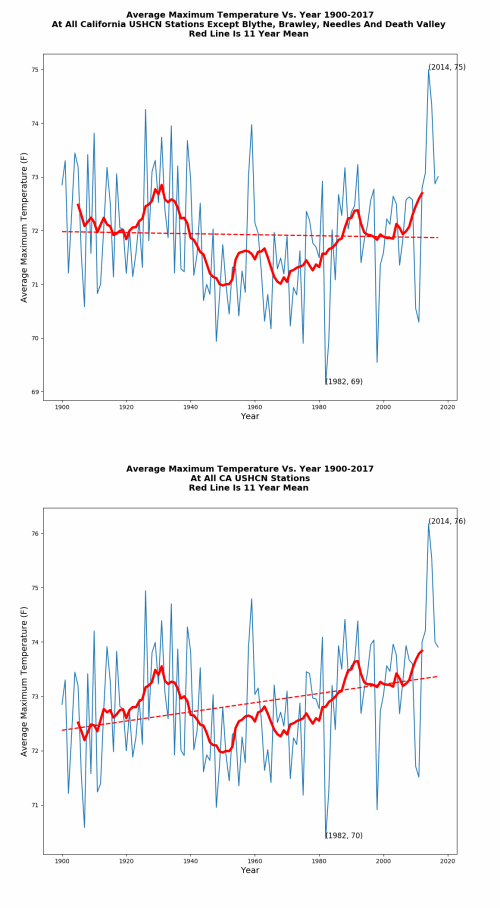

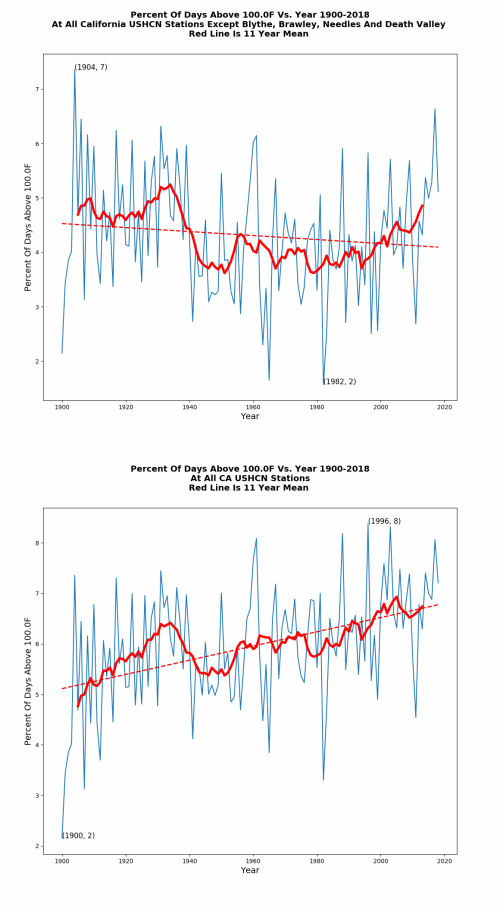
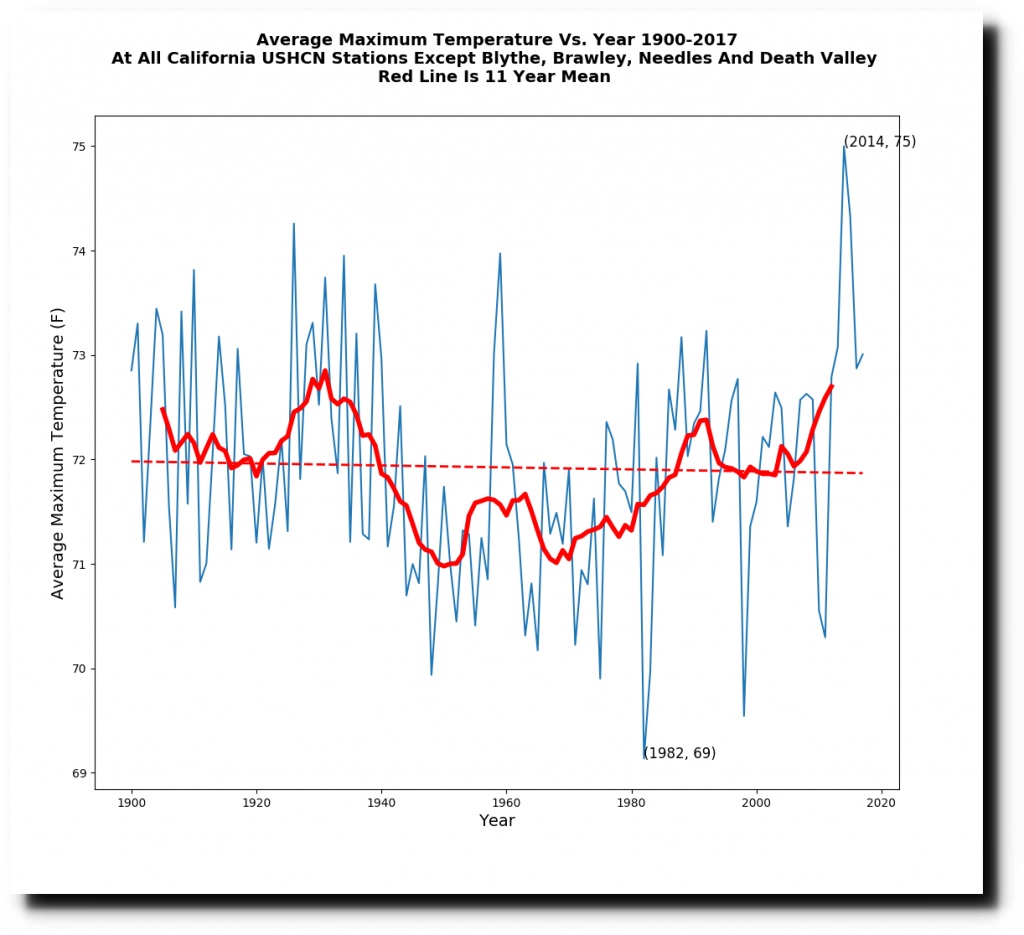
more at link...
https://realclimatescience.com/2018/08/californias-fake-temperature-record/
Plus when we do get hotter in frequently means el nino type rains.
If you study our history... cooler is drier... warmer is wetter....
here is an article you may wish to read...
"But the real dirty trick is that they successively added four hot stations over time, which pushed the temperature up on the right side of the graph. Brawley was added in 1910, Blythe was added in 1913, Needles was added in 1940, and Death Valley was added in 1961. If those stations are removed, then California maximum temperatures show no trend."
more at link...
https://realclimatescience.com/2018/08/californias-fake-temperature-record/
I own 300 acres of relatively untouched land (remnants of a few 1920s tin roof picker's cottages etc. for the citrus farm that surrounded my shady valley) in SoCal.
I don't live there but I pay attention.
Population growth is putting homes in areas that naturally and regularly go on fire, attempts to reduce fires causes buildup of fuel over years. Damned if you do, damned if you don't.
Unless they change the building code to fireproof it will continue. Americans like big cheaply made but still expensive homes, if there was no insurance industry people would build bunkers.
The climate has got way hotter suddenly despite the sun being at is solar minimum etc. in 10 years we are buggered.
I am not sure we are any hotter in CA.
"But the real dirty trick is that they successively added four hot stations over time, which pushed the temperature up on the right side of the graph. Brawley was added in 1910, Blythe was added in 1913, Needles was added in 1940, and Death Valley was added in 1961. If those stations are removed, then California maximum temperatures show no trend."
more at link...
https://realclimatescience.com/2018/08/californias-fake-temperature-record/
As said, you are literally to much of a moron to speak with, like GWB, VZ, Treefrog etc., the gap between what you think you know and the shit you spout can't be closed.
Fake temperature record my ass. That site is PURE FUCKING BOLLOCKS FOR TRICKING GOOGLING RETARDS.
The flat Earthers are missing an idiot.
Last edited: