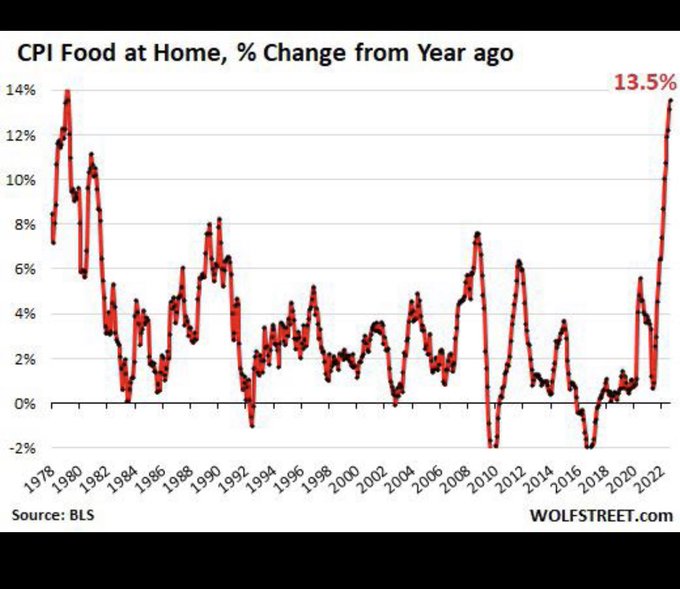
These statements about transitory inflation are bs, it is INFLATION!

You seem to be describing a free market system, however, large amounts of inefficient Government spending and subsidies causes pricing dislocations, including an increase in general inflation rates, that can last for years, if not decades. US government spending has been increasing as a percentage of GDP for a long time, seemingly accelerating in recent years. This is changing the nature of our economic system where the end result is productivity gains become harder to come by resulting in a lower standard of living for more people. This manifests in shortages of goods and higher prices even without sudden shocks to our supply chain. Long term distribution of income statistics seem to support these contentions. So while the long term adjustment mechanism regarding allocation or goods may ultimately be price, subsidies can impact that adjustment process for a long time. Subsidies can also hide some of the adverse effects of Government spending for a long time as well.

Let’s discuss inefficient Government spending in a little more detail. Imagine what could happen if the Government invested or encouraged the investment in multiple, large energy infrastructure projects that ultimately reduced the cost of energy by stabilizing supply and reducing price shocks. The cost of producing energy is more than just the cost of exploration. There are financing costs which can be affected by inflation due to potential changes in monetary policy as recently seen, there are regulatory costs that can affect willingness of energy companies to undertake exploration, and there are public resources that includes Government owned land that can also lower the risks and costs of exploration. Stable energy prices can reduce energy price risk premiums leading to a lower average price of energy needed justifying capital spending in energy projects. Given that current energy costs in manufacturing, transportation, and household expenses are rather high now, what would happen to inflation if these costs were reduced? Now consider the effect of inefficient Government spending such as subsidizes to foreign companies and excessive defense spending for a guns versus butter type of argument.

Bottom line, inefficient Government spending interferes with price discovery, often reduces productivity leading to reduced standard of living for most, and is inherently inflationary in proportion to the amount of spending. No free lunch for everybody, but if we get our energy policy right, we will all benefit.


The problem with your accurate assessment is as I said there will be no change in government spending so the free market we have is the main way price shocks revert. FED's artificial inputs can cause a quicker timeline but U.S. will never stop subsidizing or spending.
 
You seem to be describing a free market system, however, large amounts of inefficient Government spending and subsidies causes pricing dislocations, including an increase in general inflation rates, that can last for years, if not decades. US government spending has been increasing as a percentage of GDP for a long time, seemingly accelerating in recent years. This is changing the nature of our economic system where the end result is productivity gains become harder to come by resulting in a lower standard of living for more people. This manifests in shortages of goods and higher prices even without sudden shocks to our supply chain. Long term distribution of income statistics seem to support these contentions. So while the long term adjustment mechanism regarding allocation or goods may ultimately be price, subsidies can impact that adjustment process for a long time. Subsidies can also hide some of the adverse effects of Government spending for a long time as well.

Let’s discuss inefficient Government spending in a little more detail. Imagine what could happen if the Government invested or encouraged the investment in multiple, large energy infrastructure projects that ultimately reduced the cost of energy by stabilizing supply and reducing price shocks. The cost of producing energy is more than just the cost of exploration. There are financing costs which can be affected by inflation due to potential changes in monetary policy as recently seen, there are regulatory costs that can affect willingness of energy companies to undertake exploration, and there are public resources that includes Government owned land that can also lower the risks and costs of exploration. Stable energy prices can reduce energy price risk premiums leading to a lower average price of energy needed justifying capital spending in energy projects. Given that current energy costs in manufacturing, transportation, and household expenses are rather high now, what would happen to inflation if these costs were reduced? Now consider the effect of inefficient Government spending such as subsidizes to foreign companies and excessive defense spending for a guns versus butter type of argument.

Bottom line, inefficient Government spending interferes with price discovery, often reduces productivity leading to reduced standard of living for most, and is inherently inflationary in proportion to the amount of spending. No free lunch for everybody, but if we get our energy policy right, we will all benefit.

You actually make pretty valid points, good for you, buuuuuuuut the counter to your government spending is look at something like the TVA. The TVA created economic activity and production in areas of this country that were completely ignored by private industry. We still subsidize energy production in America because it makes sense for broad economic growth. Which brings up another point all the virtues of America are not encompassed in economic outputs. It’s important to remember a country is populated by people not factories or firms. Quality of life matters too.

As to increasing government spending as a percent of gdp, minus social security and Medicare it looks much different. As a matter of fact actual investments into things like education has fallen off of a cliff. We argue that the cost of college has gotten out of control but ignore that investment through support for education and direct funding actually decreased as a percentage.

My point is we don’t want to be so pro free market to the point of stupidity. We want the south and Midwest to have electricity and roads. We want an educated population. The return on these investments can far exceed the investment, even if through debt.
 
You actually make pretty valid points, good for you, buuuuuuuut the counter to your government spending is look at something like the TVA. The TVA created economic activity and production in areas of this country that were completely ignored by private industry. We still subsidize energy production in America because it makes sense for broad economic growth. Which brings up another point all the virtues of America are not encompassed in economic outputs. It’s important to remember a country is populated by people not factories or firms. Quality of life matters too.

As to increasing government spending as a percent of gdp, minus social security and Medicare it looks much different. As a matter of fact actual investments into things like education has fallen off of a cliff. We argue that the cost of college has gotten out of control but ignore that investment through support for education and direct funding actually decreased as a percentage.

My point is we don’t want to be so pro free market to the point of stupidity. We want the south and Midwest to have electricity and roads. We want an educated population. The return on these investments can far exceed the investment, even if through debt.

We are not necessarily in disagreement about all Government spending. TVA, Hoover Dam, and the Interstate roadway system are examples for Government projects increasing economic growth potential and raising the standard of living for many. I took the time to define “Inefficient Government spending” by providing examples. I see energy security as economic security and defense preparedness. Recent events in Europe highlight these points immensely.

To add, the way nuclear is done in the US seems grossly inefficient by design in order to avoid the creation of a surplus of energy to the benefit of special interests, notably oil companies, to the detriment of almost every one else. Perhaps a system of Government owned nuclear power plants could be built with rates maintained at levels that do not provide excessive competitive stress to oil producers while providing a reasonable return on taxpayer investment.

The nuclear fuel cycle from enrichment to energy production to waste storage seems grossly inefficient when one visualizes each step of the processes involved. In effect, much of nuclear waste is simply energy being thrown away, especially as our nuclear processing capabilities improve and costs of energy alternatives increase.

A bright future is there for the taking. For all of us. Anyone interested?
 
FcnW_WxagAUb-3s
 
Food CPI is still horrible and I dont see food prices crashing any time soon...

But freight rates from Asia are collapsing at a really fast rate. In one year we went from Asia - Houston of $20,000 to $7500/40'. West Coast has collapsed by a similar magnitude.

Inland trucking rates are still rapey but as the surge of cargo moving from ports to warehouses has slowed since inventories are backing up the trucking rates should start backing off.

Logistics is a huge chunk of the inflationary action in imported goods and raw materials and internally transported goods. There are still issues with chips leading to continued inflation in cars and other products dependent on chips. Food prices are still very high and since we all got to eat, I dont see that changing too fast.

The large oil tanker called inflation is starting to reduce the speed but like all oil tankers going full speed ahaead turning down the engines, they are going to glide with forward momentum for quite some time before slowing down.

Xmas presents in general will be cheaper but we are spending more on food but we are also still making more money. That means the acceleration is reduced but the not reversed.
 
Back
Top