
As I have repeated over and over, QE doesn't do a damn thing to create growth in this world, all it is is an addiction for what they believe to be the answer to all economic problems, collapses, and downfalls and thats where they will all fail, the fed didn't do 1 QE or 2, they did 3 and soon to be 4 and where has it gotten them?? anyone??? absolutely no where...thats right, the economy hasn't gone anywhere, they can't even raise rates by a 1/4 of a percent without putting the economy into a deep recession, that tells you right there just how weak this economy is......europe needs to wake up and realize QE doesn't do anything, its a complete failure and that will be known in due time when the next crisis comes and what they thought was an easy fix to the last crisis was never an actual easy fix, lets make this clear and lout, THERE IS NO FIX, the system needs to reset and fix itself, ....this world is literally on the edge of collapse, to anyone who thinks more QE is the answer and the fix to these economic downfalls is a complete FOOL!!!!
Keep pledging more QE, yes you keep thinking thats the answer......hahaha
ECB's Draghi pledges more QE if needed
Jenny Cosgrave | @jenny_cosgrave
6 Mins AgoCNBC.com
158
SHARES


4
COMMENTSEuro strength puts pressure on Draghi as ECB meets
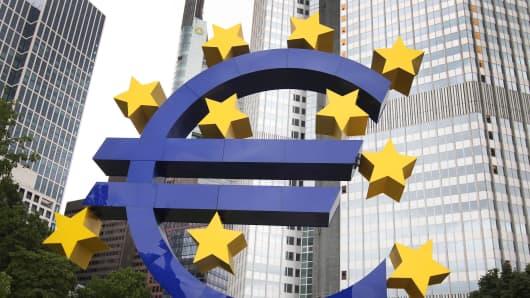
Daniel Roland | AFP | Getty Images
"The Governing Council will closely monitor all relevant incoming information. It emphasized its willingness and ability to act if warranted by using all the instruments available within its mandate and in particular recalls that the asset purchase program provides sufficient flexibility in terms of adjusting the size, composition and duration of the program," Draghi told a news conference.
The central bank also lowered its forecasts for inflation and economic growth on Thursday, citing a slowdown in emerging markets and weaker oil prices.
The ECB sees inflation at 1.1 percent next year, below its June forecast of 1.5 percent, and expects GDP growth in 2016 of 1.7 percent versus its June forecast of 1.9 percent.
A key measure of the market's longer-term inflation expectations, the five-year, five-year euro zone breakeven forward has fallen below 1.7 percent.
Inflation in the 19-country euro zone is currently at 0.2 percent year-on-year and concerns about deflation prompted the ECB to start buying 60 billion euros worth of assets a month earlier this year.
Since the central bank's last gathering in July, financial conditions have tightened, meaning liquidity in financial markets has dried up and the currency bloc's inflation outlook has worsened, following renewed strength in the euro and the continued weakness seen in oil prices.
Earlier on Thursday, the ECB left its main refinancing rate at 0.05 percent at Thursday's meeting. The central bank also kept the rate on bank overnight deposits at -0.20 percent, meaning banks have to pay to keep funds at the central bank, and held its marginal lending facility - or emergency overnight borrowing facility for banks - at 0.30 percent.
The International Monetary Fund on Wednesday urged the world's main central banks to remain accommodative in their approach to monetary policy and suggested the ECB should also expand its program of quantitative easing.
"The program should be extended if there is not sufficient improvement in inflation consistent with meeting medium-term price stability objectives," the IMF said ahead of the ECB's monetary policy meeting Thursday.
Keep pledging more QE, yes you keep thinking thats the answer......hahaha
ECB's Draghi pledges more QE if needed
Jenny Cosgrave | @jenny_cosgrave
6 Mins AgoCNBC.com
158
SHARES
4
COMMENTSEuro strength puts pressure on Draghi as ECB meets
Daniel Roland | AFP | Getty Images
"The Governing Council will closely monitor all relevant incoming information. It emphasized its willingness and ability to act if warranted by using all the instruments available within its mandate and in particular recalls that the asset purchase program provides sufficient flexibility in terms of adjusting the size, composition and duration of the program," Draghi told a news conference.
The central bank also lowered its forecasts for inflation and economic growth on Thursday, citing a slowdown in emerging markets and weaker oil prices.
The ECB sees inflation at 1.1 percent next year, below its June forecast of 1.5 percent, and expects GDP growth in 2016 of 1.7 percent versus its June forecast of 1.9 percent.
A key measure of the market's longer-term inflation expectations, the five-year, five-year euro zone breakeven forward has fallen below 1.7 percent.
Inflation in the 19-country euro zone is currently at 0.2 percent year-on-year and concerns about deflation prompted the ECB to start buying 60 billion euros worth of assets a month earlier this year.
Since the central bank's last gathering in July, financial conditions have tightened, meaning liquidity in financial markets has dried up and the currency bloc's inflation outlook has worsened, following renewed strength in the euro and the continued weakness seen in oil prices.
Earlier on Thursday, the ECB left its main refinancing rate at 0.05 percent at Thursday's meeting. The central bank also kept the rate on bank overnight deposits at -0.20 percent, meaning banks have to pay to keep funds at the central bank, and held its marginal lending facility - or emergency overnight borrowing facility for banks - at 0.30 percent.
The International Monetary Fund on Wednesday urged the world's main central banks to remain accommodative in their approach to monetary policy and suggested the ECB should also expand its program of quantitative easing.
"The program should be extended if there is not sufficient improvement in inflation consistent with meeting medium-term price stability objectives," the IMF said ahead of the ECB's monetary policy meeting Thursday.
