
You are using an out of date browser. It may not display this or other websites correctly.
You should upgrade or use an alternative browser.
You should upgrade or use an alternative browser.
The undoing of Trump's legacy.
- Thread starter Cuddles
- Start date
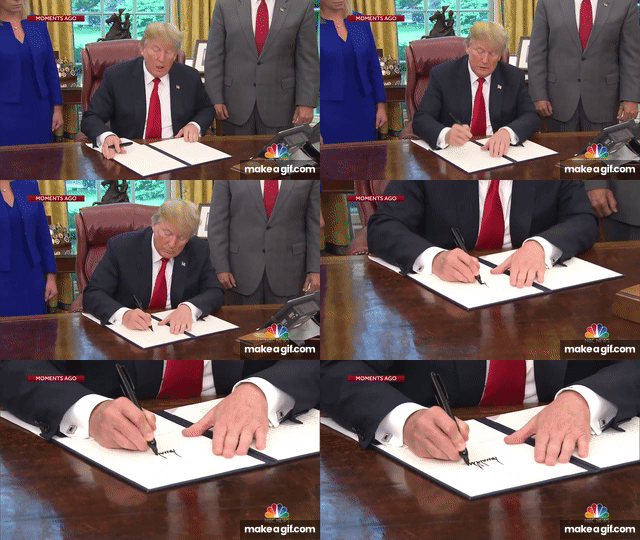

These dumbfuks unironically lambast Biden's flurry of EO's these last 2 months which were made up of basically 90% rescission of their idols' own EOs and other executive actions. I've seen little new policy by EOs so far.
Last edited:
good guy Joe
https://www.wistv.com/2021/02/04/biden-end-us-support-saudi-led-offensive-yemen/
Biden to end US support for Saudi-led offensive in Yemen
(AP) - President Joe Biden announced Thursday the United States was ending support for a grinding five-year Saudi-led military offensive in Yemen that has deepened suffering in the Arabian peninsula’s poorest country, calling the move part of restoring a U.S. emphasis on diplomacy, democracy and human rights.
“The war has created a humanitarian and strategic catastrophe,” Biden told diplomats in his first visit to the State Department as president. “This war has to end.”
The Yemen reversal is one of a series of changes Biden laid out Thursday that he said would be part of a course correction for U.S. foreign policy. That’s after President Donald Trump — and some Republican and Democratic administrations before his — often aided authoritarian leaders abroad in the name of stability.
Regardless of how you feel about endless wars in the ME, this is a win for Iran.
Is Biden going to remove the terrorist designation from the Houthis?
https://www.usnews.com/news/educati...ng-relief-to-defrauded-student-loan-borrowers
Education Department Rescinds Trump-Era Formula Limiting Relief to Defrauded Student Loan Borrowers
A new plan to grant full relief to all borrower defense claims approved to date is expected to extend roughly $1 billion in additional debt relief to 72,000 borrowers.
THE EDUCATION Department announced plans Thursday to rescind the formula established by the Trump administration that provided only partial debt relief to student loan borrowers who were defrauded by their schools.
A new plan to grant full relief to all borrower defense claims approved to date, including for those who already received less than a full loan discharge, is expected to extend roughly $1 billion in additional debt relief to 72,000 borrowers.
"Borrowers deserve a simplified and fair path to relief when they have been harmed by their institution's misconduct," Education Secretary Miguel Cardona said. "A close review of these claims and the associated evidence showed these borrowers have been harmed and we will grant them a fresh start from their debt."
In December 2019, the Trump administration announced a new methodology for processing a backlog of more than 210,000 borrower defense claims – a methodology that limited relief to those who were most seriously harmed and resulted in a large portion of the claims being denied or granted only partial relief. At the time, the new methodology represented a major shift from the more inclusive criteria for relief established by the Obama administration and was just one of several similar efforts to make it more difficult for borrowers who had been defrauded to seek relief.
Six months later, in one of the most egregious examples of those efforts, a whistleblower at the Education Department came forward with evidence of a top political appointee who tried to kill the development of a new website that allowed borrowers who had been defrauded to apply for debt relief, claiming it made the application process too easy.
It's not surprising Cardona and his team moved quickly to reverse course on the methodology established by the previous administration.
Critics of the methodology, including congressional Democrats and Republicans, student loan advocacy groups, veterans groups and higher education policy experts, panned it for intentionally limiting the amount of relief borrowers can receive by lumping them together with borrowers from other schools and drawing on earnings from programs that aren't comparable. The methodology is currently under investigation by the Education Department's Office of Inspector General.
On a press call with reporters Thursday morning, senior Education Department officials said the Trump-era formula created a very difficult if not impossible standard for borrowers to be approved for full relief and in some cases potentially denied relief altogether.
Cardona underscored that Thursday's announcement is just the Education Department's first step in addressing the underlying "borrower defense" regulations established by the Trump administration, which revised the process for how student loan borrowers can seek debt relief if their college or university misled them about things like job placement rates or estimated annual earnings. The rule, finalized last year, makes it more difficult to qualify for relief.
In addition to discharging 100% of borrowers' federal student loans, Education Department officials said Thursday that the department will also reimburse any amounts paid on the loan, request credit bureaus to remove any related negative credit reporting and reinstate federal student aid eligibility.
The new policy will be implemented immediately, Education Department officials added, and affected borrowers will receive notices from the department over the next several weeks with discharges following after that
Education Department Rescinds Trump-Era Formula Limiting Relief to Defrauded Student Loan Borrowers
A new plan to grant full relief to all borrower defense claims approved to date is expected to extend roughly $1 billion in additional debt relief to 72,000 borrowers.
THE EDUCATION Department announced plans Thursday to rescind the formula established by the Trump administration that provided only partial debt relief to student loan borrowers who were defrauded by their schools.
A new plan to grant full relief to all borrower defense claims approved to date, including for those who already received less than a full loan discharge, is expected to extend roughly $1 billion in additional debt relief to 72,000 borrowers.
"Borrowers deserve a simplified and fair path to relief when they have been harmed by their institution's misconduct," Education Secretary Miguel Cardona said. "A close review of these claims and the associated evidence showed these borrowers have been harmed and we will grant them a fresh start from their debt."
In December 2019, the Trump administration announced a new methodology for processing a backlog of more than 210,000 borrower defense claims – a methodology that limited relief to those who were most seriously harmed and resulted in a large portion of the claims being denied or granted only partial relief. At the time, the new methodology represented a major shift from the more inclusive criteria for relief established by the Obama administration and was just one of several similar efforts to make it more difficult for borrowers who had been defrauded to seek relief.
Six months later, in one of the most egregious examples of those efforts, a whistleblower at the Education Department came forward with evidence of a top political appointee who tried to kill the development of a new website that allowed borrowers who had been defrauded to apply for debt relief, claiming it made the application process too easy.
It's not surprising Cardona and his team moved quickly to reverse course on the methodology established by the previous administration.
Critics of the methodology, including congressional Democrats and Republicans, student loan advocacy groups, veterans groups and higher education policy experts, panned it for intentionally limiting the amount of relief borrowers can receive by lumping them together with borrowers from other schools and drawing on earnings from programs that aren't comparable. The methodology is currently under investigation by the Education Department's Office of Inspector General.
On a press call with reporters Thursday morning, senior Education Department officials said the Trump-era formula created a very difficult if not impossible standard for borrowers to be approved for full relief and in some cases potentially denied relief altogether.
Cardona underscored that Thursday's announcement is just the Education Department's first step in addressing the underlying "borrower defense" regulations established by the Trump administration, which revised the process for how student loan borrowers can seek debt relief if their college or university misled them about things like job placement rates or estimated annual earnings. The rule, finalized last year, makes it more difficult to qualify for relief.
In addition to discharging 100% of borrowers' federal student loans, Education Department officials said Thursday that the department will also reimburse any amounts paid on the loan, request credit bureaus to remove any related negative credit reporting and reinstate federal student aid eligibility.
The new policy will be implemented immediately, Education Department officials added, and affected borrowers will receive notices from the department over the next several weeks with discharges following after that
Last edited:
https://www.cnn.com/2021/03/19/poli...ain-in-mexico-biden-administration/index.html
Biden administration prepares to expand phased entry of migrants forced to stay in Mexico under Trump-era policy
https://www.cnn.com/profiles/priscilla-alvarez
(CNN)The Biden administration is preparing to expand the phased entry of migrants who were forced to stay in Mexico under a Trump-era policy to two additional ports of entry, the Department of Homeland Security told CNN on Friday.
"Beginning next week, after registering virtually and being tested for COVID-19 at staging sites in Mexico, approved individuals with active (Migrant Protection Protocol) cases will be processed at the Hidalgo, TX port of entry," the department said in a statement, adding that processing will also start in Laredo, Texas, thereafter.
The effort is specific to migrants who fall under the so-called remain in Mexico policy. Three other locations have already been allowing the entry of migrants under the program.
Under former President Donald Trump, the US forced migrants from Central America and other parts of the world who were seeking asylum at the southern border to stay in Mexico until their immigration court hearings in the US. More than 70,000 people were subject to the program. Many waited months, if not years, in squalid conditions and under the threat of extortion, sexual assault and kidnapping.
President Joe Biden ended the program, formally known as Migrant Protection Protocols, and kick-started the process of allowing gradual entry of those subject to the policy. For months, officials meticulously planned the rollback of the policy and engaged with immigrant advocacy organizations along the border that have directly worked with migrants.
The Biden administration has since estimated that some 25,000 migrants still have active cases. That group will be eligible for the first phase of the rollback. The administration started the gradual entry of migrants at three ports of entry -- in San Diego and in El Paso and Brownsville, Texas -- last month.
Biden administration prepares to expand phased entry of migrants forced to stay in Mexico under Trump-era policy
https://www.cnn.com/profiles/priscilla-alvarez
(CNN)The Biden administration is preparing to expand the phased entry of migrants who were forced to stay in Mexico under a Trump-era policy to two additional ports of entry, the Department of Homeland Security told CNN on Friday.
"Beginning next week, after registering virtually and being tested for COVID-19 at staging sites in Mexico, approved individuals with active (Migrant Protection Protocol) cases will be processed at the Hidalgo, TX port of entry," the department said in a statement, adding that processing will also start in Laredo, Texas, thereafter.
The effort is specific to migrants who fall under the so-called remain in Mexico policy. Three other locations have already been allowing the entry of migrants under the program.
Under former President Donald Trump, the US forced migrants from Central America and other parts of the world who were seeking asylum at the southern border to stay in Mexico until their immigration court hearings in the US. More than 70,000 people were subject to the program. Many waited months, if not years, in squalid conditions and under the threat of extortion, sexual assault and kidnapping.
President Joe Biden ended the program, formally known as Migrant Protection Protocols, and kick-started the process of allowing gradual entry of those subject to the policy. For months, officials meticulously planned the rollback of the policy and engaged with immigrant advocacy organizations along the border that have directly worked with migrants.
The Biden administration has since estimated that some 25,000 migrants still have active cases. That group will be eligible for the first phase of the rollback. The administration started the gradual entry of migrants at three ports of entry -- in San Diego and in El Paso and Brownsville, Texas -- last month.
https://www.usnews.com/news/educati...ng-relief-to-defrauded-student-loan-borrowers
Education Department Rescinds Trump-Era Formula Limiting Relief to Defrauded Student Loan Borrowers
A new plan to grant full relief to all borrower defense claims approved to date is expected to extend roughly $1 billion in additional debt relief to 72,000 borrowers.
THE EDUCATION Department announced plans Thursday to rescind the formula established by the Trump administration that provided only partial debt relief to student loan borrowers who were defrauded by their schools.
A new plan to grant full relief to all borrower defense claims approved to date, including for those who already received less than a full loan discharge, is expected to extend roughly $1 billion in additional debt relief to 72,000 borrowers.
"Borrowers deserve a simplified and fair path to relief when they have been harmed by their institution's misconduct," Education Secretary Miguel Cardona said. "A close review of these claims and the associated evidence showed these borrowers have been harmed and we will grant them a fresh start from their debt."
In December 2019, the Trump administration announced a new methodology for processing a backlog of more than 210,000 borrower defense claims – a methodology that limited relief to those who were most seriously harmed and resulted in a large portion of the claims being denied or granted only partial relief. At the time, the new methodology represented a major shift from the more inclusive criteria for relief established by the Obama administration and was just one of several similar efforts to make it more difficult for borrowers who had been defrauded to seek relief.
Six months later, in one of the most egregious examples of those efforts, a whistleblower at the Education Department came forward with evidence of a top political appointee who tried to kill the development of a new website that allowed borrowers who had been defrauded to apply for debt relief, claiming it made the application process too easy.
It's not surprising Cardona and his team moved quickly to reverse course on the methodology established by the previous administration.
Critics of the methodology, including congressional Democrats and Republicans, student loan advocacy groups, veterans groups and higher education policy experts, panned it for intentionally limiting the amount of relief borrowers can receive by lumping them together with borrowers from other schools and drawing on earnings from programs that aren't comparable. The methodology is currently under investigation by the Education Department's Office of Inspector General.
On a press call with reporters Thursday morning, senior Education Department officials said the Trump-era formula created a very difficult if not impossible standard for borrowers to be approved for full relief and in some cases potentially denied relief altogether.
Cardona underscored that Thursday's announcement is just the Education Department's first step in addressing the underlying "borrower defense" regulations established by the Trump administration, which revised the process for how student loan borrowers can seek debt relief if their college or university misled them about things like job placement rates or estimated annual earnings. The rule, finalized last year, makes it more difficult to qualify for relief.
In addition to discharging 100% of borrowers' federal student loans, Education Department officials said Thursday that the department will also reimburse any amounts paid on the loan, request credit bureaus to remove any related negative credit reporting and reinstate federal student aid eligibility.
The new policy will be implemented immediately, Education Department officials added, and affected borrowers will receive notices from the department over the next several weeks with discharges following after that
https://lawandcrime.com/high-profil...sy-devos-against-ripped-off-college-students/
Biden Admin Teams Up with Ex-Trump DOJ Official to Defend Betsy DeVos Against Ripped-Off College Students
The U.S. Department of Justice (DOJ) under President Joe Biden is going to the mat for former secretary of education Betsy DeVos.
In a Monday filing with the U.S. District Court for the Southern District of Florida, Acting Assistant Attorney General Brian Boynton and other DOJ attorneys argued that students who were ripped off by for-profit scam colleges cannot depose the former Trump-era official.
“The [students’] demand for a former cabinet official’s deposition is extraordinary, unnecessary, and unsupported,” the filing alleges. “It is a transparent attempt at harassment—part of a PR campaign that has been central to [the students’] litigation strategy from the outset. It should be rejected and the court should quash the subpoena.”
Making common cause with the DOJ in the motion to quash is another Trump-era official: former acting associate attorney general Jesse Panuccio. Now an attorney with elite law firm Boies Schiller Flexner LLP, Panuccio is acting as DeVos’s personal attorney “and is represented in her capacity as former U.S. Secretary of Education by the U.S. Department of Justice,” the filing explains in a footnote.
As a matter of law, the Biden administration does not have to take on DeVos’s representation here. The DOJ picks and chooses whether to represent present and former officials—but they are not bound by any rules, regulations or federal statues to do so. Additionally, there does not appear to be any extant legal authority for the DOJ to represent DeVos here in her personal capacity because she’s not actually a party to the underlying litigation. In order for DOJ to represent DeVos like this, the agency is supposed to initially file a statement of interest but no such document has been filed in the case.
The underlying case concerns hundreds of students who were defrauded by various for-profit colleges across the country. The students, all federal student loan borrowers who are currently in debt, sued the U.S. Department of Education because DeVos’s agency was accused of serially dragging its feet when asked to process student loan debt cancellation requests.
Multiple courts in the Northern District of California agreed with the students. DeVos herself ultimately admitted that student borrowers had paid for educational programs that were effectively “worthless.”
Still, DeVos continued to collect student loan payments from some 75,000 defrauded students who attended classes at the Corinthian Colleges chain. In May 2018, U.S. Magistrate Judge for the Northern District of California Sallie Kim barred the Department of Education from collecting payments on those student loans in the case stylized as Martin Manriquez v. Elisabeth DeVos.
After that, DeVos and the Department of Education continued to try and collect on thousands of those loans—eventually being found in violation of a court order. The Department of Education later admitted to “erroneously” violating that court order.
After being forced to reconsider student debt cancellation requests, DeVos’s agency took their time—ignoring new requests for some 18 months. A different group of students sued, alleging DeVos’s “delay to be unlawful stonewalling.” Judge Kim certified those students as a class in Oct. 2019.
Now those students want DeVos to sit for a deposition. That request was recently signed off on by U.S. District Judge William Alsup.
As Republic Report journalist David Halperin noted in that outlet’s original reporting, DeVos was subpoenaed on Jan. 26—some 19 days after she resigned. But the motion to quash offers a notable timeline: DeVos formally tendered her resignation the day after she was alerted that the students were intent on having her deposed. DeVos submitted her resignation on Jan. 7—the day after the Capitol siege. She blamed Trump’s “rhetoric” for the impacting the mob and the “situation.”
But the Biden administration and DeVos’s private counsel have other plans. In their motion, Boynton and Panuccio criticize the district court for its orders and accuse the students and their attorneys of being little more than media hounds intent on harassment.
“Plaintiffs appear to be more interested in the deposition itself (and the press attention that might come with it) than in the information they claim to seek,” the DOJ motion alleges.
The Biden administration DOJ repeatedly takes issue with a press release issued by the students’ lawyers after Judge Alsup okayed the DeVos deposition.
“Plaintiffs rebuffed Defendants’ offers to explore alternative sources, and instead hastily rushed to the district court in the underlying action (overlooking the need for a Rule 45 subpoena) to try to secure their sought-after deposition while also filing a celebratory press release,” the motion notes at one point.
The DOJ criticizes the press release again in a section complaining that the students declined to wait for the conclusion of an internal Department of Education investigation before filing: “Plaintiffs waited less than five hours before filing their request for the former Secretary’s deposition—followed by a celebratory press release.”
A lengthy footnote critiques the press release further:
In that press release, class counsel frankly reveal that they view a deposition of the former Secretary as necessary because she allegedly has a generalized “obligation to explain why defrauded student borrowers were ignored for years by the Education Department and then summarily denied their rights.” But the APA creates no such legal obligation, an dthe press release’s statement stands in stark contrast to Plaintiffs’ claim to the district court that they merely seek narrow categories of information that is unavailable from other sources. And, of course, the press release shows that Plaintiffs’ counsel is seeking, through this high-profile deposition, to get much more than the only thing sought in the Complaint: a “simple” order compelling the Department [of Education] to “start granting or denying their borrower defenses.”
A source familiar with the litigation said the language used by the DOJ in the motion to quash was unusually harsh and striking. They questioned the decision to cast admittedly defrauded students as harassers trying to attain a PR coup—as well as the general decision by the Biden administration to defend DeVos in the first place.
Jeff Hauser, an attorney and the executive director of the Revolving Door Project—an offshoot of the left-wing Center for Economic and Policy Research think tank—told Law&Crime that the decision to defend former executive branch officials is not entirely unlike a norm that should have lapsed when DeVos quit her job.
“My understanding is that it is a (problematic) norm if she were still Secretary and not a norm now that she is not,” Hauser said. “And we also think that figures like Trump and DeVos long ago forfeited the benefit of such norms.”
Some have questioned whether the abrasive motion was written by DeVos’s counsel and then signed off on by government line attorneys and the acting attorney general after a cursory read-through.
The motion to quash the subpoena was jointly authored by Obama administration alum Boynton and Panuccio as well as DOJ attorneys Marcia Berman, R. Charlie Merritt and Kevin P. Hancock.
The subpoena itself notes that the deposition is ” to be conducted via remote technology, with witness located in Vero Beach, Florida,” which is how the government and DeVos managed to file their stonewalling effort in the notoriously anti-government transparency Southern District of Florida.
The students, for their part, are hoping to get the case back where they say it belongs—which also happens to be much-friendlier ground.
“We will seek transfer of DeVos’s motion to quash to the appropriate court in California where we will continue to press for her deposition,” Eileen Connor, the legal director for the Project on Predatory Student Lending at the Legal Services Center of Harvard Law School and one of the students’ attorneys, told Law&Crime.
Read the joint DeVos-DOJ motion below:
I don't like they did cover for Ditzy DeVos, but this is a solid move
https://www.axios.com/defrauded-stu...ges-707774cd-8f7e-4c06-9a92-1902dd170b97.html
Defrauded students to receive loan forgiveness
Students who were defrauded by for-profit colleges will have their federal school loans eliminated, the Education Department announced on Thursday.
Why it matters: The change will eliminate approximately $1 billion in student loan debt for 72,000 borrowers who filed claims, AP reports.
- Debts of students whose claims were already approved will be erased.
- The department will also review backlogged cases and re-evaluate cases that were denied.
- Students who received partial credits from these universities will also be reimbursed for any payments already made on the loans, again be eligible for federal student aid and have any negative ratings resulting from loan repayments removed by credit bureaus.
Driving the news: Former Secretary of Education Betsy DeVos revised the program to tightened debt forgiveness during the Trump administration, Congress tried to overturn the changes last March, but former President Trump vetoed the measure.
https://www.cnn.com/2021/03/22/politics/biden-health-care-trump-affordable-care-act/index.html
Biden moves rapidly to shore up Obamacare and erase Trump's changes
Biden moves rapidly to shore up Obamacare and erase Trump's changes
https://www.nytimes.com/2021/03/27/business/biden-taxes-business-rich.html
Under Biden, Democrats Are Poised to Raise Taxes on Business and the Rich
The president’s infrastructure proposals are likely to require trillions of dollars in new tax revenue. They also give liberals a chance to address what they call the failures of Republican tax cuts.
WASHINGTON — Democrats have spent the last several years clamoring to raise taxes on corporations and the rich, seeing that as a necessary antidote to widening economic inequality and a rebuke of President Donald J. Trump’s signature tax cuts.
Now, under President Biden, they have a shot at ushering in the largest federal tax increase since 1942. It could help pay for a host of spending programs that liberal economists predict would bolster the economy’s performance and repair a tax code that Democrats say encourages wealthy people to hoard assets and big companies to ship jobs and book profits overseas.
The question is whether congressional Democrats and the White House can agree on how sharply taxes should rise and who, exactly, should pay the bill. They widely share the goal of reversing many of Mr. Trump’s tax cuts from 2017, and of making the wealthy and big businesses pay more. But they do not yet agree on the details — and because Republicans are unlikely to support their efforts, they have no room for error in a closely divided Senate.
For Mr. Biden, the need to find consensus is urgent. The president is set to travel to Pittsburgh on Wednesday to unveil the next phase of his economic agenda — a sprawling collection of programs that would invest in infrastructure, education, carbon-reduction and working mothers and cost $3 trillion to $4 trillion.
The package, which follows on the heels of Mr. Biden’s $1.9 trillion economic aid bill, is central to the president’s long-term plan to revitalize American workers and industry by funding bridges and roads, universal pre-K, emerging industries like advanced batteries and efforts to invigorate the fight against climate change.
Mr. Biden plans to finance that spending, at least in part, with tax increases that could raise upward of $2.5 trillion in revenue if his plan hews closely to what he proposed in the 2020 presidential campaign. Aides suggest his proposals might not be entirely paid for, with some one-time spending increases offset by increased federal borrowing.
“I think what you’re going to see is the administration is going to put a pay-for on the table for at least some and maybe all of the infrastructure plan,” said Senator Tim Kaine, Democrat of Virginia. “If Team Biden makes a proposal, I’m sure we’ll make adjustments but that’s a good way to start.”
Others in his party, including his own transportation secretary, have pushed Mr. Biden to explore tax plans he did not campaign on, like taxing consumption, wealth or vehicle miles traveled. Mr. Biden has stressed his broad-brush desire to increase the tax burden on wealthy Americans who largely earn their money through inheritance or investment, to fund spending programs meant to help people who earn their money primarily through wages.
“I want to change the paradigm,” Mr. Biden said Thursday during a news conference. “We start to reward work, not just wealth.”
Democratic lawmakers have promised for decades to raise taxes on companies and the wealthy, a desire that kicked into overdrive after Mr. Trump signed a tax-cut package that delivered an outsize share of its benefits to corporations and high earners. But they have struggled to muster the votes for large tax increases since President Bill Clinton signed a 1993 law that included a variety of hikes intended to help reduce the budget deficit. Business groups, conservative activists, lobbyists and donors across the ideological spectrum have largely blocked such attempts.
President Barack Obama campaigned on ending tax cuts for the rich signed into law by President George W. Bush, but after the 2008 financial crisis, he cut deals with Republicans to extend those cuts, before allowing some of them to expire at the end of 2012.
Liberal economists say this year could be different, thanks to the unique political and economic circumstances surrounding the recovery from the pandemic recession. With Mr. Biden’s signing of a $1.9 trillion economic relief bill, financed entirely by federal borrowing, forecasters now expect the economy to grow this year at its fastest annual clip since the 1980s. Republicans and some economists have begun to warn of overheating growth spurring runaway inflation, which could reduce the salience of warnings that tax increases would cause growth to stall.
Public polling shows broad support, even among many Republican voters, for raising taxes on large corporations and high-income individuals. The most conservative Democrats in the Senate, who hold great sway over Mr. Biden’s legislative agenda, say they favor trillions of dollars in infrastructure spending so long as there is a plan to pay for it.
That includes Senator Joe Manchin III, of West Virginia, who told reporters this week that Mr. Biden’s infrastructure plan was “going to be enormous” and that its costs needed to be covered. He signaled openness to making changes to the 2017 tax overhaul, adding that the benefits in that legislation were “weighted in one direction to the upper end.”
“Where do they think it’s going to come from? How are they going to fix America?” he said, when asked about Republican resistance to tax increases. “I don’t think that’s reasonable.”
Democrats widely share a desire to raise the corporate income tax rate after it was cut to 21 percent in 2017. And they want to raise the top marginal rate for individuals back to 39.6 percent from 37 percent.
But there are disputes in the rank and file, with some favoring Mr. Biden’s plan to set the corporate rate at 28 percent and others preferring a lower one, like 25 percent. There are also questions over which high-earning individuals should see a tax increase.
Mr. Biden has pledged not to raise taxes on people earning less than $400,000. Some of his progressive allies, including Senators Bernie Sanders of Vermont and Elizabeth Warren of Massachusetts, have advocated raising taxes on a broader group. Democrats like Mr. Manchin have pushed him to consider additional tax plans that do not solely target the rich, like a European-style tax on consumption, though that type of tax could fall more heavily on low-income Americans than wealthy ones.
ImageDemocrats, who have promised for decades to raise taxes on companies and the wealthy, have struggled to muster the votes for large tax increases.
Democrats, who have promised for decades to raise taxes on companies and the wealthy, have struggled to muster the votes for large tax increases.Credit...Stefani Reynolds for The New York Times
Republicans are unlikely to support any plan to raise taxes, leaving administration officials and leading congressional Democrats to hammer out a plan on their own. But absent Republican support in the Senate, where both parties hold 50 seats and Vice President Kamala Harris can break ties, Democrats would need to secure total consensus within their caucus to pass the legislation and use a fast-track budget process known as reconciliation to bypass the 60-vote threshold for ending a filibuster.
Business groups and Republican lawmakers, who supported the 2017 tax cuts, predict that any tax increase will slow economic growth and undermine the competitiveness of American companies. They contend that the economic and wage growth in the run-up to the pandemic prove that Mr. Trump’s tax cuts worked, an argument Mr. Biden’s advisers reject, citing research from the International Monetary Fund and others.
“He wants a massive tax increase and he wants to allocate the tax responsibility in this country, on the basis of class,” said Senator John Kennedy, Republican of Louisiana. “That’s a hell of a way to make tax policy. Sound tax policy is made on the basis of economics.”
Republicans who favor some form of an infrastructure bill have struggled to offer alternative ways to fund such an undertaking, which they argue should be significantly smaller than what Mr. Biden has floated. Some, however, are noodling on tax changes should a bipartisan plan emerge. Senator Shelley Moore Capito of West Virginia, the top Republican on the Senate Committee on Environment and Public Works, said this week that her committee would examine changes to the gas tax, or a related tax that also charges a fee to users of electric vehicles, as discussions continue about a funding mechanism.
Many liberal economists say there are good reasons to raise taxes, starting with using those funds to invest in workers and help build economic opportunity. Spending on physical infrastructure, like roads and water pipes, or on programs like education and child care that are meant to help people earn more money could help curb persistent inequalities in income and wealth. The economists also say that tax increases that are properly set up would provide incentives for multinational companies to keep jobs in the United States and not shift profits to lower-tax foreign countries.
“The purpose of the tax system is to both raise enough revenue for what the government wants to do, and to make sure that as we’re doing that we are encouraging activities that are in the national interest and discouraging ones that are not,” said Heather Boushey, a member of the White House’s Council of Economic Advisers.
Key Democrats are trying to bring the party to consensus. The top tax writer in the Senate, Ron Wyden of Oregon, is drafting a series of bills to raise taxes, many of them overlapping with Mr. Biden’s campaign proposals.
“I’ll be ready to raise what the Democratic caucus decides is required to move forward,” Mr. Wyden, the chairman of the Senate Finance Committee, said in an interview.
Mr. Wyden’s plans include big changes to the portions of Mr. Trump’s tax cuts that overhauled how the United States taxes multinational companies, including the creation of a minimum tax of sorts on income earned abroad. Mr. Wyden and many Democratic economists, including some inside the Biden administration, say that the tax was devised in a way that it ultimately incentivized companies to continue moving profits and activities offshore to avoid American taxes. Republican economists and some tax experts disagree and say the law has allowed U.S. companies to better compete globally.
A report from the congressional Joint Committee on Taxation this month showed that multinational companies paid an average U.S. tax rate of less than 8 percent on their income in 2018, down from 16 percent in 2017. The report also found that those companies did not slow their practice of booking profits in low-tax havens like Bermuda.
Mr. Biden, Mr. Wyden and Mr. Sanders have all drafted plans to raise revenues by amending the 2017 law to force multinational companies to pay more to the United States. One of the most lucrative ways to do that, according to tax scorekeepers, would be to increase the rate of the global minimum tax, forcing those companies to pay higher U.S. tax rates no matter where they locate jobs or profits.
Under Biden, Democrats Are Poised to Raise Taxes on Business and the Rich
The president’s infrastructure proposals are likely to require trillions of dollars in new tax revenue. They also give liberals a chance to address what they call the failures of Republican tax cuts.
WASHINGTON — Democrats have spent the last several years clamoring to raise taxes on corporations and the rich, seeing that as a necessary antidote to widening economic inequality and a rebuke of President Donald J. Trump’s signature tax cuts.
Now, under President Biden, they have a shot at ushering in the largest federal tax increase since 1942. It could help pay for a host of spending programs that liberal economists predict would bolster the economy’s performance and repair a tax code that Democrats say encourages wealthy people to hoard assets and big companies to ship jobs and book profits overseas.
The question is whether congressional Democrats and the White House can agree on how sharply taxes should rise and who, exactly, should pay the bill. They widely share the goal of reversing many of Mr. Trump’s tax cuts from 2017, and of making the wealthy and big businesses pay more. But they do not yet agree on the details — and because Republicans are unlikely to support their efforts, they have no room for error in a closely divided Senate.
For Mr. Biden, the need to find consensus is urgent. The president is set to travel to Pittsburgh on Wednesday to unveil the next phase of his economic agenda — a sprawling collection of programs that would invest in infrastructure, education, carbon-reduction and working mothers and cost $3 trillion to $4 trillion.
The package, which follows on the heels of Mr. Biden’s $1.9 trillion economic aid bill, is central to the president’s long-term plan to revitalize American workers and industry by funding bridges and roads, universal pre-K, emerging industries like advanced batteries and efforts to invigorate the fight against climate change.
Mr. Biden plans to finance that spending, at least in part, with tax increases that could raise upward of $2.5 trillion in revenue if his plan hews closely to what he proposed in the 2020 presidential campaign. Aides suggest his proposals might not be entirely paid for, with some one-time spending increases offset by increased federal borrowing.
“I think what you’re going to see is the administration is going to put a pay-for on the table for at least some and maybe all of the infrastructure plan,” said Senator Tim Kaine, Democrat of Virginia. “If Team Biden makes a proposal, I’m sure we’ll make adjustments but that’s a good way to start.”
Others in his party, including his own transportation secretary, have pushed Mr. Biden to explore tax plans he did not campaign on, like taxing consumption, wealth or vehicle miles traveled. Mr. Biden has stressed his broad-brush desire to increase the tax burden on wealthy Americans who largely earn their money through inheritance or investment, to fund spending programs meant to help people who earn their money primarily through wages.
“I want to change the paradigm,” Mr. Biden said Thursday during a news conference. “We start to reward work, not just wealth.”
Democratic lawmakers have promised for decades to raise taxes on companies and the wealthy, a desire that kicked into overdrive after Mr. Trump signed a tax-cut package that delivered an outsize share of its benefits to corporations and high earners. But they have struggled to muster the votes for large tax increases since President Bill Clinton signed a 1993 law that included a variety of hikes intended to help reduce the budget deficit. Business groups, conservative activists, lobbyists and donors across the ideological spectrum have largely blocked such attempts.
President Barack Obama campaigned on ending tax cuts for the rich signed into law by President George W. Bush, but after the 2008 financial crisis, he cut deals with Republicans to extend those cuts, before allowing some of them to expire at the end of 2012.
Liberal economists say this year could be different, thanks to the unique political and economic circumstances surrounding the recovery from the pandemic recession. With Mr. Biden’s signing of a $1.9 trillion economic relief bill, financed entirely by federal borrowing, forecasters now expect the economy to grow this year at its fastest annual clip since the 1980s. Republicans and some economists have begun to warn of overheating growth spurring runaway inflation, which could reduce the salience of warnings that tax increases would cause growth to stall.
Public polling shows broad support, even among many Republican voters, for raising taxes on large corporations and high-income individuals. The most conservative Democrats in the Senate, who hold great sway over Mr. Biden’s legislative agenda, say they favor trillions of dollars in infrastructure spending so long as there is a plan to pay for it.
That includes Senator Joe Manchin III, of West Virginia, who told reporters this week that Mr. Biden’s infrastructure plan was “going to be enormous” and that its costs needed to be covered. He signaled openness to making changes to the 2017 tax overhaul, adding that the benefits in that legislation were “weighted in one direction to the upper end.”
“Where do they think it’s going to come from? How are they going to fix America?” he said, when asked about Republican resistance to tax increases. “I don’t think that’s reasonable.”
Democrats widely share a desire to raise the corporate income tax rate after it was cut to 21 percent in 2017. And they want to raise the top marginal rate for individuals back to 39.6 percent from 37 percent.
But there are disputes in the rank and file, with some favoring Mr. Biden’s plan to set the corporate rate at 28 percent and others preferring a lower one, like 25 percent. There are also questions over which high-earning individuals should see a tax increase.
Mr. Biden has pledged not to raise taxes on people earning less than $400,000. Some of his progressive allies, including Senators Bernie Sanders of Vermont and Elizabeth Warren of Massachusetts, have advocated raising taxes on a broader group. Democrats like Mr. Manchin have pushed him to consider additional tax plans that do not solely target the rich, like a European-style tax on consumption, though that type of tax could fall more heavily on low-income Americans than wealthy ones.
ImageDemocrats, who have promised for decades to raise taxes on companies and the wealthy, have struggled to muster the votes for large tax increases.
Democrats, who have promised for decades to raise taxes on companies and the wealthy, have struggled to muster the votes for large tax increases.Credit...Stefani Reynolds for The New York Times
Republicans are unlikely to support any plan to raise taxes, leaving administration officials and leading congressional Democrats to hammer out a plan on their own. But absent Republican support in the Senate, where both parties hold 50 seats and Vice President Kamala Harris can break ties, Democrats would need to secure total consensus within their caucus to pass the legislation and use a fast-track budget process known as reconciliation to bypass the 60-vote threshold for ending a filibuster.
Business groups and Republican lawmakers, who supported the 2017 tax cuts, predict that any tax increase will slow economic growth and undermine the competitiveness of American companies. They contend that the economic and wage growth in the run-up to the pandemic prove that Mr. Trump’s tax cuts worked, an argument Mr. Biden’s advisers reject, citing research from the International Monetary Fund and others.
“He wants a massive tax increase and he wants to allocate the tax responsibility in this country, on the basis of class,” said Senator John Kennedy, Republican of Louisiana. “That’s a hell of a way to make tax policy. Sound tax policy is made on the basis of economics.”
Republicans who favor some form of an infrastructure bill have struggled to offer alternative ways to fund such an undertaking, which they argue should be significantly smaller than what Mr. Biden has floated. Some, however, are noodling on tax changes should a bipartisan plan emerge. Senator Shelley Moore Capito of West Virginia, the top Republican on the Senate Committee on Environment and Public Works, said this week that her committee would examine changes to the gas tax, or a related tax that also charges a fee to users of electric vehicles, as discussions continue about a funding mechanism.
Many liberal economists say there are good reasons to raise taxes, starting with using those funds to invest in workers and help build economic opportunity. Spending on physical infrastructure, like roads and water pipes, or on programs like education and child care that are meant to help people earn more money could help curb persistent inequalities in income and wealth. The economists also say that tax increases that are properly set up would provide incentives for multinational companies to keep jobs in the United States and not shift profits to lower-tax foreign countries.
“The purpose of the tax system is to both raise enough revenue for what the government wants to do, and to make sure that as we’re doing that we are encouraging activities that are in the national interest and discouraging ones that are not,” said Heather Boushey, a member of the White House’s Council of Economic Advisers.
Key Democrats are trying to bring the party to consensus. The top tax writer in the Senate, Ron Wyden of Oregon, is drafting a series of bills to raise taxes, many of them overlapping with Mr. Biden’s campaign proposals.
“I’ll be ready to raise what the Democratic caucus decides is required to move forward,” Mr. Wyden, the chairman of the Senate Finance Committee, said in an interview.
Mr. Wyden’s plans include big changes to the portions of Mr. Trump’s tax cuts that overhauled how the United States taxes multinational companies, including the creation of a minimum tax of sorts on income earned abroad. Mr. Wyden and many Democratic economists, including some inside the Biden administration, say that the tax was devised in a way that it ultimately incentivized companies to continue moving profits and activities offshore to avoid American taxes. Republican economists and some tax experts disagree and say the law has allowed U.S. companies to better compete globally.
A report from the congressional Joint Committee on Taxation this month showed that multinational companies paid an average U.S. tax rate of less than 8 percent on their income in 2018, down from 16 percent in 2017. The report also found that those companies did not slow their practice of booking profits in low-tax havens like Bermuda.
Mr. Biden, Mr. Wyden and Mr. Sanders have all drafted plans to raise revenues by amending the 2017 law to force multinational companies to pay more to the United States. One of the most lucrative ways to do that, according to tax scorekeepers, would be to increase the rate of the global minimum tax, forcing those companies to pay higher U.S. tax rates no matter where they locate jobs or profits.
good, get these incompetent racists out.
https://abcnews.go.com/Politics/hom...orkas-fires-member-homeland/story?id=76715980
Homeland Security Secretary Alejandro Mayorkas fires almost every member of Homeland Security Advisory Council
Some of the members had been installed under former President Donald Trump.
Homeland Security Secretary Alejandro Mayorkas fired most of the members of the Homeland Security Advisory Council on Friday, according to a letter obtained by ABC News.
The Homeland Security Advisory Council is made up of 30 members -- both Democrats and Republicans. Some of those who were fired included allies of former President Donald Trump, such as former acting DHS Deputy Secretary Ken Cuccinelli and former acting Immigration and Customs Enforcement Director Thomas Homan.
"I am considering how the HSAC can bring the greatest value to the Department and how the expertise, judgment, and counsel of its Members can be harnessed most effectively to advance the Department's mission. I expect to work closely with the HSAC and to rely on its Members to help guide the Department through a period of change," Mayorkas wrote.
The HSAC produces reports and advises the secretary on a range of issues from domestic violent extremism to biometrics.
"In the service of an orderly transition to a new model for the HSAC, I have ended the term of current HSAC members effective March 26, 2021," he wrote. "I will reconstitute the HSAC in the next few weeks, once the new model has been developed. Chairman William Bratton and Vice Chair Karen Tandy will remain in their HSAC leadership positions. William Webster will remain the HSAC's Chair Emeritus. I was privileged to work with Judge Webster throughout my prior service in the Department."
Bratton, Tandy and Webster are the only three members still listed on the HSAC website. Bratton, the former NYPD commissioner, serves as commissioner.
"While these members serve at the pleasure of the Secretary, today's action sends the message that this Administration has no intention of upholding a bipartisan, unifying approach to securing our homeland," Katko said. "The HSAC is not intended to be an echo chamber for what the current DHS Secretary wants to hear. Its mission is to provide a knowledgeable, diverse set of perspectives to combat the evolving threats of today and tomorrow."
"While I respect the right for a DHS Secretary to alter the HSAC to address their needs, dismissing the entire council outright and stopping a lot of important work (that was underway) is not the right approach," Wolf wrote.
https://abcnews.go.com/Politics/hom...orkas-fires-member-homeland/story?id=76715980
Homeland Security Secretary Alejandro Mayorkas fires almost every member of Homeland Security Advisory Council
Some of the members had been installed under former President Donald Trump.
Homeland Security Secretary Alejandro Mayorkas fired most of the members of the Homeland Security Advisory Council on Friday, according to a letter obtained by ABC News.
The Homeland Security Advisory Council is made up of 30 members -- both Democrats and Republicans. Some of those who were fired included allies of former President Donald Trump, such as former acting DHS Deputy Secretary Ken Cuccinelli and former acting Immigration and Customs Enforcement Director Thomas Homan.
"I am considering how the HSAC can bring the greatest value to the Department and how the expertise, judgment, and counsel of its Members can be harnessed most effectively to advance the Department's mission. I expect to work closely with the HSAC and to rely on its Members to help guide the Department through a period of change," Mayorkas wrote.
The HSAC produces reports and advises the secretary on a range of issues from domestic violent extremism to biometrics.
"In the service of an orderly transition to a new model for the HSAC, I have ended the term of current HSAC members effective March 26, 2021," he wrote. "I will reconstitute the HSAC in the next few weeks, once the new model has been developed. Chairman William Bratton and Vice Chair Karen Tandy will remain in their HSAC leadership positions. William Webster will remain the HSAC's Chair Emeritus. I was privileged to work with Judge Webster throughout my prior service in the Department."
Bratton, Tandy and Webster are the only three members still listed on the HSAC website. Bratton, the former NYPD commissioner, serves as commissioner.
"While these members serve at the pleasure of the Secretary, today's action sends the message that this Administration has no intention of upholding a bipartisan, unifying approach to securing our homeland," Katko said. "The HSAC is not intended to be an echo chamber for what the current DHS Secretary wants to hear. Its mission is to provide a knowledgeable, diverse set of perspectives to combat the evolving threats of today and tomorrow."
"While I respect the right for a DHS Secretary to alter the HSAC to address their needs, dismissing the entire council outright and stopping a lot of important work (that was underway) is not the right approach," Wolf wrote.
https://www.reuters.com/article/us-usa-immigration-visas-idUSKBN2BN029
Biden expected to end Trump ban on temporary foreign workers
(Reuters) - U.S. President Joe Biden is expected to allow a proclamation from his Republican predecessor that had blocked many temporary foreign workers from coming into the United States to expire on Wednesday, according to three people familiar with the matter.
The Democratic president has rolled back many of former President Donald Trump's immigration policies since taking office on Jan. 20 including last month revoking a proclamation that had blocked many applicants for permanent residency - known as a green card - from entering the United States.
Trump first issued his directive on temporary foreign workers in June 2020 and renewed it through March 31 before leaving office, portraying it as necessary to protect American workers amid high unemployment during the coronavirus pandemic.
Biden expected to end Trump ban on temporary foreign workers
(Reuters) - U.S. President Joe Biden is expected to allow a proclamation from his Republican predecessor that had blocked many temporary foreign workers from coming into the United States to expire on Wednesday, according to three people familiar with the matter.
The Democratic president has rolled back many of former President Donald Trump's immigration policies since taking office on Jan. 20 including last month revoking a proclamation that had blocked many applicants for permanent residency - known as a green card - from entering the United States.
Trump first issued his directive on temporary foreign workers in June 2020 and renewed it through March 31 before leaving office, portraying it as necessary to protect American workers amid high unemployment during the coronavirus pandemic.