the Tokyo Olympics are turning into a mess

Nobody really wants to host the Olympics anymore, and Tokyo demonstrates the danger
https://www.aol.com/sports/nobody-really-wants-host-olympics-122511984.html

TOKYO — There wasn’t a lot of drama last week when the International Olympic Committee awarded Brisbane, Australia, the right to host the 2032 Summer Olympics.

It was the only city up for the vote.

It wasn’t that much different for the 2024 Summer Games. Only Paris and Los Angeles were interested. So the IOC gave Paris that one and then awarded L.A. 2028, which no other city or country had made a reasonable attempt to host.

Beijing was awarded the 2022 Winter Olympics, despite being nowhere near any mountains, in part because the only other interested city was Almaty, Kazakhstan.

The IOC was once the belle of a global ball, with famed and beautiful metropolises begging for the chance to host their Games. The last time Australia hosted — 2000 in Sydney — it defeated eight competing cities, including five finalists. It required four rounds of voting to prevail.

To the coveted goes the corruption, though, and the IOC's bid process quickly led to wining, dining and plenty of bribing — not to mention outrageous budgets, cost overruns and a string of white elephant projects left behind.

Those days appear over. The world is mostly done with hosting the Olympics. The IOC may go a decade without eight legitimate bids these days.

Even the IOC acknowledges that.

853d9c5128c9384b900fd69c48435b99

Japanese citizens aren't big on hosting the Olympics. Nobody really is these days. (Photo by Damon Coulter/SOPA Images/LightRocket via Getty Images)

“[There’s been] a loss in public confidence in the Olympic Movement,” an IOC report concluded. “... Some cities found it challenging to secure government, private and public support and pulled out of the process, sometimes following a loss referendum [by voters].”

That’s what makes Tokyo 2020 such a dangerous Olympics for the IOC. The Japanese actually had the money, the facilities, the public/private backing, the technology, the organization and essentially whatever else was needed to stage the Games.

This is a vibrant city of 34.5 million, the largest in the world. If any place could hold an Olympics, it’s here. IOC president Thomas Bach repeatedly labeled it “the best-ever prepared city for the Olympic Games.”

Then COVID hit.

Officially, Japan says it spent $15.4 billion to host these Olympics, but private estimates suggest it is far higher. Either way, instead of offsetting those costs with tourism dollars, ticket and merchandise sales, and marketing opportunities for industries big and small, the virus wrecked almost everything.

Approximately $1 billion was lost in ticket sales alone. The hotel sector estimates between 700,000 and 1 million nights of reservations were canceled. Construction projects — such as the Olympic Village — that were to become private housing were delayed a year.

Absolutely nothing is working how it had been meticulously planned.

Was the pandemic just a dose of bad luck? Absolutely. That’s the point, though.

You don’t just need a fortune to host the Olympics, you need good fortune, and no one can guarantee the latter. So why risk it?

Among the Japanese, the Olympics are now wildly unpopular, with opinion polls running between 60 and 80 percent opposition to them being staged. The approval rating for Prime Minister Yoshihide Suga, who has championed this event, sank 9 percentage points just this month and is down at 34 percent according to a Nikkei/TV Tokyo poll conducted this week.

The Olympics aren’t the only issue voters judge Suga on, but it seems like no one in Japan wants to be associated with this event. Even Toyota, an iconic national brand and long an official Olympic sponsor, pulled in-country advertising around the Games.

If losing billions of dollars doesn’t faze politicians around the world, losing elections sure will.

What was once heralded as a chance to showcase your city or your country while throwing a once-in-a-generation party is now seen with great skepticism among the public.

Politicians may still want the Olympics so they can dole out deals to preferred contractors or get special projects constructed, but the public is skeptical, if not outright hostile.

The 2024/28 bidding process saw Hungary drop out after a successful “Nolympics” campaign was waged against the bid. Hamburg, Germany, bailed when 51.6 percent of voters opposed it in a referendum. Rome, Italy and Boston likewise succumbed to political backlash.

That has been the trend.

Oslo, Norway, saw 55.9 percent voter opposition to a Winter Games. Krakow, Poland, hit 70 percent. Munich, Germany … St. Moritz, Switzerland … Stockholm, Sweden … all said no. Take a globe, spin it, place a finger down and you’ll likely find some place that looked at the IOC as thieves and the Games as a bloated waste of resources.

In an effort to solve the problem, the IOC changed the selection process and states that it will now supposedly work as partners — rather than crooked judges with their hands out.

It is particularly focused on driving down hosting costs (both financially and environmentally) by using existing facilities — rather than requiring cities to construct dozens of new venues and stadiums.

Paris will be 95 percent staged in venues that already exist. Milan, Italy’s 2026 Winter Olympics bid will be 93 percent, and L.A., which actually turned a profit when it hosted the 1984 Summer Games, will be 100 percent.

Maybe it will help, but the IOC’s reputation is a well-earned one of excess, waste and deceit. It’ll take decades to change that, if the reality ever changes.

Meanwhile, for the IOC, the Tokyo Games are a concern that can’t be fixed via new policy. Japan did everything right and is now dealing with everything wrong.

COVID isn’t the local organizers' or national government’s fault, but that hardly matters. It’s the Olympics, already struggling with their reputation, on which everyone is taking out their frustration.
 
Nobody really wants to host the Olympics anymore, and Tokyo demonstrates the danger
https://www.aol.com/sports/nobody-really-wants-host-olympics-122511984.html

The IOC was once the belle of a global ball, with famed and beautiful metropolises begging for the chance to host their Games. The last time Australia hosted — 2000 in Sydney — it defeated eight competing cities, including five finalists. It required four rounds of voting to prevail.

To the coveted goes the corruption, though, and the IOC's bid process quickly led to wining, dining and plenty of bribing — not to mention outrageous budgets, cost overruns and a string of white elephant projects left behind.

Those days appear over. The world is mostly done with hosting the Olympics. The IOC may go a decade without eight legitimate bids these days.

Even the IOC acknowledges that.

853d9c5128c9384b900fd69c48435b99

Japanese citizens aren't big on hosting the Olympics. Nobody really is these days. (Photo by Damon Coulter/SOPA Images/LightRocket via Getty Images)

“[There’s been] a loss in public confidence in the Olympic Movement,” an IOC report concluded. “... Some cities found it challenging to secure government, private and public support and pulled out of the process, sometimes following a loss referendum [by voters].”

That’s what makes Tokyo 2020 such a dangerous Olympics for the IOC. The Japanese actually had the money, the facilities, the public/private backing, the technology, the organization and essentially whatever else was needed to stage the Games.

This is a vibrant city of 34.5 million, the largest in the world. If any place could hold an Olympics, it’s here. IOC president Thomas Bach repeatedly labeled it “the best-ever prepared city for the Olympic Games.”

Then COVID hit.

Officially, Japan says it spent $15.4 billion to host these Olympics, but private estimates suggest it is far higher. Either way, instead of offsetting those costs with tourism dollars, ticket and merchandise sales, and marketing opportunities for industries big and small, the virus wrecked almost everything.

Approximately $1 billion was lost in ticket sales alone. The hotel sector estimates between 700,000 and 1 million nights of reservations were canceled. Construction projects — such as the Olympic Village — that were to become private housing were delayed a year.

Absolutely nothing is working how it had been meticulously planned.

Was the pandemic just a dose of bad luck? Absolutely. That’s the point, though.

You don’t just need a fortune to host the Olympics, you need good fortune, and no one can guarantee the latter. So why risk it?

Among the Japanese, the Olympics are now wildly unpopular, with opinion polls running between 60 and 80 percent opposition to them being staged. The approval rating for Prime Minister Yoshihide Suga, who has championed this event, sank 9 percentage points just this month and is down at 34 percent according to a Nikkei/TV Tokyo poll conducted this week.

The Olympics aren’t the only issue voters judge Suga on, but it seems like no one in Japan wants to be associated with this event. Even Toyota, an iconic national brand and long an official Olympic sponsor, pulled in-country advertising around the Games.

If losing billions of dollars doesn’t faze politicians around the world, losing elections sure will.

What was once heralded as a chance to showcase your city or your country while throwing a once-in-a-generation party is now seen with great skepticism among the public.

Politicians may still want the Olympics so they can dole out deals to preferred contractors or get special projects constructed, but the public is skeptical, if not outright hostile.

The 2024/28 bidding process saw Hungary drop out after a successful “Nolympics” campaign was waged against the bid. Hamburg, Germany, bailed when 51.6 percent of voters opposed it in a referendum. Rome, Italy and Boston likewise succumbed to political backlash.

That has been the trend.

Oslo, Norway, saw 55.9 percent voter opposition to a Winter Games. Krakow, Poland, hit 70 percent. Munich, Germany … St. Moritz, Switzerland … Stockholm, Sweden … all said no. Take a globe, spin it, place a finger down and you’ll likely find some place that looked at the IOC as thieves and the Games as a bloated waste of resources.

In an effort to solve the problem, the IOC changed the selection process and states that it will now supposedly work as partners — rather than crooked judges with their hands out.

It is particularly focused on driving down hosting costs (both financially and environmentally) by using existing facilities — rather than requiring cities to construct dozens of new venues and stadiums.

Paris will be 95 percent staged in venues that already exist. Milan, Italy’s 2026 Winter Olympics bid will be 93 percent, and L.A., which actually turned a profit when it hosted the 1984 Summer Games, will be 100 percent.

Maybe it will help, but the IOC’s reputation is a well-earned one of excess, waste and deceit. It’ll take decades to change that, if the reality ever changes.

Meanwhile, for the IOC, the Tokyo Games are a concern that can’t be fixed via new policy. Japan did everything right and is now dealing with everything wrong.

COVID isn’t the local organizers' or national government’s fault, but that hardly matters. It’s the Olympics, already struggling with their reputation, on which everyone is taking out their frustration.

I thought the IOC was alpha AF for suppressing political speech GWB? What happened to your heroes?


First let's start with a survey of the athletes at the Olympics...

Athlete protests remain banned at Olympics based on survey results, IOC says
https://www.espn.com/olympics/story...banned-olympics-based-survey-results-ioc-says

Athlete protests and political messages will remain banned at the Olympics, the IOC said Wednesday, after a survey found that a majority of competitors were in favor of keeping the ban in place.

That means raising a fist on the podium -- as American sprinters Tommie Smith and John Carlos famously did at the 1968 Mexico City Olympics -- or taking a knee would still risk punishment at the Tokyo Games this year.

The IOC said that it surveyed more than 3,500 athletes over the past year and that 70% said it was "not appropriate to demonstrate or express their views" on the field of play or at the opening or closing ceremony.

The survey also showed that 67% of respondents disapproved of podium demonstrations.

(More at above url)
There are numerous surveys showing that a majority Americans and U.S. Olympic viewers support the IOC's ban on political demonstrations. Here is one...

Majority of Likely U.S. Olympics Viewers Support IOC’s Ban on Political Demonstration
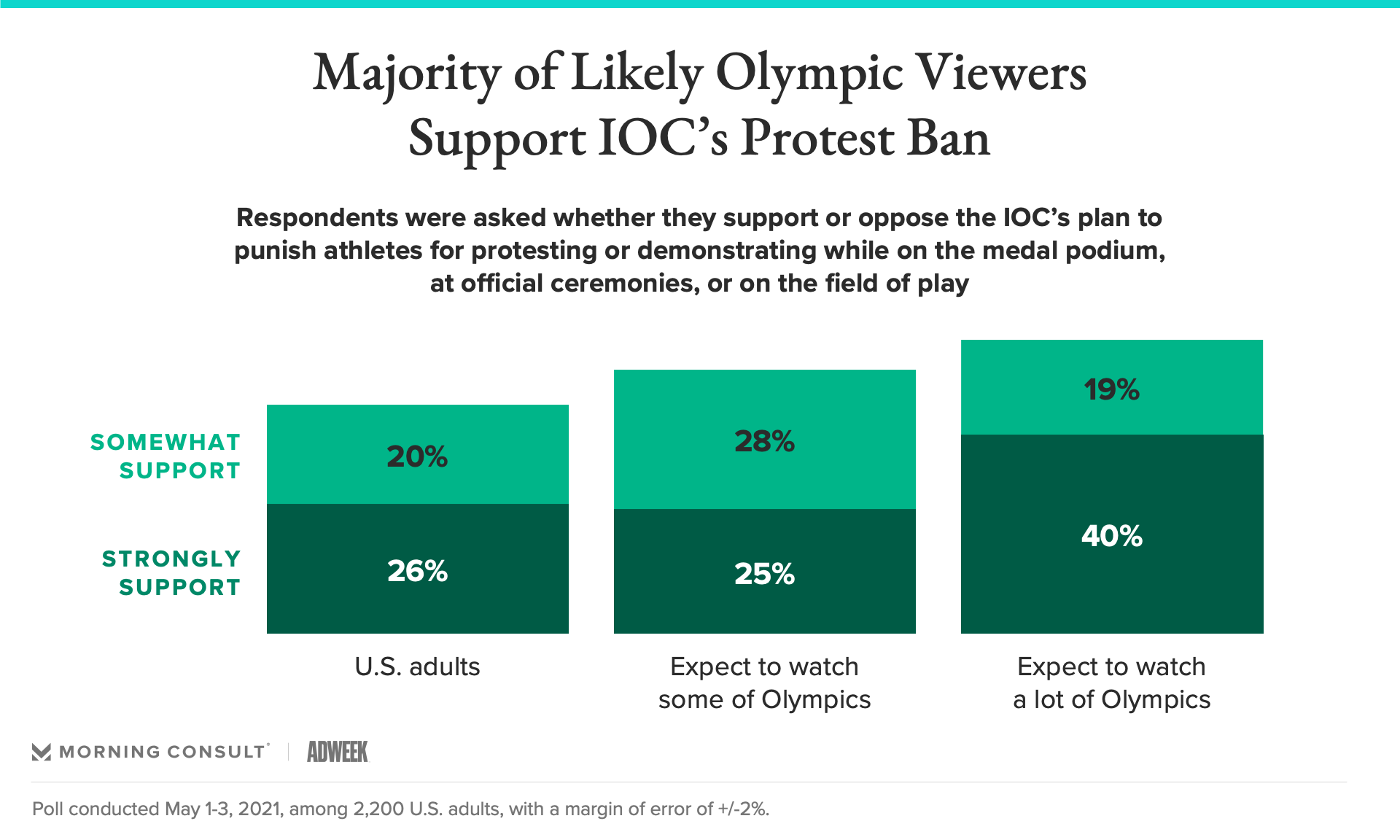
40% of Americans who say they plan to watch “a lot” of the Tokyo Games “strongly support” the policy
https://morningconsult.com/2021/05/10/tokyo-olympics-ioc-ban-athlete-protests/
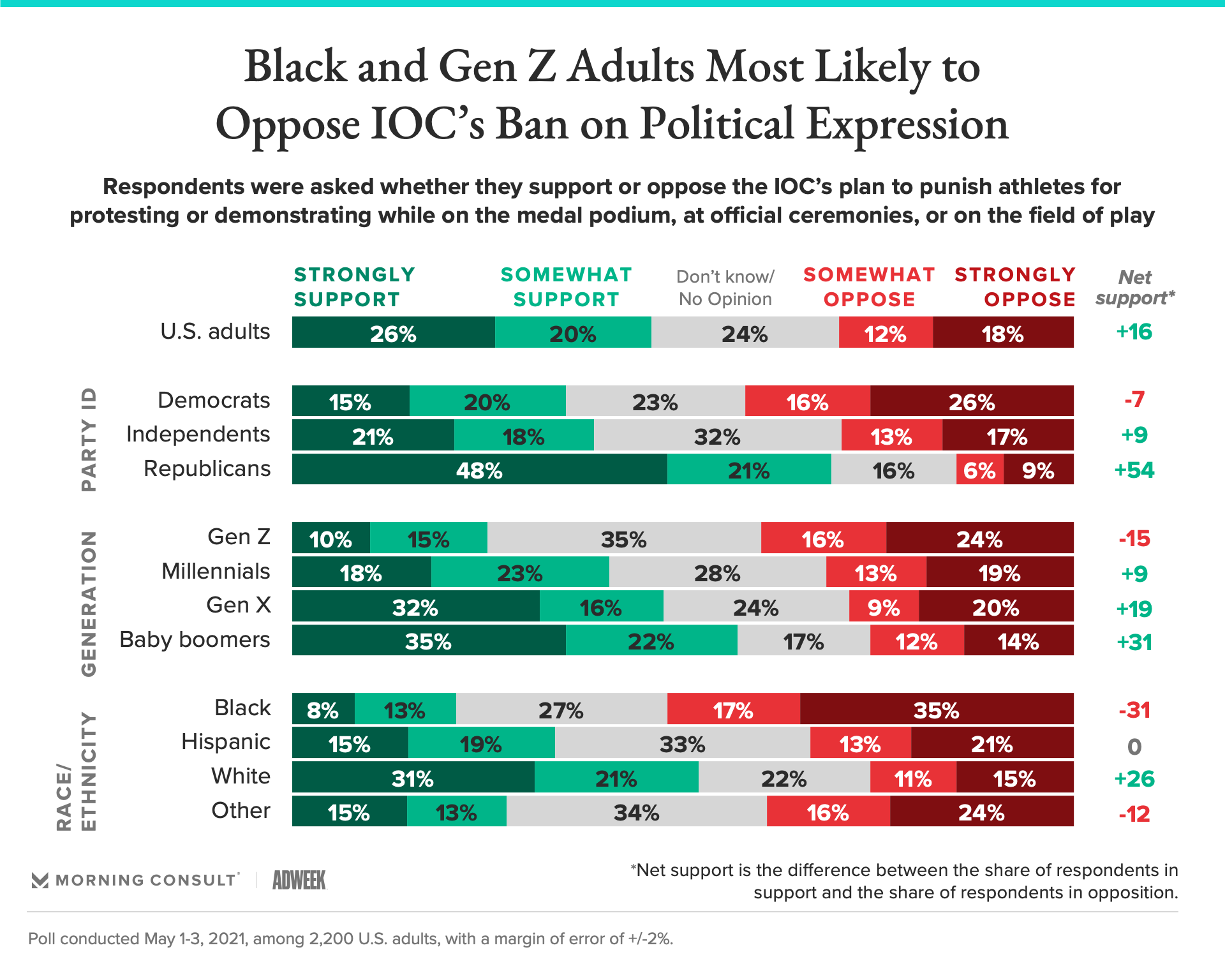
  • 52% of Black adults and 42% of Democrats oppose the plan to punish athletes for protests.
  • 69% of Republicans and 52% of white adults support the IOC’s policy on demonstrations.
On-field activism became ubiquitous in North American sports last year following the murder of George Floyd and shooting of Jacob Blake by police officers, but the International Olympic Committee recently reaffirmed that protests won’t be tolerated at this summer’s Tokyo Games. New research indicates that Americans who plan to watch the Olympics largely agree with the IOC’s policy.

In explaining its decision to maintain a ban on athlete protests, which is spelled out in Rule 50 of the Olympic Charter, the IOC cited a survey in which 70 percent of competitors said it was inappropriate to demonstrate on the field of play, on the medal stand or during the opening and closing ceremonies. The IOC said it will draft a proportionate range of punishments for violators prior to the games, which begin July 23.

200505_IOC-Protest-Policy-Support-Likely-Viewers_fullwidth-1.png


In a Morning Consult/Adweek poll conducted this month, 46 percent of U.S. adults favored the IOC’s plan to punish athletes for protesting or demonstrating, including 53 percent of those who said they expect to watch “some” of the Tokyo Games and 59 percent of those who anticipated watching “a lot” of the coverage. By comparison, 30 percent of Americans opposed the IOC’s policy.

Among the 16 percent of Americans who said they plan to watch “a lot” of the Olympics, 2 in 5 respondents “strongly” backed the IOC’s restrictions on demonstrations.

The margin of error for the 2,200 U.S. adults polled is 2 percentage points, while the group of 806 individuals who plan to watch “some” of the games and 353 people who plan to watch them “a lot” carry margins of error of 3 points and 5 points, respectively.

The IOC’s dogged defense of its long-standing rule runs counter to the stance taken by the United States Olympic and Paralympic Committee, which said last year that it would not penalize its athletes for raising their fists, as American sprinters Tommie Smith and John Carlos did at the 1968 Olympics, or kneeling during the national anthem.

200505_IOC-Protest-Opposition-Black-Gen-Z_fullwidth-1.png


Sixty-nine percent of Republicans supported the IOC’s moratorium on demonstration, more than four times the share of those in their ranks who opposed the policy. Democrats were more evenly split, with 42 percent opposing the ban and 35 percent favoring it. Independents sided with the IOC by a 9-point margin.

Meanwhile, 52 percent of Black respondents opposed the IOC’s plan to punish activism from athletes, compared with 21 percent who supported the policy. Hispanic adults were evenly split, with 34 percent in favor of the IOC’s decision and 34 percent against it. White adults were twice as likely to agree with the protest ban as to disagree with it, with 52 percent in favor and 26 percent opposed.
AP: Olympics ban apparel with slogans like ‘Black Lives Matter’, could punish athletes for political demonstrations
https://www.wbtv.com/2021/05/04/oly...uld-punish-athletes-political-demonstrations/

The IOC says athlete protests and political messages will remain banned at the Olympics after a survey found that a majority of competitors were in favor of keeping the ban in place.

That means raising a fist on the podium or taking a knee would still risk punishment at the Tokyo Games this year.

According to Graham Dunbar of The Associated Press, the IOC also said that slogans such as “Black Lives Matter” will not be allowed on athlete apparel at Olympic venues, though it approved using the words “peace,” “respect,” “solidarity,” “inclusion” and “equality” on T-shirts.

The IOC said it surveyed more than 3,500 athletes over the past year and that 70% said it was “not appropriate to demonstrate or express their views” on the field of play or at the opening or closing ceremony.

The IOC says any instance of breaking the rules will be evaluated by an athlete’s respective National Olympic Committee, International Federation and the IOC, and disciplinary action will be taken on a case-by-case basis as necessary.

The Olympic body’s legal commission should clarify what kind of punishment before this year’s games, which open on July 23.

Athletes who make political or social justice protests at the Tokyo Olympics have been promised legal support by a global union and an activist group in Germany.

The pledges by the World Players Association and Athleten Deutschland came one day after the IOC confirmed its long-standing ban on “demonstration or political, religious or racial propaganda.”

Rule 50 applies to the field of play, medal podiums and opening and closing ceremonies. Raising a fist or kneeling for a national anthem could lead to punishment from the IOC.

Under Rule 50, protests and demonstrations are banned at all Olympic venues including on the field of play, in the Olympic Village, during Olympic medal ceremonies and during the opening, closing and other official ceremonies.

The IOC says Any protest or demonstration outside Olympic venues must comply with local legislation wherever local law forbids such actions.

During the Olympic Games, athletes have the opportunity to express their views in these situations:
  • During press conferences and interviews, i.e. in the mixed zones, in the International Broadcasting Centre (IBC) or the Main Media Centre (MMC)
  • At team meetings
  • On digital or traditional media, or on other platforms.
The IOC says It should be noted that expressing views is different from protests and demonstrations. It should be noted, too, that these guidelines are also applicable to any other accredited person (trainers, coaches, officials, etc.).

Here are some examples of what would constitute a protest, as opposed to expressing views (nonexhaustive list):
  • Displaying any political messaging, including signs or armbands
  • Gestures of a political nature, like a hand gesture or kneeling
  • Refusal to follow the ceremonies protocol.
 
I thought the IOC was alpha AF for suppressing political speech GWB? What happened to your heroes?

And yes.... many days ago in this thread I posted the article outlining the IOC changes to their policies about protesting at the Olympics. I suggest you go read it.
 
Nobody really wants to host the Olympics anymore, and Tokyo demonstrates the danger
https://www.aol.com/sports/nobody-really-wants-host-olympics-122511984.html

TOKYO — There wasn’t a lot of drama last week when the International Olympic Committee awarded Brisbane, Australia, the right to host the 2032 Summer Olympics.

It was the only city up for the vote.

It wasn’t that much different for the 2024 Summer Games. Only Paris and Los Angeles were interested. So the IOC gave Paris that one and then awarded L.A. 2028, which no other city or country had made a reasonable attempt to host.

Beijing was awarded the 2022 Winter Olympics, despite being nowhere near any mountains, in part because the only other interested city was Almaty, Kazakhstan.

The IOC was once the belle of a global ball, with famed and beautiful metropolises begging for the chance to host their Games. The last time Australia hosted — 2000 in Sydney — it defeated eight competing cities, including five finalists. It required four rounds of voting to prevail.

To the coveted goes the corruption, though, and the IOC's bid process quickly led to wining, dining and plenty of bribing — not to mention outrageous budgets, cost overruns and a string of white elephant projects left behind.

Those days appear over. The world is mostly done with hosting the Olympics. The IOC may go a decade without eight legitimate bids these days.

Even the IOC acknowledges that.

853d9c5128c9384b900fd69c48435b99

Japanese citizens aren't big on hosting the Olympics. Nobody really is these days. (Photo by Damon Coulter/SOPA Images/LightRocket via Getty Images)

“[There’s been] a loss in public confidence in the Olympic Movement,” an IOC report concluded. “... Some cities found it challenging to secure government, private and public support and pulled out of the process, sometimes following a loss referendum [by voters].”

That’s what makes Tokyo 2020 such a dangerous Olympics for the IOC. The Japanese actually had the money, the facilities, the public/private backing, the technology, the organization and essentially whatever else was needed to stage the Games.

This is a vibrant city of 34.5 million, the largest in the world. If any place could hold an Olympics, it’s here. IOC president Thomas Bach repeatedly labeled it “the best-ever prepared city for the Olympic Games.”

Then COVID hit.

Officially, Japan says it spent $15.4 billion to host these Olympics, but private estimates suggest it is far higher. Either way, instead of offsetting those costs with tourism dollars, ticket and merchandise sales, and marketing opportunities for industries big and small, the virus wrecked almost everything.

Approximately $1 billion was lost in ticket sales alone. The hotel sector estimates between 700,000 and 1 million nights of reservations were canceled. Construction projects — such as the Olympic Village — that were to become private housing were delayed a year.

Absolutely nothing is working how it had been meticulously planned.

Was the pandemic just a dose of bad luck? Absolutely. That’s the point, though.

You don’t just need a fortune to host the Olympics, you need good fortune, and no one can guarantee the latter. So why risk it?

Among the Japanese, the Olympics are now wildly unpopular, with opinion polls running between 60 and 80 percent opposition to them being staged. The approval rating for Prime Minister Yoshihide Suga, who has championed this event, sank 9 percentage points just this month and is down at 34 percent according to a Nikkei/TV Tokyo poll conducted this week.

The Olympics aren’t the only issue voters judge Suga on, but it seems like no one in Japan wants to be associated with this event. Even Toyota, an iconic national brand and long an official Olympic sponsor, pulled in-country advertising around the Games.

If losing billions of dollars doesn’t faze politicians around the world, losing elections sure will.

What was once heralded as a chance to showcase your city or your country while throwing a once-in-a-generation party is now seen with great skepticism among the public.

Politicians may still want the Olympics so they can dole out deals to preferred contractors or get special projects constructed, but the public is skeptical, if not outright hostile.

The 2024/28 bidding process saw Hungary drop out after a successful “Nolympics” campaign was waged against the bid. Hamburg, Germany, bailed when 51.6 percent of voters opposed it in a referendum. Rome, Italy and Boston likewise succumbed to political backlash.

That has been the trend.

Oslo, Norway, saw 55.9 percent voter opposition to a Winter Games. Krakow, Poland, hit 70 percent. Munich, Germany … St. Moritz, Switzerland … Stockholm, Sweden … all said no. Take a globe, spin it, place a finger down and you’ll likely find some place that looked at the IOC as thieves and the Games as a bloated waste of resources.

In an effort to solve the problem, the IOC changed the selection process and states that it will now supposedly work as partners — rather than crooked judges with their hands out.

It is particularly focused on driving down hosting costs (both financially and environmentally) by using existing facilities — rather than requiring cities to construct dozens of new venues and stadiums.

Paris will be 95 percent staged in venues that already exist. Milan, Italy’s 2026 Winter Olympics bid will be 93 percent, and L.A., which actually turned a profit when it hosted the 1984 Summer Games, will be 100 percent.

Maybe it will help, but the IOC’s reputation is a well-earned one of excess, waste and deceit. It’ll take decades to change that, if the reality ever changes.

Meanwhile, for the IOC, the Tokyo Games are a concern that can’t be fixed via new policy. Japan did everything right and is now dealing with everything wrong.

COVID isn’t the local organizers' or national government’s fault, but that hardly matters. It’s the Olympics, already struggling with their reputation, on which everyone is taking out their frustration.


Olympics are a net loss to any city and then you are stuck with useless shit for decades. What the fuck is a city going to do with a canoe slalom course or bicycle indoor track or any of that shit once the olympics are over...
 
I have no 180. I do not support the IOCs new position in allowing any type of protests.

Sure you 180'd. IOC was virtuous for upholding political speech restrictions a few weeks ago, now it's corrupt and why cities won't host the games.
 
Sure you 180'd. IOC was virtuous for upholding political speech restrictions a few weeks ago, now it's corrupt and why cities won't host the games.

I merely stated I supported the IOC stance that the Olympics should be focused on the competition and the athletes— and not be derailed by political protests which are not the purpose of the games. Note that a survey of the athletes showed a large majority supported this position of the IOC.

Later I outlined how the IOC changed its guidance less than a month before the games. I do not support the change of guidance.

I have not made any posts about the IOC being corrupt.

The article about cities not wanting to host games was about the finances and risks of hosting the games — leading to a dearth of cities stepping forward to be hosts.

I don’t see how you can claim I made some sort of 180 — but that is the way you operate.
 
Back
Top