The tea party isnât just losing; itâs losing badly
Last night, Senate Minority Leader Mitch McConnell (R-Ky.) decisively beat his tea party challenger by 24 percentage points. It's the latest big beat for the tea party, and further proof of a growing trend. While the tea party has been successful when pushing candidates to the right in open-seat Republican primaries, it hasn't had any luck kicking out GOP incumbents this year. And its candidates really haven't come close.
In Idaho on Tuesday, Rep. Mike Simpson easily beat his tea party opponent, Bryan Smith. Sen. John Cornyn of Texas, former chairman of the National Republican Senatorial Committee, won 59 percent of the vote in his March primary. His closest challenger, Rep. Steve Stockman -- who vanished to Russia for part of the campaign -- won 19 percent of the vote. Dwayne Stovall, whose claim to fame is his "Turtle Soup" campaign ad, won 11 percent of the vote.
In Georgia, former secretary of state Karen Handel, endorsed by Sarah Palin, Ted Cruz and a handful of conservative organizations, did not make it into the Republican primary runoff. Reps. Phil Gingrey and Paul Broun, also tea party favorites, weren't even close to making the runoff.
Earlier in May, House Speaker John A. Boehner (R-Ohio) beat his tea party challenger, J.D. Winteregg, by 59 percentage points.
On June 3, however, the tea party will have another chance to put an establishment politician out of work. Sen. Thad Cochran of Mississippi and his tea party opponent, Chris McDaniel, have been battling for months, and it's a far closer race than the incumbent primaries that have already been decided. Cochran, matching the Republican incumbents who have come before him, has the support of nearly everyone in the old party guard. McDaniel, matching the tea party challengers who have come before him, doesn't. But, he does have the endorsement and financial backing of the Club for Growth and a few other tea party groups. In Kansas, incumbent Pat Roberts is also facing opposition from the right.
In McConnell's victory speech Tuesday, he said of Bevin, âHe made me a stronger candidate." That's one way to look at it -- McConnell has definitely had a chance to hone his arguments in advance of what could be a bracing race against Democratic candidate Alison Lundergan Grimes. There must be a cheaper way to take a refresher course in Campaigning 101, especially for a senator who has been in office for nearly 30 years. And there definitely should be a cheaper way for tea party Republicans to learn that running against Republican incumbents hasn't been working for them.
------------------
AND
-----------------
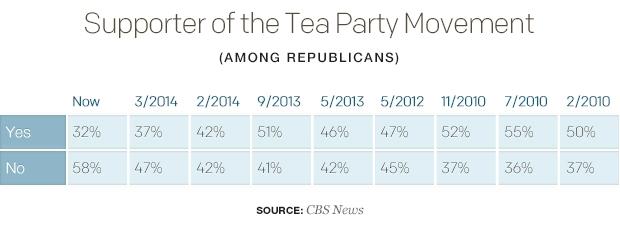 Source --The tea party was an important factor in the 2010 elections, but there's evidence in the poll that their support may be waning. Today, just 15 percent of Americans say they are supporters of the tea party movement - the lowest since CBS News began asking about the tea party in February 2010.
The movement may be losing some of its core constituency -- Republicans. Thirty-two percent of self-identified Republicans now consider themselves supporters of the tea party - down 10 points from February and a decline of 23 points from July 2010, the summer before the Republican Party took control of the House of Representatives. The percentage of Republicans who identify as tea party supporters is now among the lowest in CBS News polls.
-----------------
How will the Teadiots explain the losses? Was Stupid taken out of the drinking water or something?
Last night, Senate Minority Leader Mitch McConnell (R-Ky.) decisively beat his tea party challenger by 24 percentage points. It's the latest big beat for the tea party, and further proof of a growing trend. While the tea party has been successful when pushing candidates to the right in open-seat Republican primaries, it hasn't had any luck kicking out GOP incumbents this year. And its candidates really haven't come close.
In Idaho on Tuesday, Rep. Mike Simpson easily beat his tea party opponent, Bryan Smith. Sen. John Cornyn of Texas, former chairman of the National Republican Senatorial Committee, won 59 percent of the vote in his March primary. His closest challenger, Rep. Steve Stockman -- who vanished to Russia for part of the campaign -- won 19 percent of the vote. Dwayne Stovall, whose claim to fame is his "Turtle Soup" campaign ad, won 11 percent of the vote.
In Georgia, former secretary of state Karen Handel, endorsed by Sarah Palin, Ted Cruz and a handful of conservative organizations, did not make it into the Republican primary runoff. Reps. Phil Gingrey and Paul Broun, also tea party favorites, weren't even close to making the runoff.
Earlier in May, House Speaker John A. Boehner (R-Ohio) beat his tea party challenger, J.D. Winteregg, by 59 percentage points.
On June 3, however, the tea party will have another chance to put an establishment politician out of work. Sen. Thad Cochran of Mississippi and his tea party opponent, Chris McDaniel, have been battling for months, and it's a far closer race than the incumbent primaries that have already been decided. Cochran, matching the Republican incumbents who have come before him, has the support of nearly everyone in the old party guard. McDaniel, matching the tea party challengers who have come before him, doesn't. But, he does have the endorsement and financial backing of the Club for Growth and a few other tea party groups. In Kansas, incumbent Pat Roberts is also facing opposition from the right.
In McConnell's victory speech Tuesday, he said of Bevin, âHe made me a stronger candidate." That's one way to look at it -- McConnell has definitely had a chance to hone his arguments in advance of what could be a bracing race against Democratic candidate Alison Lundergan Grimes. There must be a cheaper way to take a refresher course in Campaigning 101, especially for a senator who has been in office for nearly 30 years. And there definitely should be a cheaper way for tea party Republicans to learn that running against Republican incumbents hasn't been working for them.
------------------
AND
-----------------
The movement may be losing some of its core constituency -- Republicans. Thirty-two percent of self-identified Republicans now consider themselves supporters of the tea party - down 10 points from February and a decline of 23 points from July 2010, the summer before the Republican Party took control of the House of Representatives. The percentage of Republicans who identify as tea party supporters is now among the lowest in CBS News polls.
-----------------
How will the Teadiots explain the losses? Was Stupid taken out of the drinking water or something?