The Taxes Are Coming, The Taxes Are Coming

Quote from PatrickQ:

true, but from some of the stories i have heard there were many ways to reduce your overall earnings, hence making actual rates inline more with today's top income rates. so the pure 75% figure is somewhat misleading...


It was over 90% from the early 50's to early 60's
 
You guys always come on here and bitch, bitch, bitch and point / counterpoint each other. But, you never get to the real point:

TERM LIMITS!

This would fix a myriad of problems in this country.
 
Quote from gurucandidate:

In the late sixties early seventies the maximum incremental personal federal tax rate was up to >>>>>>>75%. Not a misprint.

That was just the federal. In New York we also had the state and city income taxes on top of that and of course Soc. Security and disability.

When Reagan got elected the tax rates gradually declined until they became the lowest here among the developed nations.

I am afraid in a few years we are going to look back at 35% as the good old days.

Please look at the following link to get a sense of what is coming once the pendulum starts swinging the other way.

http://www.ntu.org/tax-basics/history-of-federal-individual-1.html

Regards,

GC

the debt level of the US and the combined pension liability of the federal and state and city governments were not near the levels they are today. basically we are Argentina before their crisis which resulted in riots, foreign currency confiscation and mass emigration to spain etc.
 
Quote from zdreg:

the debt level of the US and the combined pension liability of the federal and state and city governments were not near the levels they are today. basically we are Argentina before their crisis which resulted in riots, foreign currency confiscation and mass emigration to spain etc.

Surely you see the difference between the USA (largest economy in the world) and......Argentina?
 
Reagan tax cuts via Krugman,Carter, Reagan, Revenue.

One common reaction of conservatives, when you point out that the experience of the last 20 years offers zero support for the idea that tax cuts pay for themselves, is to start shouting “Jimmy Carter! Reagan! Supply side roolz!”

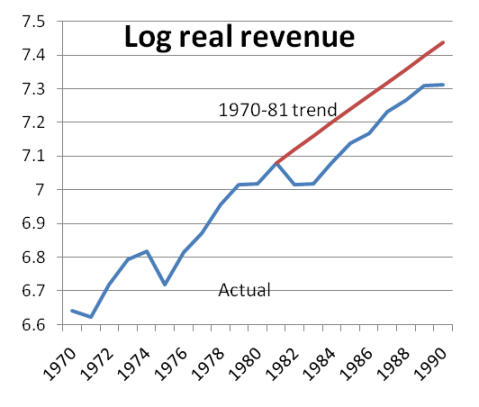
So I thought it might be worth presenting a bit of evidence from an earlier 20-year stretch. Here’s real federal revenue, in 2005 dollars, from 1970 to 1990. I’ve plotted the log, because it’s easier to look at trends:


reaganrevenue.png


A couple of points. First, the Carter years, contrary to legend, were not a period of economic stagnation and falling revenue because high tax rates were strangling the economy; there was a nasty recession starting in 1979, largely thanks to an oil shock, but overall growth was respectable and revenue growth reasonably high.

Second, the revenue track under Reagan looks a lot like the track under Bush: a drop in revenues, then a resumption of growth, but no return to the previous trend.

This is exactly what you would expect to see if supply-side economics were just plain wrong: revenues are permanently reduced relative to what they would otherwise have been.

---------

Tax cuts do not pay for themselves. And really, the rich don't contribute much of anything to society; raise their taxes back to 70%.

 
Quote from Covertibility:

Tax cuts do not pay for themselves. And really, the rich don't contribute much of anything to society.

Very niave IMO.

1. Tax cuts provide the government with less money, and yourself with more money.

2. The rich employ the poor.
 
Tax the rich; they will have less money to hire people; the gov't will have more money to hire people; people will not want to derail their livelihood so they will tend to give the gov't more power so they can keep their jobs.

Rich people get rich and stay rich because they can deploy capital more effectively than the average guy. You get richer by doing so, that's the incentive.

There is no performance based compensation in gov't bureaucracies. You get more money and power by keeping your job longer and having more people work for you. The incentive is simply to remain and to expand.

Which is more efficient, Walmart or the DMV? Which has happier customers? Which has competition? You see the correlation.. right?
 
Quote from Covertibility:

Reagan tax cuts via Krugman,Carter, Reagan, Revenue.

One common reaction of conservatives, when you point out that the experience of the last 20 years offers zero support for the idea that tax cuts pay for themselves, is to start shouting “Jimmy Carter! Reagan! Supply side roolz!”

So I thought it might be worth presenting a bit of evidence from an earlier 20-year stretch. Here’s real federal revenue, in 2005 dollars, from 1970 to 1990. I’ve plotted the log, because it’s easier to look at trends:


reaganrevenue.png


A couple of points. First, the Carter years, contrary to legend, were not a period of economic stagnation and falling revenue because high tax rates were strangling the economy; there was a nasty recession starting in 1979, largely thanks to an oil shock, but overall growth was respectable and revenue growth reasonably high.

Second, the revenue track under Reagan looks a lot like the track under Bush: a drop in revenues, then a resumption of growth, but no return to the previous trend.

This is exactly what you would expect to see if supply-side economics were just plain wrong: revenues are permanently reduced relative to what they would otherwise have been.

---------

Tax cuts do not pay for themselves. And really, the rich don't contribute much of anything to society; raise their taxes back to 70%.

Who cares how well the government does with high taxes. This is about freedom. To hell with federal revenue. It should be zero.
 
So Bill Gates and that massive cash hoarding giant known as MSFT wants more HB1 visa workers yet there are plenty of US programmers looking for jobs...and that's what I call typical of the rich. How exactly does this benefit the society?
 
Quote from Covertibility:

So Bill Gates and that massive cash hoarding giant known as MSFT wants more HB1 visa workers yet there are plenty of US programmers looking for jobs...and that's what I call typical of the rich. How exactly does this benefit the society?

Your view on the matter is too narrow and short sighted. Disproportionately taxing the rich is an attempt to make things "equal". It destroys incentive to produce wealth because the rich don't want to give all of their hard earned money to an undeserving government. So what do the rich do? They leave the country, along with their capital.

Where do you think America would be today if Bill Gates never took the initiative to create MSFT? Some dude in a different country with low taxes would have invented Windows. Think about that.
 
Back
Top