tried to download your writing, but couldn't. Anyway, two things. One is learn how to trade a breakout/ retracement. I'm assuming that's not something you've done much. That's OK, and you may decide it's not for you. I'm just guessing here, so if I'm wrong_say so. The other is simplify and let the best setups work. They can't all be above average. Sometimes the markets are just not understand able, and its OK to just say so. Bottom line is to be able to participate in a trend and take a piece out of it. If that means buying high or selling low, so be it.Well, I initially set out this weekend to better define my setups. I ended up starting the first few pages of a trading manual for myself. I first reduced the different stages of price movement into the following conceptual categories: sharp trends, choppy trends and trading ranges. Then I began describing each in as much detail as I could. I'm only about halfway through this part. After I completely describe each stage of price movement, I hope to develop well defined and unique rules on how to trade each stage. Just the first few pages took me many hours to draft. This entire process will likely take me many months, but I think it will be extremely worthwhile for improving my trading. I already see how such an investigation will expand my repertoire of trading setups. In fact, I spent most of my time this weekend just exploring sharp trends, which I usually stay away from because I'm not sure how to trade them. I have a lot of notes for trading sharp trends but they are disorganized right now. Attached is the introduction to my manual. As you can see I really did not cover trading ranges yet.

You are using an out of date browser. It may not display this or other websites correctly.
You should upgrade or use an alternative browser.
You should upgrade or use an alternative browser.
The student is ready
- Thread starter 2_bits
- Start date
OK I looked at it. My first impression would be to always ask --what is happening now?_Is it up, down, or sideways. The past is good to look at but maybe not so useful if you have to make a trade. You can always go back and find that a particular market is going up and down at the same time, depending upon timeframe. But we trade in the now. I think you should be able to say who is in control at the present time, up to a certain level. If you cannot, then don't trade, IMO.tried to download your writing, but couldn't. Anyway, two things. One is learn how to trade a breakout/ retracement. I'm assuming that's not something you've done much. That's OK, and you may decide it's not for you. I'm just guessing here, so if I'm wrong_say so. The other is simplify and let the best setups work. They can't all be above average. Sometimes the markets are just not understand able, and its OK to just say so. Bottom line is to be able to participate in a trend and take a piece out of it. If that means buying high or selling low, so be it.
tried to download your writing, but couldn't. Anyway, two things. One is learn how to trade a breakout/ retracement. I'm assuming that's not something you've done much. That's OK, and you may decide it's not for you. I'm just guessing here, so if I'm wrong_say so. The other is simplify and let the best setups work. They can't all be above average. Sometimes the markets are just not understand able, and its OK to just say so. Bottom line is to be able to participate in a trend and take a piece out of it. If that means buying high or selling low, so be it.
Thanks for your advice Cswim. I'm sorry you weren't able to download the attachment; it's just a framework I laid out to help me better understand the type of market environments I'm trading. It's a PDF file as I was unable to post a Word document.
You are right also that often the market is hard to understand, especially within trading ranges. My main setup right now is a retracement in a strong trend typically involving the 40 period EMA in some way. Sometimes I get fancy and drop down a timeframe and try to enter early. This is what I'm calling a reversal. I never really trade true reversals by bottom or top picking the overall trend as that lost me lots of $$$ when I first started trading. I will work on better learning how to trade breakouts and retracements.
OK I looked at it. My first impression would be to always ask --what is happening now?_Is it up, down, or sideways. The past is good to look at but maybe not so useful if you have to make a trade. You can always go back and find that a particular market is going up and down at the same time, depending upon timeframe. But we trade in the now. I think you should be able to say who is in control at the present time, up to a certain level. If you cannot, then don't trade, IMO.
Makes sense. Thanks again.
The problem with analysing the markets is that usually by the time you nail something down its already in the process of changing. The trick is to be able to spot the change as its happening. Then you can make a bet--will it continue or revert back?OK I looked at it. My first impression would be to always ask --what is happening now?_Is it up, down, or sideways. The past is good to look at but maybe not so useful if you have to make a trade. You can always go back and find that a particular market is going up and down at the same time, depending upon timeframe. But we trade in the now. I think you should be able to say who is in control at the present time, up to a certain level. If you cannot, then don't trade, IMO.
As discretionary traders, I feel like,we are just gathering evidence most of the time, and trying to suspend judgement.The problem with analysing the markets is that usually by the time you nail something down its already in the process of changing. The trick is to be able to spot the change as its happening. Then you can make a bet--will it continue or revert back?
A trader I follow said something like, "We are like surfers. We are not trying to catch every wave. Just the nice big ones that we can handle"As discretionary traders, I feel like,we are just gathering evidence most of the time, and trying to suspend judgement.
Aussie and Loonie strong again tonight vs USD. Peace, out. . .A trader I follow said something like, "We are like surfers. We are not trying to catch every wave. Just the nice big ones that we can handle"
Thanks for your advice Cswim. I'm sorry you weren't able to download the attachment; it's just a framework I laid out to help me better understand the type of market environments I'm trading. It's a PDF file as I was unable to post a Word document.
You are right also that often the market is hard to understand, especially within trading ranges. My main setup right now is a retracement in a strong trend typically involving the 40 period EMA in some way. Sometimes I get fancy and drop down a timeframe and try to enter early. This is what I'm calling a reversal. I never really trade true reversals by bottom or top picking the overall trend as that lost me lots of $$$ when I first started trading. I will work on better learning how to trade breakouts and retracements.
I checked out the 40 EMA, and while it is good and does offer more opportunities for entry, I use Bollinger 18, 1.8, as a filter, then drop down to either 2/5 minute barchart looking for fine tuning my entry. I find using the BB requires a deeper retracement than 40 EMA, I want less addional trades that might fulfill higher chance of being profitable cause I am staying in much longer, lots of rollovers, and also doing much more counter-trend credit spreads when anticipating short term movements. No matter if I am putting my original entry or add-ons, all get hedged cause in last few months I have gone to stop and reverse when price gets into 9 year zones of being at or near extremes, I usually get in 1-7 add-on trades and not all of those work out but usually the worst are very small losses. I prefer using the BB cause that is normally when many call that as change of trend, so it suckers in more of the newbies.
Heating Oil and all the energies, I was either already long or Nat Gas got long Friday as all are close or beyond nine year lows.
A trader I follow said something like, "We are like surfers. We are not trying to catch every wave. Just the nice big ones that we can handle"
Agreed. Those trades that I did well on over the past five year
I checked out the 40 EMA, and while it is good and does offer more opportunities for entry, I use Bollinger 18, 1.8, as a filter, then drop down to either 2/5 minute barchart looking for fine tuning my entry. I find using the BB requires a deeper retracement than 40 EMA, I want less addional trades that might fulfill higher chance of being profitable cause I am staying in much longer, lots of rollovers, and also doing much more counter-trend credit spreads when anticipating short term movements. No matter if I am putting my original entry or add-ons, all get hedged cause in last few months I have gone to stop and reverse when price gets into 9 year zones of being at or near extremes, I usually get in 1-7 add-on trades and not all of those work out but usually the worst are very small losses. I prefer using the BB cause that is normally when many call that as change of trend, so it suckers in more of the newbies.
Heating Oil and all the energies, I was either already long or Nat Gas got long Friday as all are close or beyond nine year lows.
A lot of traders use Bollinger Bands. I studied them in the past – even read John’s original book. Not sure why I stopped using them, but you can clearly see that they provide a lot of valuable information: dynamic S/R, trend, price compression, etc. I’ll have to take a closer look this weekend when I have more free time.
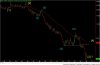
Regarding fossil fuels I agree that their downtrends appear to be overdue for a bounce at a minimum. One of the other techniques I studied extensively and subsequently gave up on was Elliott Wave analysis. For natural gas in particular, I was sure that last year’s low was the bottom of a 10 year “wave 3” on the continuous adjusted contract and that recent impulsive move up from the December lows to the beginning of January was the first minor leg up of the larger “wave 4”. However I don’t have the cojones anymore to trade true reversals like this without more confirmation as I gotten slaughtered in the past too many times trying to time them. A reasonable target for “wave” 4 should be the white line in the attached chart. I hope you’ve caught the bottom!