

https://www.smh.com.au/world/middle...-control-killing-machine-20210920-p58t5o.html
The scientist and the AI-assisted, remote-control killing machine
Israeli agents had wanted to kill Iran’s top nuclear scientist for years. Then they came up with a way to pull the trigger with no operatives present.
By Ronen Bergman and Farnaz Fassihi September 20, 2021
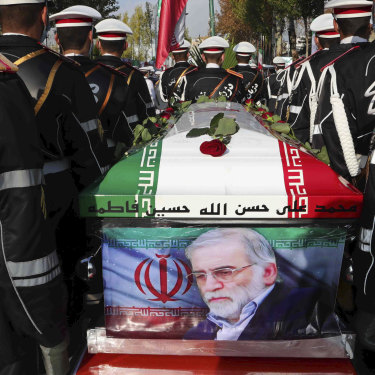
The Iranian Defence Ministry, military personnel stand near the flag-draped coffin of Mohsen Fakhrizadeh, a scientist who was killed on Friday, during a funeral ceremony in Tehran, Iran.Credit:AP
Iran’s top nuclear scientist woke up an hour before dawn, as he did most days, to study Islamic philosophy before his day began.
That afternoon, he and his wife would leave their vacation home on the Caspian Sea and drive to their country house in Absard, a bucolic town east of Tehran, where they planned to spend the weekend.
Iran’s intelligence service had warned him of a possible assassination plot, but the scientist, Mohsen Fakhrizadeh, had brushed it off.
Convinced that Fakhrizadeh was leading Iran’s efforts to build a nuclear bomb, Israel had wanted to kill him for at least 14 years. But there had been so many threats and plots that he no longer paid them much attention.
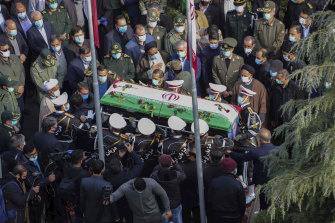
Military personnel carry the flag-draped coffin of Mohsen Fakhrizadeh at his funeral on Monday.Credit:Iranian Defence Ministry via AP
Despite his prominent position in Iran’s military establishment, Fakhrizadeh wanted to live a normal life. He craved small domestic pleasures: reading Persian poetry, taking his family to the seashore, going for drives in the countryside.
And, disregarding the advice of his security team, he often drove his car to Absard instead of having bodyguards drive him in an armoured vehicle. It was a serious breach of security protocol, but he insisted.
So shortly after noon on Friday, November 27 last year, he slipped behind the wheel of his black Nissan Teana sedan, his wife in the passenger seat beside him, and hit the road.
Since 2004, when the Israeli government ordered its foreign intelligence agency, the Mossad, to prevent Iran from obtaining nuclear weapons, the agency had been carrying out a campaign of sabotage and cyber attacks on Iran’s nuclear fuel enrichment facilities. It was also methodically picking off the experts thought to be leading Iran’s nuclear weapons program.
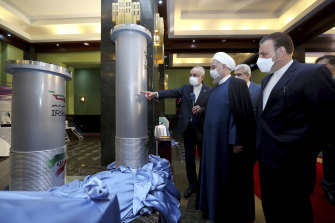
President Hassan Rouhani, second right, listens to head of the Atomic Energy Organization of Iran Ali Akbar Salehi while visiting an exhibition of Iran’s new nuclear achievements in Tehran, Iran. Credit:Iranian Presidency Office via AP, File
Israeli agents had also killed the Iranian general in charge of missile development and 16 members of his team.
But the man Israel said led the bomb program was elusive.
In 2009, a hit team was waiting for Fakhrizadeh at the site of a planned assassination in Tehran, but the operation was called off at the last moment. The plot had been compromised, Mossad suspected, and Iran had laid an ambush.
This time they were going to try something new.
Iranian agents working for the Mossad had parked a blue Nissan Zamyad utility on the side of the road connecting Absard to the main highway. The spot was on a slight elevation with a view of approaching vehicles. Hidden beneath tarpaulins and decoy construction material in the truck bed was a 7.62 mm sniper machine gun.
About 1pm, the hit team received a signal that Fakhrizadeh, his wife and a team of armed guards in escort cars were about to leave for Absard, where many of Iran’s elite have second homes and vacation villas.
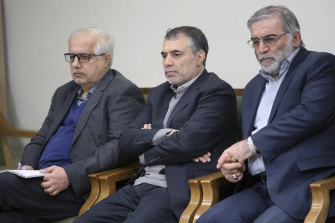
Iranian nuclear scientist Mohsen Fakhrizadeh, right, and his team were targeted by the Mossad.Credit:AP
The assassin, a skilled sniper, took up his position, calibrated the gun sights, cocked the weapon and lightly touched the trigger.
He was nowhere near Absard, however. He was peering into a computer screen at an undisclosed location more than 1600 kilometres away. The entire hit squad had already left Iran.
The straight-out-of-science-fiction story of what happened that afternoon and the events leading up to it, published for the first time, is based on interviews byThe New York Times with American, Israeli and Iranian officials, including two intelligence officials familiar with the details of the planning and execution of the operation, and statements Fakhrizadeh’s family made to the Iranian news media.
The operation’s success was the result of many factors: serious security failures by Iran’s Revolutionary Guard, extensive planning and surveillance by the Mossad, and an insouciance bordering on fatalism for Fakhrizadeh.
But it was also the debut test of a high-tech, computerised sharpshooter kitted out with artificial intelligence and multiple camera eyes, operated via satellite and capable of firing 600 rounds a minute.
The souped-up, remote-controlled machine gun now joins the combat drone in the arsenal of high-tech weapons for remote targeted killing. But unlike a drone, the robotic machine gun draws no attention in the sky, where a drone could be shot down, and can be situated anywhere — qualities likely to reshape the worlds of security and espionage.
Preparations for the assassination began after a series of meetings towards the end of 2019 and in early 2020 between Israeli officials, led by Mossad director Yossi Cohen and high-ranking American officials, including then president Donald Trump, secretary of state Mike Pompeo and the CIA director Gina Haspel.
Israel had paused the sabotage and assassination campaign in 2012 when the US began negotiations with Iran leading to the 2015 nuclear agreement. Now that Trump had abrogated that agreement, the Israelis wanted to resume the campaign to try to thwart Iran’s nuclear progress and force it to accept strict constraints on its nuclear program.
In late February, Cohen presented the Americans with a list of potential operations, including the killing of Fakhrizadeh. Fakhrizadeh had been at the top of Israel’s hit list since 2007, and the Mossad had never taken its eyes off him.
The American officials briefed about the assassination plan in Washington supported it, according to an official who was present at the meeting.
The surveillance of Fakhrizadeh moved into high gear.
The scientist’s security details belonged to the elite Ansar unit of the Revolutionary Guard, heavily armed and well trained, who communicated via encrypted channels. They accompanied Fakhrizadeh’s movements in convoys of four to seven vehicles, changing the routes and timing to foil possible attacks. And the car he drove himself was rotated among four or five at his disposal.
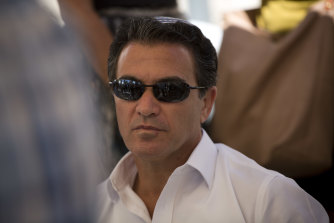
Yossi Cohen, the former director of Israel’s Mossad intelligence agency.Credit:AP
The planners considered detonating a bomb along Fakhrizadeh’s route, forcing the convoy to a halt, so it could be attacked by snipers. That plan was shelved because of the likelihood of a gangland-style gunbattle with many casualties.
The idea of a pre-positioned, remote-controlled machine gun was proposed, but there were a host of logistical complications and myriad ways it could go wrong. Remote-controlled machine guns existed, and several armies had them, but their bulk and weight made them difficult to transport and conceal, and they had only been used with operators nearby.
Time was running out.
By the northern summer, it looked as if Trump, who saw eye to eye on Iran with Netanyahu, could lose the US election. His likely successor, Joe Biden, had promised to reverse Trump’s policies and return to the 2015 nuclear agreement that Israel had vigorously opposed.
If Israel was going to kill a top Iranian official, an act that had the potential to start a war, it needed the assent and protection of the US. That meant acting before Biden could take office. In Netanyahu’s best-case scenario, the assassination would derail any chance of resurrecting the nuclear agreement even if Biden won.
Israel chose a special model of a Belgian-made FN MAG machine gun attached to an advanced robotic apparatus, according to an intelligence official familiar with the plot. The official said the system was not unlike the off-the-rack Sentinel 20 manufactured by the Spanish defence contractor Escribano.
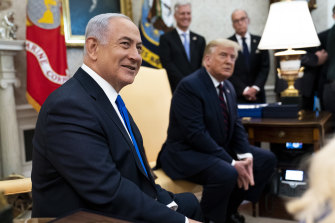
Benjamin Netanyahu, then Israel’s prime minister, meets with US president Donald Trump in the Oval Office.Credit:New York Times
But the machine gun, the robot, its components and accessories together weigh about 1 tonne. So the equipment was broken down into its smallest possible parts and smuggled into the country piece by piece, in various ways, routes and times, then secretly reassembled in Iran.
The robot was built to fit in the bed of a Zamyad ute, a common model in Iran. Cameras pointing in multiple directions were mounted on the truck to give the command room a full picture not just of the target and his security detail, but of the surrounding environment. Finally, the truck was packed with explosives, so it could be blown to bits after the kill, destroying all evidence.
There were further complications in firing the weapon. A machine gun mounted on a truck, even a parked one, will shake after each shot’s recoil, changing the trajectory of subsequent bullets.
Also, even though the computer communicates with the control room via satellite, sending data at the speed of light, there would be a slight delay; what the operator saw on the screen was already a moment old, and adjusting the aim to compensate would take another moment, all while Fakhrizadeh’s car was in motion.
The time it took for the camera images to reach the sniper and for the sniper’s response to reach the machine gun, not including his reaction time, was estimated to be 1.6 seconds, enough of a lag for the best-aimed shot to go astray.
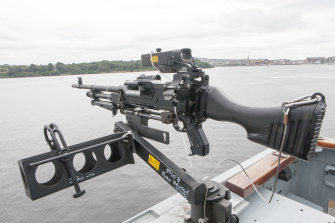
Israel used a special model of a Belgian-made FN MAG machine gun, similar to this one, attached to an apparatus. Credit:Getty
The AI was programmed to compensate for the delay, the shake and the car’s speed.
Another challenge was to determine in real time that it was Fakhrizadeh driving the car and not one of his children, his wife or a bodyguard.
Israel lacks the surveillance capabilities in Iran that it has in other places, like Gaza, where it uses drones to identify a target before a strike. A drone large enough to make the trip to Iran could be easily shot down by Iran’s Russian-made anti-aircraft missiles. And a drone circling the quiet Absard countryside could expose the whole operation.
The solution was to station a fake disabled car, resting on a jack with a wheel missing, at a junction on the main road where vehicles heading for Absard had to make a U-turn, about a kilometre from the kill zone. That vehicle contained another camera.
At dawn Friday, the operation was put into motion. Israeli officials gave the Americans a final heads-up.
The blue Zamyad ute was parked on the shoulder of Imam Khomeini Boulevard. Investigators later found that security cameras on the road had been disabled.
As the convoy left the city of Rostamkala on the Caspian coast, the first car carried a security detail. It was followed by the unarmoured black Nissan driven by Fakhrizadeh, with his wife, Sadigheh Ghasemi, at his side. Two more security cars followed.
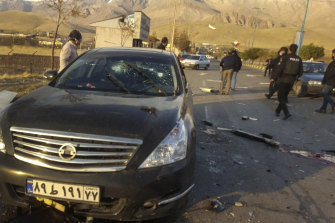
The scene where Mohsen Fakhrizadeh was killed in Absard, a small city just east of the capital, Tehran, Iran.Credit:AP
Shortly before 3.30pm, the motorcade arrived at the U-turn on Firuzkouh Road. Fakhrizadeh’s car came to a near halt, and he was positively identified by the operators, who could also see his wife sitting beside him.
The convoy turned right on Imam Khomeini Boulevard, and the lead car then zipped ahead to the house to inspect it before Fakhrizadeh arrived. Its departure left Fakhrizadeh’s car fully exposed.
The convoy slowed down for a speed bump just before the parked Zamyad. A stray dog began crossing the road.
The machine gun fired a burst of bullets, hitting the front of the car below the windshield. It is not clear if these shots hit Fakhrizadeh, but the car swerved and came to a stop.
The shooter adjusted the sights and fired another burst, hitting the windshield at least three times and Fakhrizadeh at least once in the shoulder. He stepped out of the car and crouched behind the open front door.
According to Iran’s Fars News, three more bullets tore into his spine. He collapsed on the road.
The first bodyguard arrived from a chase car: Hamed Asghari, a national judo champion, holding a rifle. He looked around for the assailant, seemingly confused.
Ghasemi ran out to her husband.
“They want to kill me, and you must leave,” he told her, according to his sons.
She sat on the ground and held his head on her lap, she told Iranian state television.
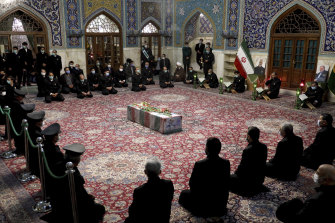
People pray over the flag draped coffin of Mohsen Fakhrizadeh.Credit:AP
The blue Zamyad exploded.
That was the only part of the operation that did not go as planned.
The explosion was intended to rip the robot to shreds, so the Iranians could not piece together what had happened. Instead, most of the equipment was hurled into the air and then fell to the ground, damaged beyond repair but largely intact.
The entire operation took less than a minute. Fifteen bullets were fired.
Iranian investigators noted that not one of them hit Ghasemi, seated inches away, accuracy that they attributed to the use of facial recognition software.
The New York Times
The scientist and the AI-assisted, remote-control killing machine
Israeli agents had wanted to kill Iran’s top nuclear scientist for years. Then they came up with a way to pull the trigger with no operatives present.
By Ronen Bergman and Farnaz Fassihi September 20, 2021
The Iranian Defence Ministry, military personnel stand near the flag-draped coffin of Mohsen Fakhrizadeh, a scientist who was killed on Friday, during a funeral ceremony in Tehran, Iran.Credit:AP
Iran’s top nuclear scientist woke up an hour before dawn, as he did most days, to study Islamic philosophy before his day began.
That afternoon, he and his wife would leave their vacation home on the Caspian Sea and drive to their country house in Absard, a bucolic town east of Tehran, where they planned to spend the weekend.
Iran’s intelligence service had warned him of a possible assassination plot, but the scientist, Mohsen Fakhrizadeh, had brushed it off.
Convinced that Fakhrizadeh was leading Iran’s efforts to build a nuclear bomb, Israel had wanted to kill him for at least 14 years. But there had been so many threats and plots that he no longer paid them much attention.
Military personnel carry the flag-draped coffin of Mohsen Fakhrizadeh at his funeral on Monday.Credit:Iranian Defence Ministry via AP
Despite his prominent position in Iran’s military establishment, Fakhrizadeh wanted to live a normal life. He craved small domestic pleasures: reading Persian poetry, taking his family to the seashore, going for drives in the countryside.
And, disregarding the advice of his security team, he often drove his car to Absard instead of having bodyguards drive him in an armoured vehicle. It was a serious breach of security protocol, but he insisted.
So shortly after noon on Friday, November 27 last year, he slipped behind the wheel of his black Nissan Teana sedan, his wife in the passenger seat beside him, and hit the road.
Since 2004, when the Israeli government ordered its foreign intelligence agency, the Mossad, to prevent Iran from obtaining nuclear weapons, the agency had been carrying out a campaign of sabotage and cyber attacks on Iran’s nuclear fuel enrichment facilities. It was also methodically picking off the experts thought to be leading Iran’s nuclear weapons program.
President Hassan Rouhani, second right, listens to head of the Atomic Energy Organization of Iran Ali Akbar Salehi while visiting an exhibition of Iran’s new nuclear achievements in Tehran, Iran. Credit:Iranian Presidency Office via AP, File
Israeli agents had also killed the Iranian general in charge of missile development and 16 members of his team.
But the man Israel said led the bomb program was elusive.
In 2009, a hit team was waiting for Fakhrizadeh at the site of a planned assassination in Tehran, but the operation was called off at the last moment. The plot had been compromised, Mossad suspected, and Iran had laid an ambush.
This time they were going to try something new.
Iranian agents working for the Mossad had parked a blue Nissan Zamyad utility on the side of the road connecting Absard to the main highway. The spot was on a slight elevation with a view of approaching vehicles. Hidden beneath tarpaulins and decoy construction material in the truck bed was a 7.62 mm sniper machine gun.
About 1pm, the hit team received a signal that Fakhrizadeh, his wife and a team of armed guards in escort cars were about to leave for Absard, where many of Iran’s elite have second homes and vacation villas.
Iranian nuclear scientist Mohsen Fakhrizadeh, right, and his team were targeted by the Mossad.Credit:AP
The assassin, a skilled sniper, took up his position, calibrated the gun sights, cocked the weapon and lightly touched the trigger.
He was nowhere near Absard, however. He was peering into a computer screen at an undisclosed location more than 1600 kilometres away. The entire hit squad had already left Iran.
The straight-out-of-science-fiction story of what happened that afternoon and the events leading up to it, published for the first time, is based on interviews byThe New York Times with American, Israeli and Iranian officials, including two intelligence officials familiar with the details of the planning and execution of the operation, and statements Fakhrizadeh’s family made to the Iranian news media.
The operation’s success was the result of many factors: serious security failures by Iran’s Revolutionary Guard, extensive planning and surveillance by the Mossad, and an insouciance bordering on fatalism for Fakhrizadeh.
But it was also the debut test of a high-tech, computerised sharpshooter kitted out with artificial intelligence and multiple camera eyes, operated via satellite and capable of firing 600 rounds a minute.
The souped-up, remote-controlled machine gun now joins the combat drone in the arsenal of high-tech weapons for remote targeted killing. But unlike a drone, the robotic machine gun draws no attention in the sky, where a drone could be shot down, and can be situated anywhere — qualities likely to reshape the worlds of security and espionage.
Preparations for the assassination began after a series of meetings towards the end of 2019 and in early 2020 between Israeli officials, led by Mossad director Yossi Cohen and high-ranking American officials, including then president Donald Trump, secretary of state Mike Pompeo and the CIA director Gina Haspel.
Israel had paused the sabotage and assassination campaign in 2012 when the US began negotiations with Iran leading to the 2015 nuclear agreement. Now that Trump had abrogated that agreement, the Israelis wanted to resume the campaign to try to thwart Iran’s nuclear progress and force it to accept strict constraints on its nuclear program.
In late February, Cohen presented the Americans with a list of potential operations, including the killing of Fakhrizadeh. Fakhrizadeh had been at the top of Israel’s hit list since 2007, and the Mossad had never taken its eyes off him.
The American officials briefed about the assassination plan in Washington supported it, according to an official who was present at the meeting.
The surveillance of Fakhrizadeh moved into high gear.
The scientist’s security details belonged to the elite Ansar unit of the Revolutionary Guard, heavily armed and well trained, who communicated via encrypted channels. They accompanied Fakhrizadeh’s movements in convoys of four to seven vehicles, changing the routes and timing to foil possible attacks. And the car he drove himself was rotated among four or five at his disposal.
Yossi Cohen, the former director of Israel’s Mossad intelligence agency.Credit:AP
The planners considered detonating a bomb along Fakhrizadeh’s route, forcing the convoy to a halt, so it could be attacked by snipers. That plan was shelved because of the likelihood of a gangland-style gunbattle with many casualties.
The idea of a pre-positioned, remote-controlled machine gun was proposed, but there were a host of logistical complications and myriad ways it could go wrong. Remote-controlled machine guns existed, and several armies had them, but their bulk and weight made them difficult to transport and conceal, and they had only been used with operators nearby.
Time was running out.
By the northern summer, it looked as if Trump, who saw eye to eye on Iran with Netanyahu, could lose the US election. His likely successor, Joe Biden, had promised to reverse Trump’s policies and return to the 2015 nuclear agreement that Israel had vigorously opposed.
If Israel was going to kill a top Iranian official, an act that had the potential to start a war, it needed the assent and protection of the US. That meant acting before Biden could take office. In Netanyahu’s best-case scenario, the assassination would derail any chance of resurrecting the nuclear agreement even if Biden won.
Israel chose a special model of a Belgian-made FN MAG machine gun attached to an advanced robotic apparatus, according to an intelligence official familiar with the plot. The official said the system was not unlike the off-the-rack Sentinel 20 manufactured by the Spanish defence contractor Escribano.
Benjamin Netanyahu, then Israel’s prime minister, meets with US president Donald Trump in the Oval Office.Credit:New York Times
But the machine gun, the robot, its components and accessories together weigh about 1 tonne. So the equipment was broken down into its smallest possible parts and smuggled into the country piece by piece, in various ways, routes and times, then secretly reassembled in Iran.
The robot was built to fit in the bed of a Zamyad ute, a common model in Iran. Cameras pointing in multiple directions were mounted on the truck to give the command room a full picture not just of the target and his security detail, but of the surrounding environment. Finally, the truck was packed with explosives, so it could be blown to bits after the kill, destroying all evidence.
There were further complications in firing the weapon. A machine gun mounted on a truck, even a parked one, will shake after each shot’s recoil, changing the trajectory of subsequent bullets.
Also, even though the computer communicates with the control room via satellite, sending data at the speed of light, there would be a slight delay; what the operator saw on the screen was already a moment old, and adjusting the aim to compensate would take another moment, all while Fakhrizadeh’s car was in motion.
The time it took for the camera images to reach the sniper and for the sniper’s response to reach the machine gun, not including his reaction time, was estimated to be 1.6 seconds, enough of a lag for the best-aimed shot to go astray.
Israel used a special model of a Belgian-made FN MAG machine gun, similar to this one, attached to an apparatus. Credit:Getty
The AI was programmed to compensate for the delay, the shake and the car’s speed.
Another challenge was to determine in real time that it was Fakhrizadeh driving the car and not one of his children, his wife or a bodyguard.
Israel lacks the surveillance capabilities in Iran that it has in other places, like Gaza, where it uses drones to identify a target before a strike. A drone large enough to make the trip to Iran could be easily shot down by Iran’s Russian-made anti-aircraft missiles. And a drone circling the quiet Absard countryside could expose the whole operation.
The solution was to station a fake disabled car, resting on a jack with a wheel missing, at a junction on the main road where vehicles heading for Absard had to make a U-turn, about a kilometre from the kill zone. That vehicle contained another camera.
At dawn Friday, the operation was put into motion. Israeli officials gave the Americans a final heads-up.
The blue Zamyad ute was parked on the shoulder of Imam Khomeini Boulevard. Investigators later found that security cameras on the road had been disabled.
As the convoy left the city of Rostamkala on the Caspian coast, the first car carried a security detail. It was followed by the unarmoured black Nissan driven by Fakhrizadeh, with his wife, Sadigheh Ghasemi, at his side. Two more security cars followed.
The scene where Mohsen Fakhrizadeh was killed in Absard, a small city just east of the capital, Tehran, Iran.Credit:AP
Shortly before 3.30pm, the motorcade arrived at the U-turn on Firuzkouh Road. Fakhrizadeh’s car came to a near halt, and he was positively identified by the operators, who could also see his wife sitting beside him.
The convoy turned right on Imam Khomeini Boulevard, and the lead car then zipped ahead to the house to inspect it before Fakhrizadeh arrived. Its departure left Fakhrizadeh’s car fully exposed.
The convoy slowed down for a speed bump just before the parked Zamyad. A stray dog began crossing the road.
The machine gun fired a burst of bullets, hitting the front of the car below the windshield. It is not clear if these shots hit Fakhrizadeh, but the car swerved and came to a stop.
The shooter adjusted the sights and fired another burst, hitting the windshield at least three times and Fakhrizadeh at least once in the shoulder. He stepped out of the car and crouched behind the open front door.
According to Iran’s Fars News, three more bullets tore into his spine. He collapsed on the road.
The first bodyguard arrived from a chase car: Hamed Asghari, a national judo champion, holding a rifle. He looked around for the assailant, seemingly confused.
Ghasemi ran out to her husband.
“They want to kill me, and you must leave,” he told her, according to his sons.
She sat on the ground and held his head on her lap, she told Iranian state television.
People pray over the flag draped coffin of Mohsen Fakhrizadeh.Credit:AP
The blue Zamyad exploded.
That was the only part of the operation that did not go as planned.
The explosion was intended to rip the robot to shreds, so the Iranians could not piece together what had happened. Instead, most of the equipment was hurled into the air and then fell to the ground, damaged beyond repair but largely intact.
The entire operation took less than a minute. Fifteen bullets were fired.
Iranian investigators noted that not one of them hit Ghasemi, seated inches away, accuracy that they attributed to the use of facial recognition software.
The New York Times

