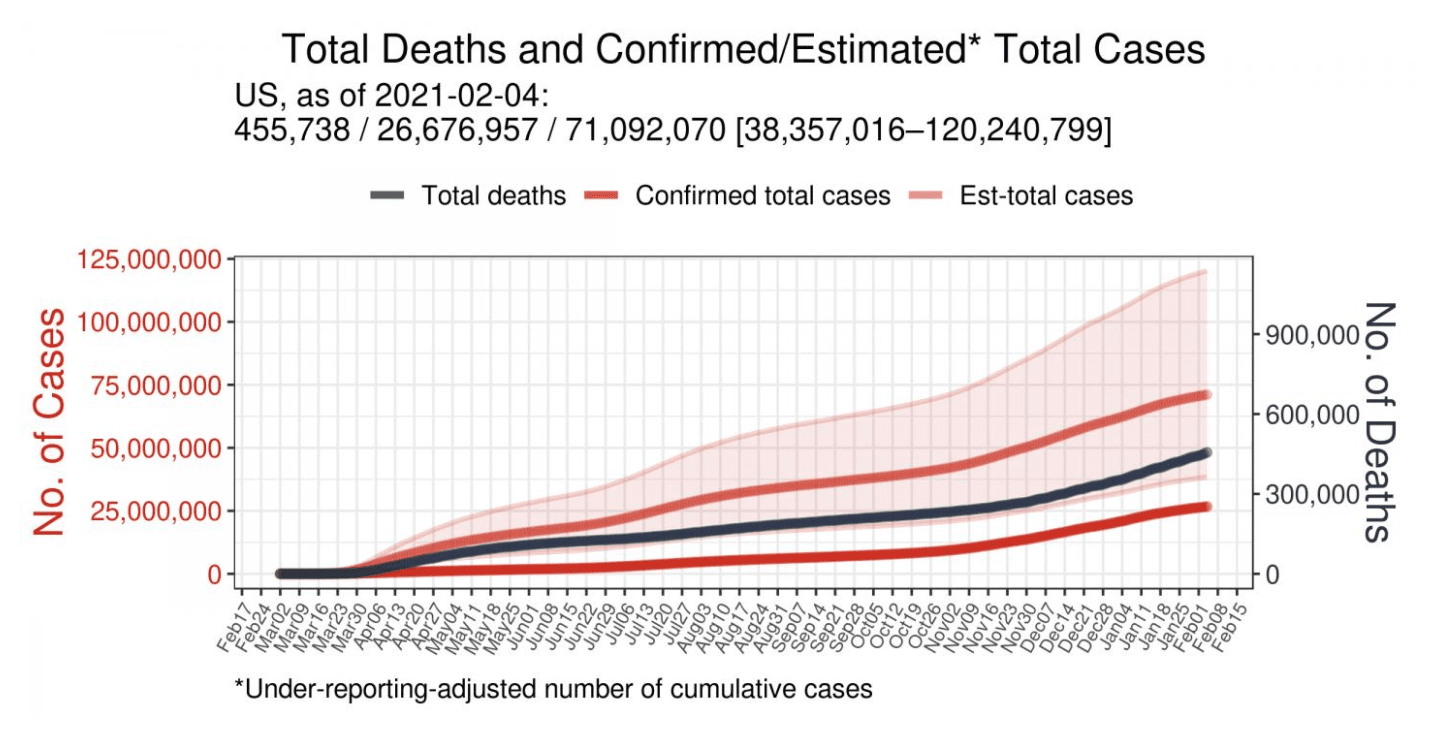
In my opinion... the months of March to May of this year will be a COVID "twilight zone" with a lot of uncertainty. The vaccination level will not be at a high enough level during this time to really have an impact on slowing (note: not stopping) the spread of COVID. The new variants which are more contagious will become more commonplace. All of this leaves the U.S. in a state of precariousness where people can see the finish line but COVID spread is still high -- with large scale hospitalizations and deaths continuing. This, of course, brings up the re-open conversation -- when is it safe to open schools, or to open businesses? What are the necessary guidelines to make openings safe? All of these questions will continued to be debated by politicians --- as a renewed vaccination & public health drive attempts to reduce the spread of COVID. It all comes out to a question of the level of acceptable risk versus the toll for bad decisions.
Don't get cocky with these Covid-19 numbers. With new variants, easing restrictions now would be 'incredibly risky'
https://www.cnn.com/2021/02/09/health/us-coronavirus-tuesday/
Covid-19 numbers are getting better. But letting your guard down could be an open invitation for highly contagious variants to trample the US -- erasing the progress made.
"We're ... seeing what happens in other countries when these variants take over," emergency physician Dr. Leana Wen said. "There is (an) explosive surge, even when the countries are basically in shutdown."
The warning comes as more Americans believe there's no big risk in returning to pre-Covid life, according to a new poll.
An Axios-Ipsos poll published Tuesday showed 66% of those surveyed said they thought the risk of returning to pre-Covid life was moderate or large. That's the lowest percentage since October.
The groups least likely to see Covid-19 as a risk were people ages 18 to 29 (58%) and Republicans (49%).
But a majority of those vaccinated -- 76% -- still see coronavirus as a high risk.
Americans shouldn't assume the vaccine rollout means it's OK to get lax with safety measures. In fact, ditching precautions now would be "incredibly risky," said Dr. Richard Besser, former acting director of the US Centers for Disease Control and Prevention.
"It is absolutely essential that we continue to do steps beyond vaccination to keep this under control," Besser said.
"The reason for that is that the more this virus is allowed to spread in our communities, the more we're going to see these variants spreading," he said.
"And if the vaccines aren't as effective against some of these variants, then we could see the gains that we're so excited about right now, we could see those reversed in a very short amount of time."
What the gains look like right now
-- The US has averaged 110,854 new Covid-19 cases each day over the past week, according to Johns Hopkins University.
That's down 24% compared to the previous week. (But testing has dropped by 12.3% over the same time period, according to the COVID Tracking Project.)
-- Covid-19 hospitalizations have decreased 12.53% this past week, compared to the previous week, according to the project.
-- The national test positivity rate -- or the percentage of tests taken that turn out to be positive -- now averages 6.93%, according to the COVID Tracking Project.
That number has steadily declined since the record high of 13.55% on January 8. But the World Health Organization has recommended governments not reopen until the test positivity rate is 5% or lower for at least two weeks.
Despite warnings, some states are easing up
Scientists are worried about several troubling strains of coronavirus that are now in the US.
They include the B.1.1.7 variant, first detected in the UK, which is highly contagious and spreading rapidly in the US; and the B.1.351 strain, first discovered in South Africa, which might partly escape the effects of vaccines.
The US faces "something really potentially catastrophic, and we should be doubling down on the measures that we know to work," said Wen, a visiting professor at George Washington University's Milken Institute School of Public Health.
Despite similar comments from other health experts, some states are letting go of certain safety precautions:
-- North Dakota's statewide mask mandate recently expired. Gov. Doug Burgum said last week he was not concerned Covid-19 numbers would go up.
-- Iowa Gov. Kim Reynolds recently signed an executive order ending all mask requirements, gathering restrictions and other public health emergency mandates, while encouraging residents to follow recommended safety guidelines.
-- New York Gov. Andrew Cuomo said New York City indoor dining can reopen at 25% capacity starting Friday. But the state could tighten restrictions again if needed.
"As we move forward, we're continuing to respond to the facts and data every day," Cuomo said, "and when the enemy changes tactics, we change with the enemy."
Where we are with vaccines
More than 32.3 million Americans have received at least their one dose of their two-dose Covid-19 vaccines, according to CDC data.
More than 9.5 million people have been fully inoculated with both doses. That's less than 3% of the US population.
Local and state officials say they're facing challenges such as supply and trying to ensure fair access.
Starting Tuesday, Los Angeles County will only offer appointments for second doses of the vaccine to "ensure that we have enough doses to guarantee a second dose for people who already received the first one," county Public Health Director Barbara Ferrer said Monday.
That plan will stay in place for the rest of this weeks.
"Scheduling an appointment right now is challenging because of the limited supply of vaccines that the county is receiving on a weekly basis," county health officials said Monday.
Kentucky Gov. Andy Beshear said the state will produce demographic data every week to track where vaccine doses go, so that they will be "held accountable" for equitable access.
"Black and African American Kentuckians, to date, have received about 4.3% of vaccinations where we know the person's race. That is unacceptable," Beshear said Monday.
"About 1.1% of vaccines, where ethnicity is known, have gone to our Hispanic population -- also too low."
Study: Transmission is low in day care centers that take precautions
The first multicenter study to investigate the spread of coronavirus in day care centers suggests preschool-age children are not superspreaders.
When the right public health measures are implemented, day care centers are safe for both children and staff members, the researchers said.
The study was published Monday in the Lancet Child & Adolescent Health and conducted in the French cities of Paris, Rouen and Annecy between June 4 and July 3 -- up to two months after France's national lockdown.
The study used data from rapid antibody tests and found the prevalence of antibodies for children at day care centers was only 3.7% -- well below the national rate of 10% found in adults in the same time period.
The 14 children that were found to have antibodies came from 13 different centers, and the two children from the same center never had contact.
At those day care centers, staff members wore face masks; enrollment and staffing were reduced; children who became symptomatic were excluded; staff conducted regular temperature checks and reinforced hand hygiene; and everyone practiced physical distancing.
But the researchers said one limitation to the study was that data were collected before the emergence of coronavirus variants that some experts suggest may be more transmissible in children.
In the US, more than 2.9 million children have been infected with coronavirus throughout this pandemic, according to a report last week from the American Academy of Pediatrics and the Children's Hospital Association.
Covid-19 cases in children represent about 13% of all US cases, the report said. But the definition of "child" varied by state. Some states defined "child" as those under age 14, while some considered children to be anyone under 20.
Severe illness from the virus is rare among children, the report said.
"However, there is an urgent need to collect more data on longer-term impacts of the pandemic on children, including ways the virus may harm the long-term physical health of infected children, as well as its emotional and mental health effects," it said.
Ya know, we must all remain humbled by the fact that the data has never given us a good and reliable snapshot of what the hell is going on.
I notice that in recent days there has been new modeling released and going around and about that continues to bang on the drum of their being ten times more covid cases out there then have been reported in the past. There is nothing new with that assertion, we have seen it since the beginning. It is just that a year has gone by and more and more studies still want to make that case. The point is not whether I agree with them or not. The point is that they are there and have to be reconciled some how over time.
So let's just say for shiites and giggles that the number of cases that have occurred is only five times what is reported rather than the ten times in recent studies- so as to come at it in a moderate kind of way.
We have had about 28 million cases reported so far. The five times would take us to 140 million. out of a population of what- 366 million or the like. In other words, 38%.
So that number could easily skip up to more than 50% either by the "10-times unreported" theory/study having some merit or just by the newer more transmissable variants spreading and doing their thing or just the current virus which is chugging along plenty fast already.
If that is true or has some merit then we are at sort of crazy or precarious tipping point, where the numbers could explode as a result of the more transmissable variants but their rapid spread would also start driving the numbers of people who have had it or exposed to above the 50% mark- if some of these models are correct- which would or is already reducing its transmissability in the general population due to high levels of previous exposure (not my restraint in not using the H word, I dont go that binary route but accept it as a factor).
Don't know. Going to need to have to give some weight to some of these models though if the case load keeps going down while the tramsmissability of the virus is allegedly going up. Adding some vaccine into the mix will only increase the "previous exposure" population.
I think I said I dont know. And neither does anyone else right now. Interesting time. I agree with the title of this article except I would put an "OR NOT" at the end of it.
Why The Pandemic Is 10 Times Worse Than You Think
https://www.npr.org/sections/health...the-pandemic-is-10-times-worse-than-you-think