
You are using an out of date browser. It may not display this or other websites correctly.
You should upgrade or use an alternative browser.
You should upgrade or use an alternative browser.
The lies that Capitalists want you to believe about themselves
- Thread starter nitro
- Start date

Absolutely unconditionally irrevocably must reading:
And the Weak Suffer What They Must?: Europe's Crisis and America's Economic Future Hardcover – April 12, 2016
by Yanis Varoufakis (Author)
And the Weak Suffer What They Must?: Europe's Crisis and America's Economic Future Hardcover – April 12, 2016
by Yanis Varoufakis (Author)
Back to the future.
America’s Monopoly Problem
How big business jammed the wheels of innovation
http://www.theatlantic.com/magazine/archive/2016/10/americas-monopoly-problem/497549/
At the heart of which is:
Antitrust Paradox by Robert H. Bork (1993-01-31) Paperback – 1796
by Robert H. Bork (Author)
"...But in the late 1970s and early 1980s, several prominent conservatives succeeded in persuading Washington—especially the Justice Department—to abandon its old dogmas about big business. In a book that galvanized a movement, The Antitrust Paradox, Robert Bork argued that the government fetishized competition and often leveled the playing field for the benefit of poorly run companies. The book argued that by protecting bad companies for the sake of competition, the government was keeping prices higher than they would be if the most-efficient companies were allowed to dominate. The Justice Department’s rules on vertical and horizontal mergers were rewritten to make it easier for large companies to merge, as long as the new, larger business could deliver lower prices...."
Theil argues that monopoly is good, but from the perspective of the small, not the gigantic through mergers:
Zero to One: Notes on Startups, or How to Build the Future Kindle Edition
by Peter Thiel Blake Masters (Author)
America’s Monopoly Problem
How big business jammed the wheels of innovation
http://www.theatlantic.com/magazine/archive/2016/10/americas-monopoly-problem/497549/
At the heart of which is:
Antitrust Paradox by Robert H. Bork (1993-01-31) Paperback – 1796
by Robert H. Bork (Author)
"...But in the late 1970s and early 1980s, several prominent conservatives succeeded in persuading Washington—especially the Justice Department—to abandon its old dogmas about big business. In a book that galvanized a movement, The Antitrust Paradox, Robert Bork argued that the government fetishized competition and often leveled the playing field for the benefit of poorly run companies. The book argued that by protecting bad companies for the sake of competition, the government was keeping prices higher than they would be if the most-efficient companies were allowed to dominate. The Justice Department’s rules on vertical and horizontal mergers were rewritten to make it easier for large companies to merge, as long as the new, larger business could deliver lower prices...."
Theil argues that monopoly is good, but from the perspective of the small, not the gigantic through mergers:
Zero to One: Notes on Startups, or How to Build the Future Kindle Edition
by Peter Thiel Blake Masters (Author)
Last edited:
Trickle down economics at work:
TAXES
Kansas Tried Tax Cuts. Its Neighbor Didn't. Guess Which Worked.
334
MARCH 29, 2016 11:13 AM EDT
By
Justin Fox
For the past few years, Kansas's Republican Governor Sam Brownback and his allies in the state's legislature have been conducting a fiscal experiment involving big cuts in income taxes for individuals and businesses. The theory was that this "march to zero income taxes," as Brownback has called it, would spur entrepreneurship, economic growth and lots of job creation -- 25,000 new jobs in each of the next four years, Brownback pledged during his successful re-election campaign in 2014.
There have been repeated budget shortfalls since Brownback first took office in January 2011, which have led to repeatedproclamations in the national news media that the Kansasexperiment has failed. In the sense that the tax cuts haven't paid for themselves, that's true.
But the budget crises have helped Brownback push through the policies he favors -- he and the legislature have so far made up for the lost revenue with increased sales taxes and cutbacks in spending on education and other government functions. One goal, as prominent backer (and index-fund pioneer!) Rex Sinquefield explained last year, is to shift taxes from income to consumption. Another is just to shrink the state government.
Has this approach succeeded in stimulating Kansas's economy and creating jobs?To know that for sure you'd have to know what would have happened in the absence of Brownback's experiment, which is of course not possible. But there is a simple substitute -- just look at what's been happening in Nebraska.
Kansas has more people than its neighbor to the north: 2.9 million to 1.9 million. But by other measures -- median household income, per-capita income, percentage of the population living in urban areas, acreage under cultivation -- the two states are pretty similar. They're also both run by Republicans, although Nebraska's legislators are elected via a nonpartisan primary and runoff that seem to reward moderation in a way that Kansas's more conventional elections don't. While Nebraska has elected governors withBrownbackian opinions on taxes, the legislature has yet to approve a Kansas-scale tax experiment. Which makes it an imperfect but possibly useful scientific control.
With that in mind, here's where the two states' unemployment rates have gone since Brownback took office:
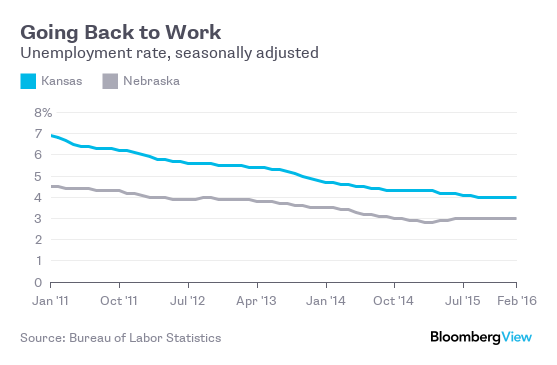
Kansas doesn't look bad at all here: The unemployment rate remains higher than in Nebraska (which is tied with Colorado for fourth-lowest unemployment rate in the country), but it has fallen farther. Still, sometimes the unemployment rate falls because fewer people are looking for work. And, in fact, employment has been rising more slowly in Kansas than in Nebraska (I've indexed the two states' employment totals to a shared starting point of 100 to make them easier to compare):
....
https://www.bloomberg.com/view/arti...x-cuts-its-neighbor-didn-t-guess-which-worked
TAXES
Kansas Tried Tax Cuts. Its Neighbor Didn't. Guess Which Worked.
334
MARCH 29, 2016 11:13 AM EDT
By
Justin Fox
For the past few years, Kansas's Republican Governor Sam Brownback and his allies in the state's legislature have been conducting a fiscal experiment involving big cuts in income taxes for individuals and businesses. The theory was that this "march to zero income taxes," as Brownback has called it, would spur entrepreneurship, economic growth and lots of job creation -- 25,000 new jobs in each of the next four years, Brownback pledged during his successful re-election campaign in 2014.
There have been repeated budget shortfalls since Brownback first took office in January 2011, which have led to repeatedproclamations in the national news media that the Kansasexperiment has failed. In the sense that the tax cuts haven't paid for themselves, that's true.
But the budget crises have helped Brownback push through the policies he favors -- he and the legislature have so far made up for the lost revenue with increased sales taxes and cutbacks in spending on education and other government functions. One goal, as prominent backer (and index-fund pioneer!) Rex Sinquefield explained last year, is to shift taxes from income to consumption. Another is just to shrink the state government.
Has this approach succeeded in stimulating Kansas's economy and creating jobs?To know that for sure you'd have to know what would have happened in the absence of Brownback's experiment, which is of course not possible. But there is a simple substitute -- just look at what's been happening in Nebraska.
Kansas has more people than its neighbor to the north: 2.9 million to 1.9 million. But by other measures -- median household income, per-capita income, percentage of the population living in urban areas, acreage under cultivation -- the two states are pretty similar. They're also both run by Republicans, although Nebraska's legislators are elected via a nonpartisan primary and runoff that seem to reward moderation in a way that Kansas's more conventional elections don't. While Nebraska has elected governors withBrownbackian opinions on taxes, the legislature has yet to approve a Kansas-scale tax experiment. Which makes it an imperfect but possibly useful scientific control.
With that in mind, here's where the two states' unemployment rates have gone since Brownback took office:
Kansas doesn't look bad at all here: The unemployment rate remains higher than in Nebraska (which is tied with Colorado for fourth-lowest unemployment rate in the country), but it has fallen farther. Still, sometimes the unemployment rate falls because fewer people are looking for work. And, in fact, employment has been rising more slowly in Kansas than in Nebraska (I've indexed the two states' employment totals to a shared starting point of 100 to make them easier to compare):
....
https://www.bloomberg.com/view/arti...x-cuts-its-neighbor-didn-t-guess-which-worked
Trickle down economics at work:
TAXES
Kansas Tried Tax Cuts. Its Neighbor Didn't. Guess Which Worked.
334
MARCH 29, 2016 11:13 AM EDT
By
Justin Fox
For the past few years, Kansas's Republican Governor Sam Brownback and his allies in the state's legislature have been conducting a fiscal experiment involving big cuts in income taxes for individuals and businesses. The theory was that this "march to zero income taxes," as Brownback has called it, would spur entrepreneurship, economic growth and lots of job creation -- 25,000 new jobs in each of the next four years, Brownback pledged during his successful re-election campaign in 2014.
There have been repeated budget shortfalls since Brownback first took office in January 2011, which have led to repeatedproclamations in the national news media that the Kansasexperiment has failed. In the sense that the tax cuts haven't paid for themselves, that's true.
But the budget crises have helped Brownback push through the policies he favors -- he and the legislature have so far made up for the lost revenue with increased sales taxes and cutbacks in spending on education and other government functions. One goal, as prominent backer (and index-fund pioneer!) Rex Sinquefield explained last year, is to shift taxes from income to consumption. Another is just to shrink the state government.
Has this approach succeeded in stimulating Kansas's economy and creating jobs?To know that for sure you'd have to know what would have happened in the absence of Brownback's experiment, which is of course not possible. But there is a simple substitute -- just look at what's been happening in Nebraska.
Kansas has more people than its neighbor to the north: 2.9 million to 1.9 million. But by other measures -- median household income, per-capita income, percentage of the population living in urban areas, acreage under cultivation -- the two states are pretty similar. They're also both run by Republicans, although Nebraska's legislators are elected via a nonpartisan primary and runoff that seem to reward moderation in a way that Kansas's more conventional elections don't. While Nebraska has elected governors withBrownbackian opinions on taxes, the legislature has yet to approve a Kansas-scale tax experiment. Which makes it an imperfect but possibly useful scientific control.
With that in mind, here's where the two states' unemployment rates have gone since Brownback took office:
Kansas doesn't look bad at all here: The unemployment rate remains higher than in Nebraska (which is tied with Colorado for fourth-lowest unemployment rate in the country), but it has fallen farther. Still, sometimes the unemployment rate falls because fewer people are looking for work. And, in fact, employment has been rising more slowly in Kansas than in Nebraska (I've indexed the two states' employment totals to a shared starting point of 100 to make them easier to compare):
....
https://www.bloomberg.com/view/arti...x-cuts-its-neighbor-didn-t-guess-which-worked
If it didn't work, that's because the tax cut wasn't big enough. It needed to be much bigger, like Krugman said about the demand side economics of Obama. It failed because it wasn't big enough. Or maybe the tax cuts didn't work because they didn't do it enough times. The fed went qe1 then qe2 then qe3. I guess qe1 didn't work, so they did it again. And kept doing it. In fact, it's still on the table as a future option for more.
I wonder how come when one tax cut is implemented, liberals say it was a failure and must be reversed, but when demand side economics is enacted, it failed because it wasn't big enough and they need to keep adding to it. Things that make you go hmmmm.
If it didn't work, that's because the tax cut wasn't big enough. It needed to be much bigger, like Krugman said about the demand side economics of Obama. It failed because it wasn't big enough. Or maybe the tax cuts didn't work because they didn't do it enough times. The fed went qe1 then qe2 then qe3. I guess qe1 didn't work, so they did it again. And kept doing it. In fact, it's still on the table as a future option for more.
I wonder how come when one tax cut is implemented, liberals say it was a failure and must be reversed, but when demand side economics is enacted, it failed because it wasn't big enough and they need to keep adding to it. Things that make you go hmmmm.
The effects of IRs on the economy are believed to be well understood by Economists. Or I should say, second order logical understanding since it definitely affects asset prices, which in turn is supposed to invigorate investment and ultimately lead to job creation. Long story short, money seeks yield (otherwise inflation evaporates its buying power) and lower IRs forces the hand of business. These charts bear that out. The effects of monetary stimulus were almost immediate, although note that after about 2013 any more stimulus is almost negligible in the real economy and it is all asset class gains now.
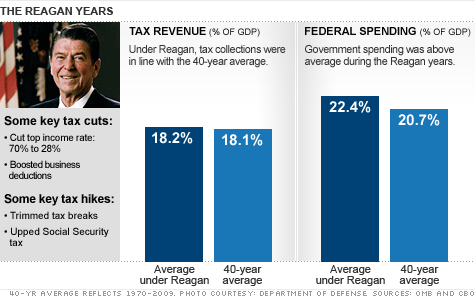
On the other hand, the effects on reducing taxes on businesses has shown no such effect, or if it has, it has always been at best fuzzy because you have to do the accounting carefully: In the Reagan years the theory is that while tax cuts lead to what was seemingly an economic stimulus, when the deficit is taken into account it was nearly a wash. See next post for that story.
Last edited:
America's Debt Crisis
Taxes: What people forget about Reagan
By Jeanne Sahadi, senior writerSeptember 12, 2010: 8:21 AM ET
NEW YORK (CNNMoney.com) --
Those who oppose higher taxes and are fed up with record levels of U.S. debt may pine for Ronald Reagan, the patron saint of lower taxes and smaller government.
But it's worth considering just what Reagan did -- and didn't do -- as lawmakers grapple with many of the same issues that their 1980s counterparts faced: a deep recession, high deficits and a rip-roaring political divide over taxes.
Soon after taking office in 1981, Reagan signed into law one of the largest tax cuts in the postwar period.
That legislation -- phased in over three years -- pushed through a 23% across-the-board cut of individual income tax rates.It also called for tax brackets, the standard deduction and personal exemptions to be adjusted for inflation starting in 1984. That would reduce "bracket creep" since the high inflation of the 1970s and early 1980s meant incomes rose very fast, pushing taxpayers into ever higher brackets even though the real value of their income hadn't changed.
The 1981 bill also made certain business deductions more generous.
In 1986, Reagan lowered individual income tax rates again, this time in landmark tax reform legislation.
As a result of the 1981 and 1986 bills, the top income tax rate was slashed from 70% to 28%.
Despite the aggressive tax cutting, Reagan couldn't ignore the budget deficit, which was burgeoning.
After Reagan's first year in office, the annual deficit was 2.6% of gross domestic product. But it hit a high of 6% in 1983, stayed in the 5% range for the next three years, and fell to 3.1% by 1988. (By comparison, this year it's projected to be 9% but is expected to drop considerably thereafter.)
So, despite his public opposition to higher taxes, Reagan ended up signing off on several measures intended to raise more revenue.
"Reagan was certainly a tax cutter legislatively, emotionally and ideologically. But for a variety of political reasons, it was hard for him to ignore the cost of his tax cuts," said tax historian Joseph Thorndike.
Two bills passed in 1982 and 1984 together"constituted the biggest tax increase ever enacted during peacetime," Thorndike said.
The bills didn't raise more revenue by hiking individual income tax rates though. Instead they did it largely through making it tougher to evade taxes, and through "base broadening" -- that is, reducing various federal tax breaks and closing tax loopholes.
For instance, more asset sales became taxable and tax-advantaged contributions and benefits under pension plans were further limited.
"What people forget about Ronald Reagan was that he very much converted to base broadening as a means of reducing deficits and as a means of tax reform," said Eugene Steuerle, an Institute Fellow at the Urban Institute who had helped lay the groundwork for tax reform in 1986 and served as a deputy assistant Treasury secretary during Reagan's second term.
There were other notable tax increases under Reagan.
In 1983, for example, he signed off on Social Security reform legislation that, among other things, accelerated an increase in the payroll tax rate, required that higher-income beneficiaries pay income tax on part of their benefits, and required the self-employed to pay the full payroll tax rate, rather than just the portion normally paid by employees...
http://money.cnn.com/2010/09/08/news/economy/reagan_years_taxes/
Taxes: What people forget about Reagan
By Jeanne Sahadi, senior writerSeptember 12, 2010: 8:21 AM ET
NEW YORK (CNNMoney.com) --
Those who oppose higher taxes and are fed up with record levels of U.S. debt may pine for Ronald Reagan, the patron saint of lower taxes and smaller government.
But it's worth considering just what Reagan did -- and didn't do -- as lawmakers grapple with many of the same issues that their 1980s counterparts faced: a deep recession, high deficits and a rip-roaring political divide over taxes.
Soon after taking office in 1981, Reagan signed into law one of the largest tax cuts in the postwar period.
That legislation -- phased in over three years -- pushed through a 23% across-the-board cut of individual income tax rates.It also called for tax brackets, the standard deduction and personal exemptions to be adjusted for inflation starting in 1984. That would reduce "bracket creep" since the high inflation of the 1970s and early 1980s meant incomes rose very fast, pushing taxpayers into ever higher brackets even though the real value of their income hadn't changed.
The 1981 bill also made certain business deductions more generous.
In 1986, Reagan lowered individual income tax rates again, this time in landmark tax reform legislation.
As a result of the 1981 and 1986 bills, the top income tax rate was slashed from 70% to 28%.
Despite the aggressive tax cutting, Reagan couldn't ignore the budget deficit, which was burgeoning.
After Reagan's first year in office, the annual deficit was 2.6% of gross domestic product. But it hit a high of 6% in 1983, stayed in the 5% range for the next three years, and fell to 3.1% by 1988. (By comparison, this year it's projected to be 9% but is expected to drop considerably thereafter.)
So, despite his public opposition to higher taxes, Reagan ended up signing off on several measures intended to raise more revenue.
"Reagan was certainly a tax cutter legislatively, emotionally and ideologically. But for a variety of political reasons, it was hard for him to ignore the cost of his tax cuts," said tax historian Joseph Thorndike.
Two bills passed in 1982 and 1984 together"constituted the biggest tax increase ever enacted during peacetime," Thorndike said.
The bills didn't raise more revenue by hiking individual income tax rates though. Instead they did it largely through making it tougher to evade taxes, and through "base broadening" -- that is, reducing various federal tax breaks and closing tax loopholes.
For instance, more asset sales became taxable and tax-advantaged contributions and benefits under pension plans were further limited.
"What people forget about Ronald Reagan was that he very much converted to base broadening as a means of reducing deficits and as a means of tax reform," said Eugene Steuerle, an Institute Fellow at the Urban Institute who had helped lay the groundwork for tax reform in 1986 and served as a deputy assistant Treasury secretary during Reagan's second term.
There were other notable tax increases under Reagan.
In 1983, for example, he signed off on Social Security reform legislation that, among other things, accelerated an increase in the payroll tax rate, required that higher-income beneficiaries pay income tax on part of their benefits, and required the self-employed to pay the full payroll tax rate, rather than just the portion normally paid by employees...
http://money.cnn.com/2010/09/08/news/economy/reagan_years_taxes/
It is as misleading to say Reagan favored these measure as it is to say Bill Clinton wanted welfare reform. Each had to compromise with a legislature held by the other party.
The Bullies of Wall Street: This Is How Greed Messed Up Our Economy Kindle Edition
by Sheila Bair (Author)
by Sheila Bair (Author)