The Great Reset Is Here

The Great Reset Is Here
The Bretton Woods conference of 1944 set the global financial system that still prevails today. The period 1969-1971 can be regarded as the First Reset, which involved the creation of Special Drawing Rights (SDR, ticker:XDR), the devaluation of the dollar and the end of the gold standard.

For years, commentators (myself included) have discussed the next global monetary realignment, which is sometimes called The Big Reset or The Great Reset.

Now, it looks like the long-expected Great Reset is finally here.

Details vary depending on the source, but the basic idea is that the current global monetary system centered around the dollar is inherently unstable and needs to be reformed.

Part of the problem is due to a process called Triffin’s Dilemma, named after economist Robert Triffin. Triffin said that the issuer of a dominant reserve currency had to run trade deficits so that the rest of the world could have enough of the currency to buy goods from the issuer and expand world trade.

But, if you ran deficits long enough, you would eventually go broke. This was said about the dollar in the early 1960s.

In 1969, the International Monetary Fund (IMF) created the SDR, possibly to serve as a source of liquidity and alternative to the dollar.

In 1971, the dollar did devalue relative to gold and other major currencies. SDRs were issued by the IMF from 1970 to 1981. None were issued after 1981 until 2009 during the global financial crisis.

“Testing the Plumbing”
The 2009 issuance was a case of the IMF “testing the plumbing” of the system to make sure it worked properly. Because zero SDRs were issued from 1981–2009, the IMF wanted to rehearse the governance, computational, and legal processes for issuing SDRs.

The purpose was partly to alleviate liquidity concerns at the time, but it was also to make sure the system works, in case a large new issuance was needed on short notice. The 2009 experiment showed the system worked fine.

Since 2009, the IMF has proceeded in slow steps to create a platform for massive new issuances of SDRs and the creation of a deep liquid pool of SDR-denominated assets.

On January 7, 2011, the IMF issued a master plan for replacing the dollar with SDRs.

This included the creation of an SDR bond market, SDR dealers, and ancillary facilities such as repos, derivatives, settlement and clearance channels, and the entire apparatus of a liquid bond market.

A liquid bond market is critical. U.S. Treasury bonds are among the world’s most liquid securities, which makes the dollar a legitimate reserve currency.

The IMF study recommended that the SDR bond market replicate the infrastructure of the U.S. Treasury market, with hedging, financing, settlement and clearance mechanisms substantially similar to those used to support trading in Treasury securities today.

China Gets a Seat at the Monetary Table
In July 2016, the IMF issued a paper calling for the creation of a private SDR bond market. These bonds are called “M-SDRs” (for market SDRs), in contrast to “O-SDRs” (for official SDRs).

In August 2016, the World Bank announced that it would issue SDR-denominated bonds to private purchasers. Industrial and Commercial Bank of China (ICBC), the largest bank in China, will be the lead underwriter on the deal.

In September 2016, the IMF included the Chinese yuan in the SDR basket, giving China a seat at the monetary table.

So, the framework has been created to expand the SDR’s scope.

The SDR can be issued in abundance to IMF members and used in the future for a select list of the most important transactions in the world, including balance-of-payments settlements, oil pricing and the financial accounts of the world’s largest corporations, such as Exxon Mobil, Toyota and Royal Dutch Shell.

Now, the IMF is planning to issue $500 billion of new SDRs, although some Democrat senators are lobbying for an issue of $2 trillion SDRs or more.

This would be almost ten times the amount of SDRs issued in 2009 and would go a long way to increasing SDR liquidity and advancing the globalist agenda of eventually having the SDR replace the U.S. dollar as the leading reserve asset.

This proposal closely follows the global elite game plan predicted in chapter 2 of my 2016 book, The Road to Ruin.

Over the next several years, we will see the issuance of SDRs to transnational organizations, such as the U.N. and World Bank, to be spent on climate change infrastructure and other elite pet projects outside the supervision of any democratically elected bodies. I call this the New Blueprint for Worldwide Inflation.

More Than Just SDRs
But there’s more to the Great Reset than the issuance of new SDRs. Here’s another breaking news story that validates the longstanding prediction of a coming reset in the global financial system.

In 1999, the euro replaced the individual currencies of Germany, France, Netherlands, Italy and other major economies in Europe. Today, the number of countries that have joined the euro is up to 19, and more countries are awaiting admission.

The euro is the second largest reserve currency asset after the U.S. dollar. The creation of the euro can be thought of as a stepping stone from national currencies to a single world currency.

Now, the euro (along with the Chinese yuan) is moving quickly to become a Central Bank Digital Currency (CBDC). A CBDC combines a traditional currency with the blockchain technology of a cryptocurrency.

It’s an important move in the direction of eliminating cash and forcing users into a 100% digital system using credit cards, debit cards, and smartphone apps.

Why are China and Europe so focused on eliminating cash?

Use It or Lose It
I’ve said all along that you cannot put negative interest rates on consumers until you eliminate cash. Otherwise, savers would just withdraw cash from the banks and stuff it in mattresses to avoid the negative rates. Implicitly, the European Central Bank (ECB) seems to agree.

One of the ECB Board members says that negative rates (really confiscation) will be applied as a “penalty” against “hoarding” cash. In plain English, that means they will create digital money, force you to spend it, and if you don’t spend it, they will take it away as a “negative rate.”

Now all of the pieces of the global elite plan are converging.

The IMF SDR issuance will reliquify global central banks that cannot print dollars. Then CBDCs will be used to eliminate cash.

Once the cattle (that’s us) have been herded into the digital slaughterhouse, we will be told to “use it or lose it” when it comes to our own money. In other words, either we spend the money, or the government will take it away.

Of course, the spending can be channeled into politically correct causes by excluding unpopular vendors such as gun dealers or conservative social media platforms from the payment system. This represents total domination of human behavior through world money + digital currencies + confiscation.

This is not speculation anymore; it’s happening in front of our eyes. The Great Reset is coming fast. The future is here.

The only solution is to use a non-digital, non-bank store of wealth that cannot be traced or manipulated. Given the planned dollar devaluation, it’s one more reason to own physical gold and silver.

Get it while you still can.

Regards,

Jim Rickards
for The Daily Reckoning

https://dailyreckoning.com/the-grea...gn=Feed:+dailyreckoning+(The+Daily+Reckoning)
 
"the great reset" is the newest Qanon BS

I thought it was from the World Economic Forum.
https://www.weforum.org/agenda/2020/06/now-is-the-time-for-a-great-reset/
Now is the time for a 'great reset'
large_ut1Bzt82VNEov1VSW9yDQmJn1fLu57mn7jXgibjmZFA.jpg

In every crisis, there is an opportunity
Image: Unsplash
03 Jun 2020
  1. Klaus SchwabFounder and Executive Chairman, World Economic Forum

UpLink - Take Action for the SDGs

Take action on UpLink

Most Popular

Digital roles top the list of jobs on the rise in 2021
Katharine Rooney 22 Feb 2021


COVID-19: what happens if some countries don’t vaccinate?
Ahmed Kalebi · The Conversation 22 Feb 2021


COVID-19: What you need to know about the coronavirus pandemic on 22 February
Joe Myers 22 Feb 2021

More on the agenda
Forum in focus
Outputs
Read more about this project
Explore context
tmap-icon-2045d4d484cd2c52255f705c433a7290911308b18f88496a3163e92d39ee491e.svg

The Great Reset

Explore the latest strategic trends, research and analysis

  • Visit the Great Reset microsite here.
  • Hear Klaus Schwab on these podcast episodes: the Great Reset launch and his book.
  • We can emerge from this crisis a better world, if we act quickly and jointly, writes Schwab.
  • The changes we have already seen in response to COVID-19 prove that a reset of our economic and social foundations is possible.
  • This is our best chance to instigate stakeholder capitalism - and here's how it can be achieved.
COVID-19 lockdowns may be gradually easing, but anxiety about the world’s social and economic prospects is only intensifying. There is good reason to worry: a sharp economic downturn has already begun, and we could be facing the worst depression since the 1930s. But, while this outcome is likely, it is not unavoidable.

To achieve a better outcome, the world must act jointly and swiftly to revamp all aspects of our societies and economies, from education to social contracts and working conditions. Every country, from the United States to China, must participate, and every industry, from oil and gas to tech, must be transformed. In short, we need a “Great Reset” of capitalism.

What is the World Economic Forum doing about the coronavirus outbreak?


There are many reasons to pursue a Great Reset, but the most urgent is COVID-19. Having already led to hundreds of thousands of deaths, the pandemic represents one of the worst public-health crises in recent history. And, with casualties still mounting in many parts of the world, it is far from over.

This will have serious long-term consequences for economic growth, public debt, employment, and human wellbeing. According to the Financial Times, global government debt has already reached its highest level in peacetime. Moreover, unemployment is skyrocketing in many countries: in the US, for example, one in four workers have filed for unemployment since mid-March, with new weekly claims far above historic highs. The International Monetary Fund expects the world economy to shrink by 3% this year – a downgrade of 6.3 percentage points in just four months.

All of this will exacerbate the climate and social crises that were already underway. Some countries have already used the COVID-19 crisis as an excuse to weaken environmental protections and enforcement. And frustrations over social ills like rising inequality – US billionaires’ combined wealth has increased during the crisis – are intensifying.

Have you read?
Left unaddressed, these crises, together with COVID-19, will deepen and leave the world even less sustainable, less equal, and more fragile. Incremental measures and ad hoc fixes will not suffice to prevent this scenario. We must build entirely new foundations for our economic and social systems.

The level of cooperation and ambition this implies is unprecedented. But it is not some impossible dream. In fact, one silver lining of the pandemic is that it has shown how quickly we can make radical changes to our lifestyles. Almost instantly, the crisis forced businesses and individuals to abandon practices long claimed to be essential, from frequent air travel to working in an office.

Likewise, populations have overwhelmingly shown a willingness to make sacrifices for the sake of health-care and other essential workers and vulnerable populations, such as the elderly. And many companies have stepped up to support their workers, customers, and local communities, in a shift toward the kind of stakeholder capitalism to which they had previously paid lip service.

Clearly, the will to build a better society does exist. We must use it to secure the Great Reset that we so badly need. That will require stronger and more effective governments, though this does not imply an ideological push for bigger ones. And it will demand private-sector engagement every step of the way.

The Great Reset agenda would have three main components. The first would steer the market toward fairer outcomes. To this end, governments should improve coordination (for example, in tax, regulatory, and fiscal policy), upgrade trade arrangements, and create the conditions for a “stakeholder economy.” At a time of diminishing tax bases and soaring public debt, governments have a powerful incentive to pursue such action.

Moreover, governments should implement long-overdue reforms that promote more equitable outcomes. Depending on the country, these may include changes to wealth taxes, the withdrawal of fossil-fuel subsidies, and new rules governing intellectual property, trade, and competition.

The second component of a Great Reset agenda would ensure that investments advance shared goals, such as equality and sustainability. Here, the large-scale spending programs that many governments are implementing represent a major opportunity for progress. The European Commission, for one, has unveiled plans for a €750 billion ($826 billion) recovery fund. The US, China, and Japan also have ambitious economic-stimulus plans.

Rather than using these funds, as well as investments from private entities and pension funds, to fill cracks in the old system, we should use them to create a new one that is more resilient, equitable, and sustainable in the long run. This means, for example, building “green” urban infrastructure and creating incentives for industries to improve their track record on environmental, social, and governance (ESG) metrics.

The third and final priority of a Great Reset agenda is to harness the innovations of the Fourth Industrial Revolution to support the public good, especially by addressing health and social challenges. During the COVID-19 crisis, companies, universities, and others have joined forces to develop diagnostics, therapeutics, and possible vaccines; establish testing centers; create mechanisms for tracing infections; and deliver telemedicine. Imagine what could be possible if similar concerted efforts were made in every sector.

v-DNMPGaF5RQ1D4lP0kWQe9olnmiqejNN-WtPzffWO0.jpg

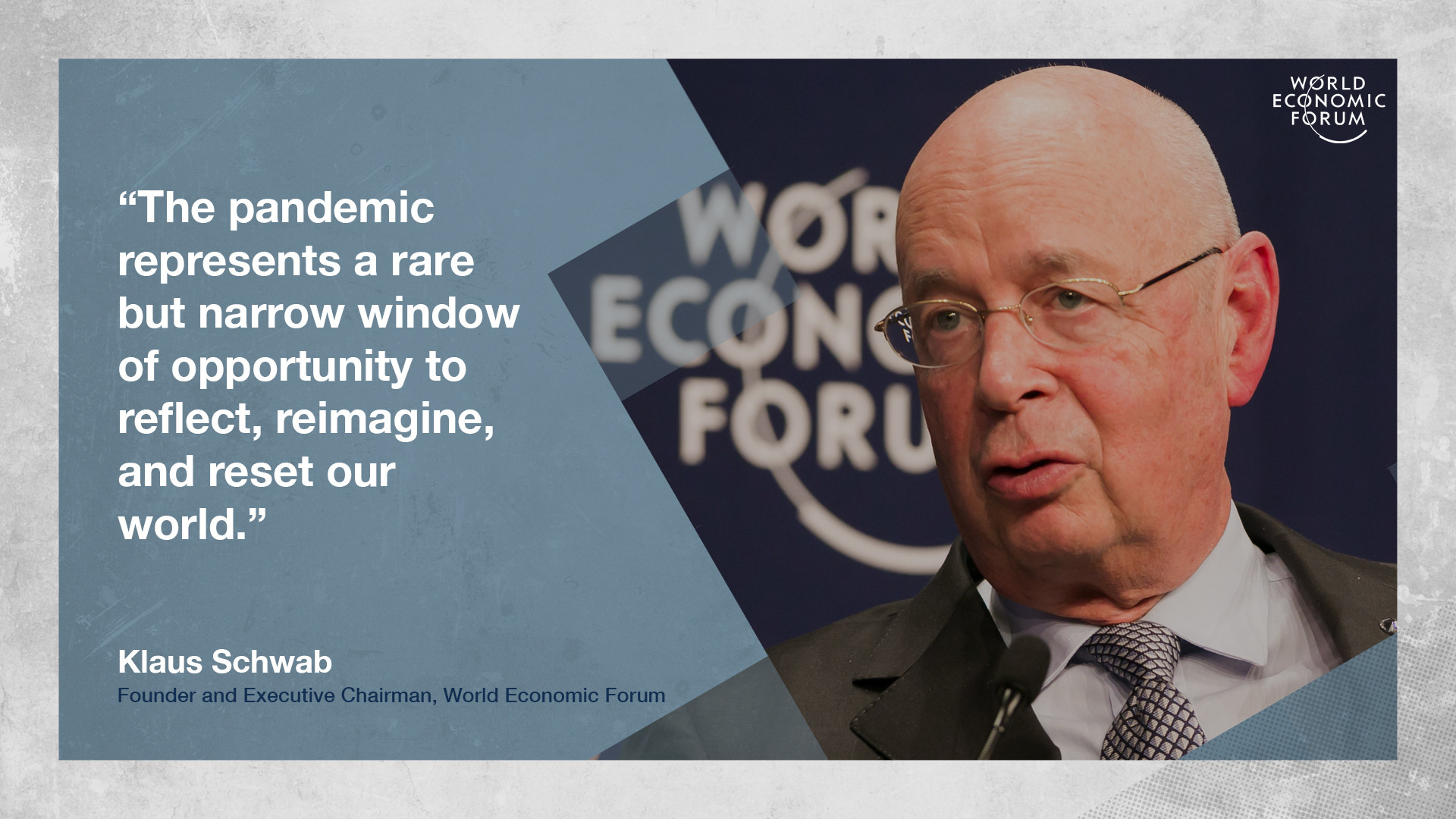
The COVID-19 crisis is affecting every facet of people’s lives in every corner of the world. But tragedy need not be its only legacy. On the contrary, the pandemic represents a rare but narrow window of opportunity to reflect, reimagine, and reset our world to create a healthier, more equitable, and more prosperous future.


Explore The Great Reset Transformation Map
Image: World Economic Forum

Surely all these rich people know what's best for you and everyone else on the planet and will guide us to that end.:rolleyes:
 
Wouldn't Bitcoin and other non central bank backed digital currencies also be another solution to gold and silver.

According to the author, if you don't use it, you'll lose it. And governments will have access to all your bitcoin balances through their computers.
 
The Great Reset Is Here
The Bretton Woods conference of 1944 set the global financial system that still prevails today. The period 1969-1971 can be regarded as the First Reset, which involved the creation of Special Drawing Rights (SDR, ticker:XDR), the devaluation of the dollar and the end of the gold standard.

For years, commentators (myself included) have discussed the next global monetary realignment, which is sometimes called The Big Reset or The Great Reset.

Now, it looks like the long-expected Great Reset is finally here.

Details vary depending on the source, but the basic idea is that the current global monetary system centered around the dollar is inherently unstable and needs to be reformed.

Part of the problem is due to a process called Triffin’s Dilemma, named after economist Robert Triffin. Triffin said that the issuer of a dominant reserve currency had to run trade deficits so that the rest of the world could have enough of the currency to buy goods from the issuer and expand world trade.

But, if you ran deficits long enough, you would eventually go broke. This was said about the dollar in the early 1960s.

In 1969, the International Monetary Fund (IMF) created the SDR, possibly to serve as a source of liquidity and alternative to the dollar.

In 1971, the dollar did devalue relative to gold and other major currencies. SDRs were issued by the IMF from 1970 to 1981. None were issued after 1981 until 2009 during the global financial crisis.

“Testing the Plumbing”
The 2009 issuance was a case of the IMF “testing the plumbing” of the system to make sure it worked properly. Because zero SDRs were issued from 1981–2009, the IMF wanted to rehearse the governance, computational, and legal processes for issuing SDRs.

The purpose was partly to alleviate liquidity concerns at the time, but it was also to make sure the system works, in case a large new issuance was needed on short notice. The 2009 experiment showed the system worked fine.

Since 2009, the IMF has proceeded in slow steps to create a platform for massive new issuances of SDRs and the creation of a deep liquid pool of SDR-denominated assets.

On January 7, 2011, the IMF issued a master plan for replacing the dollar with SDRs.

This included the creation of an SDR bond market, SDR dealers, and ancillary facilities such as repos, derivatives, settlement and clearance channels, and the entire apparatus of a liquid bond market.

A liquid bond market is critical. U.S. Treasury bonds are among the world’s most liquid securities, which makes the dollar a legitimate reserve currency.

The IMF study recommended that the SDR bond market replicate the infrastructure of the U.S. Treasury market, with hedging, financing, settlement and clearance mechanisms substantially similar to those used to support trading in Treasury securities today.

China Gets a Seat at the Monetary Table
In July 2016, the IMF issued a paper calling for the creation of a private SDR bond market. These bonds are called “M-SDRs” (for market SDRs), in contrast to “O-SDRs” (for official SDRs).

In August 2016, the World Bank announced that it would issue SDR-denominated bonds to private purchasers. Industrial and Commercial Bank of China (ICBC), the largest bank in China, will be the lead underwriter on the deal.

In September 2016, the IMF included the Chinese yuan in the SDR basket, giving China a seat at the monetary table.

So, the framework has been created to expand the SDR’s scope.

The SDR can be issued in abundance to IMF members and used in the future for a select list of the most important transactions in the world, including balance-of-payments settlements, oil pricing and the financial accounts of the world’s largest corporations, such as Exxon Mobil, Toyota and Royal Dutch Shell.

Now, the IMF is planning to issue $500 billion of new SDRs, although some Democrat senators are lobbying for an issue of $2 trillion SDRs or more.

This would be almost ten times the amount of SDRs issued in 2009 and would go a long way to increasing SDR liquidity and advancing the globalist agenda of eventually having the SDR replace the U.S. dollar as the leading reserve asset.

This proposal closely follows the global elite game plan predicted in chapter 2 of my 2016 book, The Road to Ruin.

Over the next several years, we will see the issuance of SDRs to transnational organizations, such as the U.N. and World Bank, to be spent on climate change infrastructure and other elite pet projects outside the supervision of any democratically elected bodies. I call this the New Blueprint for Worldwide Inflation.

More Than Just SDRs
But there’s more to the Great Reset than the issuance of new SDRs. Here’s another breaking news story that validates the longstanding prediction of a coming reset in the global financial system.

In 1999, the euro replaced the individual currencies of Germany, France, Netherlands, Italy and other major economies in Europe. Today, the number of countries that have joined the euro is up to 19, and more countries are awaiting admission.

The euro is the second largest reserve currency asset after the U.S. dollar. The creation of the euro can be thought of as a stepping stone from national currencies to a single world currency.

Now, the euro (along with the Chinese yuan) is moving quickly to become a Central Bank Digital Currency (CBDC). A CBDC combines a traditional currency with the blockchain technology of a cryptocurrency.

It’s an important move in the direction of eliminating cash and forcing users into a 100% digital system using credit cards, debit cards, and smartphone apps.

Why are China and Europe so focused on eliminating cash?

Use It or Lose It
I’ve said all along that you cannot put negative interest rates on consumers until you eliminate cash. Otherwise, savers would just withdraw cash from the banks and stuff it in mattresses to avoid the negative rates. Implicitly, the European Central Bank (ECB) seems to agree.

One of the ECB Board members says that negative rates (really confiscation) will be applied as a “penalty” against “hoarding” cash. In plain English, that means they will create digital money, force you to spend it, and if you don’t spend it, they will take it away as a “negative rate.”

Now all of the pieces of the global elite plan are converging.

The IMF SDR issuance will reliquify global central banks that cannot print dollars. Then CBDCs will be used to eliminate cash.

Once the cattle (that’s us) have been herded into the digital slaughterhouse, we will be told to “use it or lose it” when it comes to our own money. In other words, either we spend the money, or the government will take it away.

Of course, the spending can be channeled into politically correct causes by excluding unpopular vendors such as gun dealers or conservative social media platforms from the payment system. This represents total domination of human behavior through world money + digital currencies + confiscation.

This is not speculation anymore; it’s happening in front of our eyes. The Great Reset is coming fast. The future is here.

The only solution is to use a non-digital, non-bank store of wealth that cannot be traced or manipulated. Given the planned dollar devaluation, it’s one more reason to own physical gold and silver.

Get it while you still can.

Regards,

Jim Rickards
for The Daily Reckoning

https://dailyreckoning.com/the-great-reset-is-here/?utm_source=feedburner&utm_medium=feed&utm_campaign=Feed:+dailyreckoning+(The+Daily+Reckoning)

Arnie, thanks for the interesting article.

I don't really understand SDR's, but my take, it's another form of currency controlled by the IMF, and not backed by anything.

It looks like the U.S. dollar will eventually collapse, but doesn't logic demand we go back on the gold standard? The massive debt, countries have been suckered into, will still be on the hook. Somebody has to pay. That's basic economics.

If SDR's are not backed by anything, wouldn't this whole exercise become like a merry-go-round?

It's funny, I hold silver bars, no gold, and bought them awhile back because they were cheap, never thinking I'd be needing them for currency.
 
According to the author, if you don't use it, you'll lose it. And governments will have access to all your bitcoin balances through their computers.

Government's don't have control or access to your Bitcoin. Might need to read up on it to understand. What the article is referring to is a new digital currency that is created by the central banks in which they have control of. BTC is untouchable by central banks.
 
The Great Reset Is Here
The Bretton Woods conference of 1944 set the global financial system that still prevails today. The period 1969-1971 can be regarded as the First Reset, which involved the creation of Special Drawing Rights (SDR, ticker:XDR), the devaluation of the dollar and the end of the gold standard.

For years, commentators (myself included) have discussed the next global monetary realignment, which is sometimes called The Big Reset or The Great Reset.

Now, it looks like the long-expected Great Reset is finally here.

Details vary depending on the source, but the basic idea is that the current global monetary system centered around the dollar is inherently unstable and needs to be reformed.

Part of the problem is due to a process called Triffin’s Dilemma, named after economist Robert Triffin. Triffin said that the issuer of a dominant reserve currency had to run trade deficits so that the rest of the world could have enough of the currency to buy goods from the issuer and expand world trade.

But, if you ran deficits long enough, you would eventually go broke. This was said about the dollar in the early 1960s.

In 1969, the International Monetary Fund (IMF) created the SDR, possibly to serve as a source of liquidity and alternative to the dollar.

In 1971, the dollar did devalue relative to gold and other major currencies. SDRs were issued by the IMF from 1970 to 1981. None were issued after 1981 until 2009 during the global financial crisis.

“Testing the Plumbing”
The 2009 issuance was a case of the IMF “testing the plumbing” of the system to make sure it worked properly. Because zero SDRs were issued from 1981–2009, the IMF wanted to rehearse the governance, computational, and legal processes for issuing SDRs.

The purpose was partly to alleviate liquidity concerns at the time, but it was also to make sure the system works, in case a large new issuance was needed on short notice. The 2009 experiment showed the system worked fine.

Since 2009, the IMF has proceeded in slow steps to create a platform for massive new issuances of SDRs and the creation of a deep liquid pool of SDR-denominated assets.

On January 7, 2011, the IMF issued a master plan for replacing the dollar with SDRs.

This included the creation of an SDR bond market, SDR dealers, and ancillary facilities such as repos, derivatives, settlement and clearance channels, and the entire apparatus of a liquid bond market.

A liquid bond market is critical. U.S. Treasury bonds are among the world’s most liquid securities, which makes the dollar a legitimate reserve currency.

The IMF study recommended that the SDR bond market replicate the infrastructure of the U.S. Treasury market, with hedging, financing, settlement and clearance mechanisms substantially similar to those used to support trading in Treasury securities today.

China Gets a Seat at the Monetary Table
In July 2016, the IMF issued a paper calling for the creation of a private SDR bond market. These bonds are called “M-SDRs” (for market SDRs), in contrast to “O-SDRs” (for official SDRs).

In August 2016, the World Bank announced that it would issue SDR-denominated bonds to private purchasers. Industrial and Commercial Bank of China (ICBC), the largest bank in China, will be the lead underwriter on the deal.

In September 2016, the IMF included the Chinese yuan in the SDR basket, giving China a seat at the monetary table.

So, the framework has been created to expand the SDR’s scope.

The SDR can be issued in abundance to IMF members and used in the future for a select list of the most important transactions in the world, including balance-of-payments settlements, oil pricing and the financial accounts of the world’s largest corporations, such as Exxon Mobil, Toyota and Royal Dutch Shell.

Now, the IMF is planning to issue $500 billion of new SDRs, although some Democrat senators are lobbying for an issue of $2 trillion SDRs or more.

This would be almost ten times the amount of SDRs issued in 2009 and would go a long way to increasing SDR liquidity and advancing the globalist agenda of eventually having the SDR replace the U.S. dollar as the leading reserve asset.

This proposal closely follows the global elite game plan predicted in chapter 2 of my 2016 book, The Road to Ruin.

Over the next several years, we will see the issuance of SDRs to transnational organizations, such as the U.N. and World Bank, to be spent on climate change infrastructure and other elite pet projects outside the supervision of any democratically elected bodies. I call this the New Blueprint for Worldwide Inflation.

More Than Just SDRs
But there’s more to the Great Reset than the issuance of new SDRs. Here’s another breaking news story that validates the longstanding prediction of a coming reset in the global financial system.

In 1999, the euro replaced the individual currencies of Germany, France, Netherlands, Italy and other major economies in Europe. Today, the number of countries that have joined the euro is up to 19, and more countries are awaiting admission.

The euro is the second largest reserve currency asset after the U.S. dollar. The creation of the euro can be thought of as a stepping stone from national currencies to a single world currency.

Now, the euro (along with the Chinese yuan) is moving quickly to become a Central Bank Digital Currency (CBDC). A CBDC combines a traditional currency with the blockchain technology of a cryptocurrency.

It’s an important move in the direction of eliminating cash and forcing users into a 100% digital system using credit cards, debit cards, and smartphone apps.

Why are China and Europe so focused on eliminating cash?

Use It or Lose It
I’ve said all along that you cannot put negative interest rates on consumers until you eliminate cash. Otherwise, savers would just withdraw cash from the banks and stuff it in mattresses to avoid the negative rates. Implicitly, the European Central Bank (ECB) seems to agree.

One of the ECB Board members says that negative rates (really confiscation) will be applied as a “penalty” against “hoarding” cash. In plain English, that means they will create digital money, force you to spend it, and if you don’t spend it, they will take it away as a “negative rate.”

Now all of the pieces of the global elite plan are converging.

The IMF SDR issuance will reliquify global central banks that cannot print dollars. Then CBDCs will be used to eliminate cash.

Once the cattle (that’s us) have been herded into the digital slaughterhouse, we will be told to “use it or lose it” when it comes to our own money. In other words, either we spend the money, or the government will take it away.

Of course, the spending can be channeled into politically correct causes by excluding unpopular vendors such as gun dealers or conservative social media platforms from the payment system. This represents total domination of human behavior through world money + digital currencies + confiscation.

This is not speculation anymore; it’s happening in front of our eyes. The Great Reset is coming fast. The future is here.

The only solution is to use a non-digital, non-bank store of wealth that cannot be traced or manipulated. Given the planned dollar devaluation, it’s one more reason to own physical gold and silver.

Get it while you still can.

Regards,

Jim Rickards
for The Daily Reckoning

https://dailyreckoning.com/the-great-reset-is-here/?utm_source=feedburner&utm_medium=feed&utm_campaign=Feed:+dailyreckoning+(The+Daily+Reckoning)
This article has all the hallmarks of having been written by a lunatic. It intermingles truth, truthiness, and crazy shit to a lovely degree.
 
This article has all the hallmarks of having been written by a lunatic. It intermingles truth, truthiness, and crazy shit to a lovely degree.
You should know.
Piehole...ET's resident Educated Fool, Esq.
 
Back
Top