Bruce Bartlett held senior policy roles in the Reagan and George H.W. Bush administrations and served on the staffs of Representatives Jack Kemp and Ron Paul. He is the author of âThe Benefit and the Burden: Tax Reform â Why We Need It and What It Will Take.â
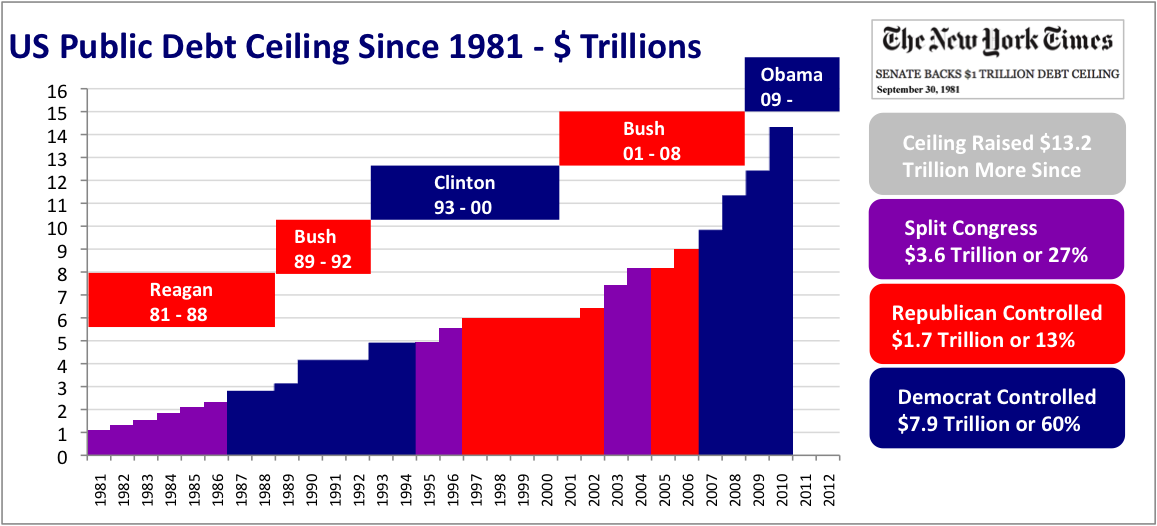
Republicans assert that Barack Obama assumed sole responsibility for the budget on Jan. 20, 2009. From that date, all increases in the debt or deficit are his responsibility and no one elseâs, they say.
This is, of course, nonsense â and the American people know it. As I documented in a previous post, even today 43 percent of them hold George W. Bush responsible for the current budget deficit versus only 14 percent who blame Mr. Obama.
The American people are right; Mr. Bush is more responsible, as a new report from the Congressional Budget Office documents.
In January 2001, the office projected that the federal government would run a total budget surplus of $3.5 trillion through 2008 if policy was unchanged and the economy continued according to forecast. In fact, there was a deficit of $5.5 trillion.
The projected surplus was primarily the result of two factors. First was a big tax increase in 1993 that every Republican in Congress voted against, saying that it would tank the economy. This belief was wrong. The economy boomed in 1994, growing 4.1 percent that year and strongly throughout the Clinton administration.
The second major contributor to budget surpluses that emerged in 1998 was tough budget controls that were part of the 1990 and 1993 budget deals. The main one was a requirement that spending could not be increased or taxes cut unless offset by spending cuts or tax increases. This was known as Paygo, for pay as you go.
During the 2000 campaign, Mr. Bush warned that budget surpluses were dangerous because Congress might spend them, even though Paygo rules prevented this from happening. His Feb. 28, 2001, budget message reiterated this point and asserted that future surpluses were likely to be even larger than projected due principally to anticipated strong revenue growth.
This was the primary justification for a big tax cut. Subsequently, as it became clear that the economy was slowing â a recession began in March 2001 â that became a further justification.
The 2001 tax cut did nothing to stimulate the economy, yet Republicans pushed for additional tax cuts in 2002, 2003, 2004, 2006 and 2008. The economy continued to languish even as the Treasury hemorrhaged revenue, which fell to 17.5 percent of the gross domestic product in 2008 from 20.6 percent in 2000. Republicans abolished Paygo in 2002, and spending rose to 20.7 percent of G.D.P. in 2008 from 18.2 percent in 2001.
http://economix.blogs.nytimes.com/2012/06/12/the-fiscal-legacy-of-george-w-bush/?partner=rss&emc=rss
Republicans assert that Barack Obama assumed sole responsibility for the budget on Jan. 20, 2009. From that date, all increases in the debt or deficit are his responsibility and no one elseâs, they say.
This is, of course, nonsense â and the American people know it. As I documented in a previous post, even today 43 percent of them hold George W. Bush responsible for the current budget deficit versus only 14 percent who blame Mr. Obama.
The American people are right; Mr. Bush is more responsible, as a new report from the Congressional Budget Office documents.
In January 2001, the office projected that the federal government would run a total budget surplus of $3.5 trillion through 2008 if policy was unchanged and the economy continued according to forecast. In fact, there was a deficit of $5.5 trillion.
The projected surplus was primarily the result of two factors. First was a big tax increase in 1993 that every Republican in Congress voted against, saying that it would tank the economy. This belief was wrong. The economy boomed in 1994, growing 4.1 percent that year and strongly throughout the Clinton administration.
The second major contributor to budget surpluses that emerged in 1998 was tough budget controls that were part of the 1990 and 1993 budget deals. The main one was a requirement that spending could not be increased or taxes cut unless offset by spending cuts or tax increases. This was known as Paygo, for pay as you go.
During the 2000 campaign, Mr. Bush warned that budget surpluses were dangerous because Congress might spend them, even though Paygo rules prevented this from happening. His Feb. 28, 2001, budget message reiterated this point and asserted that future surpluses were likely to be even larger than projected due principally to anticipated strong revenue growth.
This was the primary justification for a big tax cut. Subsequently, as it became clear that the economy was slowing â a recession began in March 2001 â that became a further justification.
The 2001 tax cut did nothing to stimulate the economy, yet Republicans pushed for additional tax cuts in 2002, 2003, 2004, 2006 and 2008. The economy continued to languish even as the Treasury hemorrhaged revenue, which fell to 17.5 percent of the gross domestic product in 2008 from 20.6 percent in 2000. Republicans abolished Paygo in 2002, and spending rose to 20.7 percent of G.D.P. in 2008 from 18.2 percent in 2001.
http://economix.blogs.nytimes.com/2012/06/12/the-fiscal-legacy-of-george-w-bush/?partner=rss&emc=rss