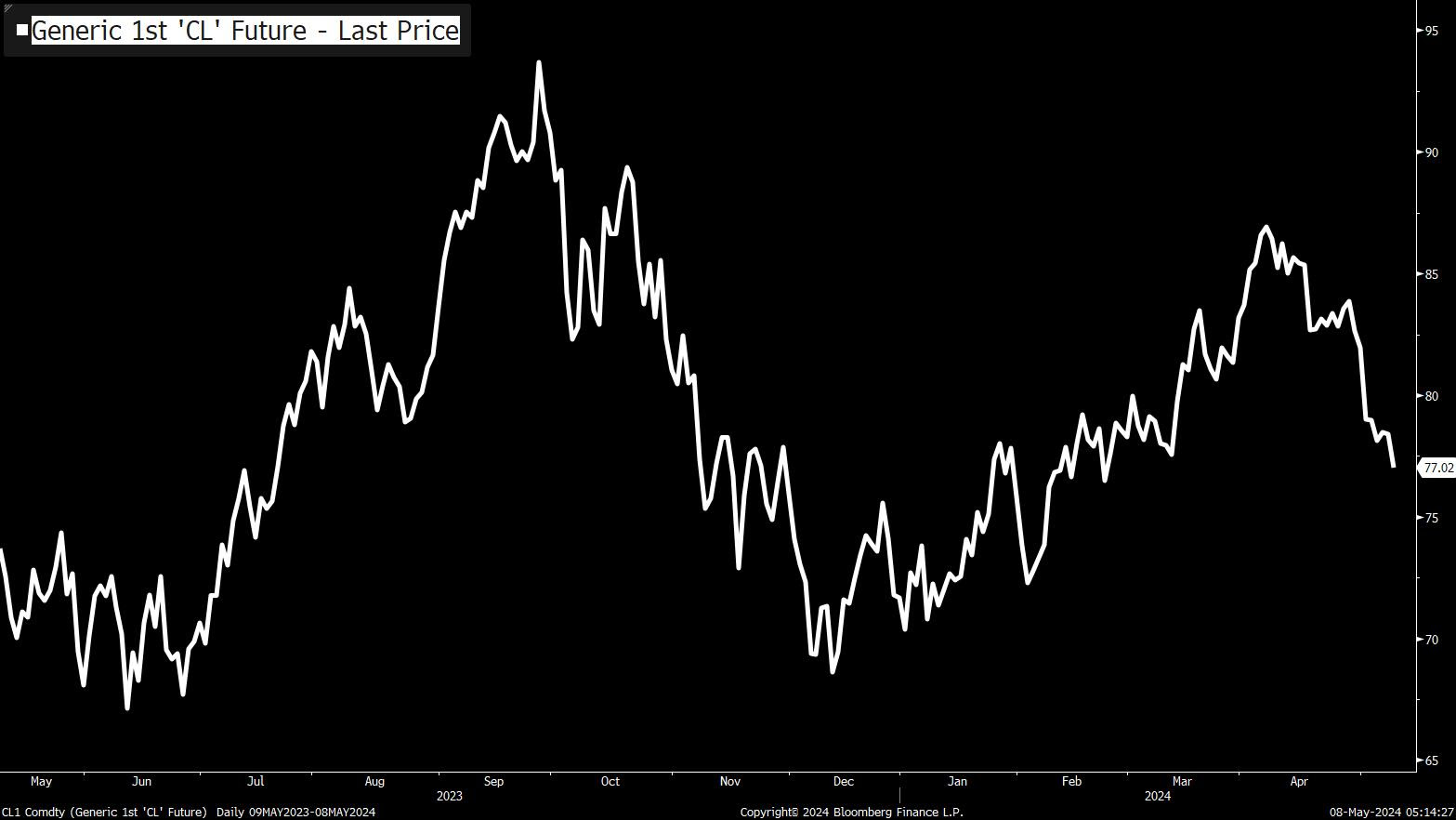
(Bloomberg) this morning and obviously they are not rightwingnuts loons when it comes to climate change kinda stuff but I note what Joe Weisenthal sez below which is exactly what I think as well and BTW not just in this country.
And finally, here's what Joe’s interested in this morning
Good morning. The price of a barrel of West Texas Intermediate crude is falling again today, and at least as of the time I'm typing this it's right around $77. Just a month ago, it was above $85.
Just from a simple macro standpoint, the line should help ease some of the "inflation overheating" narrative. Not only is this probably good news for gasoline costs, etc. but, since oil is an input into almost everything else one way or another, the decline should ease general pressures.
Also The White House's oil trading operation continues to look pretty good.
Back on April 2, the US canceled a plan to buy oil to refill the Strategic Petroleum Reserve.
Then yesterday, the administration said it planned to buy the dip, seeking as much as 3.3 million barrels.
So yeah, the trading isn't bad. But more importantly, we may be watching the full transformation of the SPR into its logical new purpose. When the US was a major oil importer, whose economy could be brought to its knees by the lack of imports, there was a very good case for a huge stockpile of crude to serve as a buffer against that external risk. But for awhile now, the US has been producing oil like crazy.
Thus the same facility, which previously was a geostrategic hedge, can now be used for more conventionally macro purposes. Oil can be released when prices get intolerably high, and oil can be bought when the price gets low enough, such that further US production growth becomes impaired. The idea seems to be working both in theory and in practice. Oil is famously boom-bust, which is why historically and globally, organizations like OPEC (or the early version of the Texas Railroad Commission) have played a role in allowing producers to coordinate. (There's a
great piece in Phenomenal World by
Greg Brew which walks through the history of oil market control and decontrol.)
Obviously oil is going to be an important commodity decades to come, but the question now is whether this new SPR model can be used for other critical commodities. Last week the company Albermarle, a major lithium producer, said it could
slow its pace of capital investment due to low spot prices for the metal. That may be a fine move for the company, but if you accept the premise that we're going to need a lot more lithium for EVs in the future, it's not great for long-term supply and capacity.
Hence you see
rising calls for the DOE to engage in SPR-like logic for these other commodities: Build up infrastructure (both physical and financial) to keep prices bid up, such that it doesn't slow down the pace of mining and production, which an then serve as a buffer when prices are creating a crunch.