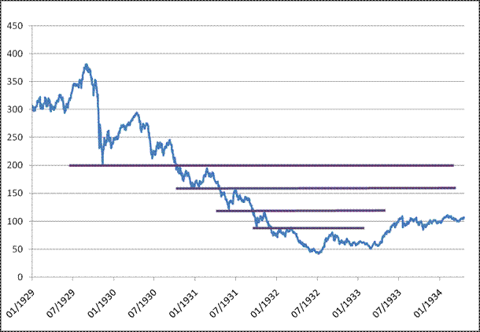
There may be some useful lessons to be learned from this. After all, everyone on this thread was i) mega-bearish on all these stocks (and more) ii) put real money on the line iii) had to deal with the numerous huge counter-trend rallies in the last few months iv) turned out to be 100% correct in their long-term view on the stocks.
I think the lesson here is that if you really are right, then if you hold on will eventually get paid handsomely - but there is no free lunch and your price for getting paid is to have numerous massive rallies against you, despite the being absolutely *zero* fundamental reasons for the stocks to go up.
Put simply - you just have to be able to hang on and ride out the volatility somehow. Ways to ride out the volatility:
1. Purchasing short-dated calls when the panic/selling gets extreme
2. Going naked short and having balls of steel and ignoring 100-200% bear market rallies against you
3. Having supernatural market timing abilities
4. Using long-dated puts
IMO 4 seems best for mortals, with 1 another attractive option (but only for smaller positions). 2 is hard and means you can only have small positions (e.g. if you were short a mere 20% in these perfect short candidates, you could easily have had a 20-30% drawdown in a few days on some occasions. So you could only really be short 5-10% tops, which is not an amazingly great payday even if all go to 0%).
Using my own experience from the last year, my big winners on the short side have been CFC, CORS, FNM, FRE. I used both outright shorts, long-dated deep OTM puts, and 1-6 month OTM puts too. My experience was as follows:
Outright shorts: I found that these are very hard to hang onto if you employ no hedging. Outright shorts seem to work best if you get in reasonably early, AND if you use either profit-taking or hedging with calls once the stocks get into a true panic selling mode. To identify when to profit-take or hedge with calls requires a high level of market timing ability, and even then is difficult to get right. Whereas to identify the stocks are going to get butchered is child's play by comparison. IMO it was several times easier to see all these stocks were going down, than it was to tell when they would rally 50, 100, 200%. So I would say outright shorts can be good for the early and middle period of a decline. But in the later period, you need to employ some kind of hedging technique, or take profits and run the risk of i) missing further declines ii) calling the low, then failing to re-enter your shorts, and seeing it go even lower iii) overnight bankruptcy or takeunder announcements (e.g. LEH, FNM, FRE).
Long-dated options: these generally worked best. I found it incredibly easy to hold on - I simply put 0.5-1% into each options position, then forgot about it. Occasionally I would roll down to a lower strike. Knowing the risk was limited made it easy to sleep at night, and thus easy to hold on long-term. The main downside was it took a LONG time for some stocks to get hammered. For example on CORS, I thought it would be bust by now, but it's still hanging on (albeit barely). My Jan 10 puts have done really well, but my Jan 09 puts are only up 2-3 fold, despite the stock falling 80%+ - the time decay seriously eroded the profit. With CORS I would have been better off just being naked short - in theory anyway...whether I could have held on to the shorts is another matter. Another advantage of LEAP puts is that the illiquidity discourages in and out timing - this means if you are right, you have a fairly low chance of prematurely exiting.
Short-dated options: these were hit or miss. I hit some home runs on FNM and FRE, but I found it difficult to time the moves. For each big winner I had 3 or 4 that expired worthless. If you have great timing ability to spot declines, they are a good play to juice returns, but i would not use them for anything more than 10% or so of your total bearish position.
Summary: if you are right on the fundies, and the market is not expecting the same event, then eventually the stocks WILL go down massively. However, you need to be able to take a LOT of heat in the meantime, and you need to be able to stay bearish for 12-18 months, maybe more. The extreme volatility and sharp rallies mean that you either have to trade small with your shorts, or have nerves of steel, or have great market-timing ability to spot bear-market bounces (and hedge using short-dated calls), or use buy and hold the ong-term OTM puts (1-2 years duration) and take the time decay as the cost of doing business.
Overall it reminds me a lot of the 2000-2002 tech wreck. I had similar experiences with stocks like PMC Sierra, Red Hat, Juniper Networks etc i.e. shorting, being correct, but being unable to handle the volatility on outright shorts.
I would recommend for future trades like this, using mostly long-dated puts, with maybe 1/4-1/3 in outright shorts, and hedging with short-dated calls once the panic seems to reach an extreme.
The biggest mistakes you can make are:
i) trading too big (the rallies will freak you out and make you cover some or all of your position)
ii) taking profits prematurely (the stocks WILL eventually get crucified, but you need to be patient. Don't exit just because it's down 70%).
iii) thinking that rallies in any way invalidate your trading thesis. 50-200% rallies are *normal* in these situations, even if the stock is going to $0.
iv) not hedging or reducing size once panic selling hits the stock (or, worse still, adding to shorts into panic selling)