BIS Explores Allowing Banks to Hold 1% of Reserves in Bitcoin
 Alejandro ArriecheLast updated: 4 July 2022
TwitterFacebookLinkedInFlipboardBitcoin (BTC) being one of the assets considered part of this group due to the absence of a counterparty.
The Basel Committee on Banking Supervision for BIS started to look into the topic of “prudential treatment of cryptoasset exposures” for financial institutions back in June 2021 due to the “rapid evolution and volatile nature of the cryptoasset market”.
“While the cryptoasset market remains small relative to the size of the global financial system, and banks’ exposures to cryptoassets are currently limited, its absolute size is meaningful and there continue to be rapid developments”, the Committee’s report states.
The report adds: “The Committee believes that the growth of crypto assets and related services has the potential to raise financial stability concerns and increase risks faced by banks”.
The BIS Plans to Draft a Standard for Cryptos Before the Year Ends
These public consultations are the first step to eventually drafting definite policies in regards to how digital assets must be treated by banks when assessing their risk and, more importantly, when they calculate their risk-weighted assets and how much capital they hold relative to that amount as part of their requirement to comply with the minimum required Tier 1 capital ratio.
The Committee will be receiving opinions and comments from all relevant parties until 30 September 2022 and aims to finalize a standard for the industry before the year ends.
Once the Committee drafts an industry-wide standard, banks would be set free to incorporate crypto assets into their balance sheet contingent on the approval of their respective local authorities.
What Could this Standard Mean for Crypto Adoption by Banks?
Since most countries adhere to Basel and apply most of the rules set forth by this committee, chances are that this would accelerate investments in the crypto market.
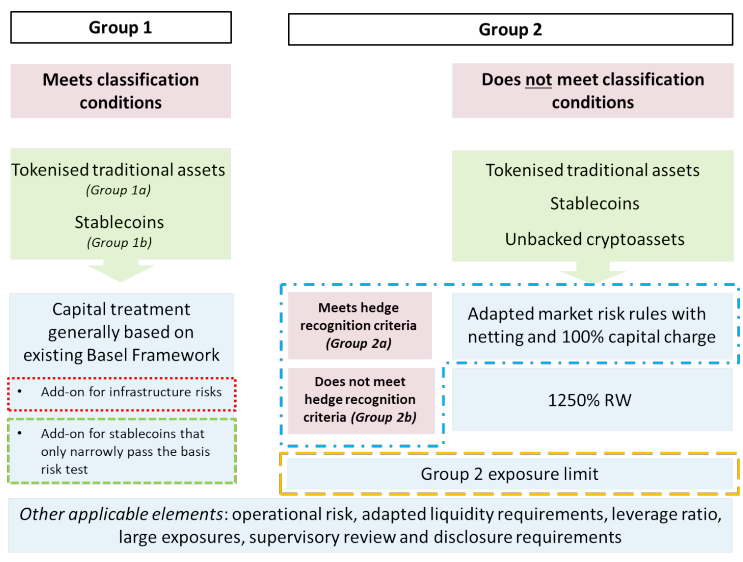
However, banks would probably scrutinize first if the potential earnings coming out of these investments justify the large amount that crypto assets would contribute to their risk-weighted asset base as, in some cases, the rules set forth in the Committee’s proposal state demand that group 2 assets are assigned a 1,250% weight on their absolute value.
In practical terms, if a bank targets a 10% minimum tier 1 capital ratio, a $10 exposure to these assets would demand $13.5 in capital to hit that target due to the extensive weight assigned to assets within this group.
This may discourage institutions from increasing their holdings of group 2 assets such as BTC and other similar crypto tokens.
On the other hand, the standardization of how crypto assets are treated by financial institutions could immediately result in higher demand for stablecoins and reserve-backed assets within the crypto ecosystem if banks decide to start offering access and exposure to these innovative financial instruments for their customers.
Alejandro ArriecheLast updated: 4 July 2022TwitterFacebookLinkedInFlipboardBitcoin (BTC) being one of the assets considered part of this group due to the absence of a counterparty.
The Basel Committee on Banking Supervision for BIS started to look into the topic of “prudential treatment of cryptoasset exposures” for financial institutions back in June 2021 due to the “rapid evolution and volatile nature of the cryptoasset market”.
“While the cryptoasset market remains small relative to the size of the global financial system, and banks’ exposures to cryptoassets are currently limited, its absolute size is meaningful and there continue to be rapid developments”, the Committee’s report states.
The report adds: “The Committee believes that the growth of crypto assets and related services has the potential to raise financial stability concerns and increase risks faced by banks”.
The BIS Plans to Draft a Standard for Cryptos Before the Year Ends
These public consultations are the first step to eventually drafting definite policies in regards to how digital assets must be treated by banks when assessing their risk and, more importantly, when they calculate their risk-weighted assets and how much capital they hold relative to that amount as part of their requirement to comply with the minimum required Tier 1 capital ratio.
The Committee will be receiving opinions and comments from all relevant parties until 30 September 2022 and aims to finalize a standard for the industry before the year ends.
Once the Committee drafts an industry-wide standard, banks would be set free to incorporate crypto assets into their balance sheet contingent on the approval of their respective local authorities.
What Could this Standard Mean for Crypto Adoption by Banks?
Since most countries adhere to Basel and apply most of the rules set forth by this committee, chances are that this would accelerate investments in the crypto market.
However, banks would probably scrutinize first if the potential earnings coming out of these investments justify the large amount that crypto assets would contribute to their risk-weighted asset base as, in some cases, the rules set forth in the Committee’s proposal state demand that group 2 assets are assigned a 1,250% weight on their absolute value.
In practical terms, if a bank targets a 10% minimum tier 1 capital ratio, a $10 exposure to these assets would demand $13.5 in capital to hit that target due to the extensive weight assigned to assets within this group.
This may discourage institutions from increasing their holdings of group 2 assets such as BTC and other similar crypto tokens.
On the other hand, the standardization of how crypto assets are treated by financial institutions could immediately result in higher demand for stablecoins and reserve-backed assets within the crypto ecosystem if banks decide to start offering access and exposure to these innovative financial instruments for their customers.

 Ana
Ana