Quote from Maverick74:
Ugh, I may have to e-mail Michael Covel and ask him where I saw it. I have a bunch of his books. I know that I saw the graphic somewhere. Still trying to dig it up.
This graphic I'm attaching isn't it, but it gives you an idea of how you could create the data yourself.
[/QUO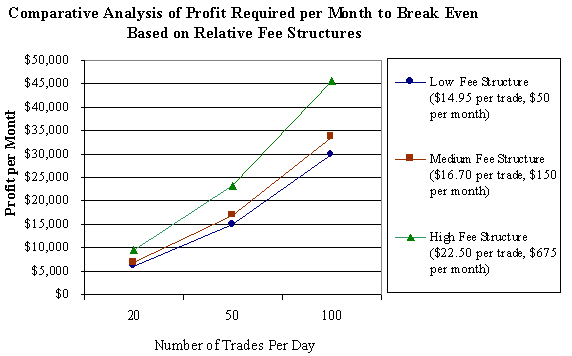
Thanks for this point well taken

You are using an out of date browser. It may not display this or other websites correctly.
You should upgrade or use an alternative browser.
You should upgrade or use an alternative browser.
The ACD Method
- Thread starter sbrowne126
- Start date
Quote from Maverick74:
Let me also warn and re-iterate what Fisher said on the last webinar when I asked him about sentiment readings. I, nor he, would NEVER make a trade solely based on ISEE readings. It's simply one variable among many. I watch the ISEE readings because it gives you a good feel on day to day sentiment which you can cross reference with your number lines or A levels. But ALL my trading decisions are number line based. Not on sentiment. [/B]
While my questions below are directed toward Maverick, I would be interested in anyone's thoughts on the topic of number lines.
Fisher made it very clear that markets obviously evolve and trading tactics and strategies need to evolve as well. With respect to number lines, do you still use the method of calculation outlined originally in the Logical Trader or have you modified it over time? Do you have any observations on how to calculate number lines that differ from Fisher's that you would be willing to share? On a related note, Fisher mentioned using second, midday ranges in energy and index products as reference points. Do you use these and do they impact how you calculate number lines?
I have been looking at trying to incorporate other relevant but irregular points in this process. For example, a second OR coincident with an FOMC release or an 11AM Grain report such as last Friday's with respect to the grain markets. Another observation there is a continued influence of the old 930 central open time point despite the official open now being 830.
Thanks for all of your help. Hope this spurs some useful discussion.
Quote from OneFive:
While my questions below are directed toward Maverick, I would be interested in anyone's thoughts on the topic of number lines.
Fisher made it very clear that markets obviously evolve and trading tactics and strategies need to evolve as well. With respect to number lines, do you still use the method of calculation outlined originally in the Logical Trader or have you modified it over time? Do you have any observations on how to calculate number lines that differ from Fisher's that you would be willing to share? On a related note, Fisher mentioned using second, midday ranges in energy and index products as reference points. Do you use these and do they impact how you calculate number lines?
I have been looking at trying to incorporate other relevant but irregular points in this process. For example, a second OR coincident with an FOMC release or an 11AM Grain report such as last Friday's with respect to the grain markets. Another observation there is a continued influence of the old 930 central open time point despite the official open now being 830.
Thanks for all of your help. Hope this spurs some useful discussion.
I have modified my number lines considerably from his. But let me make this point, as it's very important, I modified my number lines based on MY personal trading experience over the last 15 years. I wanted them to make sense to me. I have to score them everyday so it only makes sense if I want them to be accurate I should base them on how I see the market. The number lines are THE most vital part of my strategy so I maintain them with great precision. Which is why I would NEVER automate them.
More importantly, it's not just how I score them that's different then Fisher but also how I use them that's different. I've said this probably many times already on this thread but it's worth repeating, Fisher's book from over a decade ago should serve as a general outline. Ultimately you have to reconfigure it to match your own personality and style. This is why I am always so reluctant when people always ask me how I do this or that as if I have the secret recipe and don't want to share. No two people have the same aggregate trading experience or most people don't even have the same style of trading, so using numbers and time frames and caveats from someone else will prove ineffective.
What CAN be effective and what I've made an effort to do over the years (yes years) on this thread is to point out unusual things I see in the market to draw your attention to them. Then you can look at those products and see if your data is giving you anything to act on.
Just remember some core basic principles as you are putting together your ACD machine, the importance of time and cycles, less is more (filter), the concept of rarity, locate opportunities BEFORE the crowd. My general rule of thumb is if my ideas are being discussed on Fast Money, then the trade is out. If you get all these principles incorporated into your ACD machine, you will do just fine.
And yes, I played around with the mid day cycles and they can be effective. I used them a lot back in 2008 and 2009 when the spoos were having 80 handles ranges.
Thanks, Maverick, for the insight and advice. I have been working through developing my own modifications. Of course, this leads to the need for an interpretation of the numbers I am generating since what will be meaningful in my system may not be very similar to the Fisher system or any other. Since this is a product of experience but also data collection, do you have any thoughts on how much data to accumulate in order to derive useful parameters? While I could potentially backtest this, my sense is that I need to accumulate this data and experience over real time to develop the understanding of what is happening and how to interpret the results. Your own experience in modifying the number line parameters could prove pretty helpful, not in terms of what to use, but how long it took you before you got to a point of comfort and confidence that your methods were solid. Are there any pitfalls to be especially aware of in trying to build a personal model?
Thanks again.
Thanks again.
Quote from OneFive:
Thanks, Maverick, for the insight and advice. I have been working through developing my own modifications. Of course, this leads to the need for an interpretation of the numbers I am generating since what will be meaningful in my system may not be very similar to the Fisher system or any other. Since this is a product of experience but also data collection, do you have any thoughts on how much data to accumulate in order to derive useful parameters? While I could potentially backtest this, my sense is that I need to accumulate this data and experience over real time to develop the understanding of what is happening and how to interpret the results. Your own experience in modifying the number line parameters could prove pretty helpful, not in terms of what to use, but how long it took you before you got to a point of comfort and confidence that your methods were solid. Are there any pitfalls to be especially aware of in trying to build a personal model?
Thanks again.
Do NOT backtest. Form a hypothesis first based on whatever experience or knowledge you have (as little as it may me), then collect data and see if the data is agreeing with your hypothesis. Not the other way around. One you have some sound ideas, the important thing to remember is to be absolutely consistent in how you analyze and compare your data. Remember, form the idea first, then collect the data. Don't just grab a lot of data and say, oh, it looks like every time there is an A Up on monday, there is follow through the rest of the week. You'll be chasing a lot of rabbits.
Try to form a scoring system that is consistent. Maybe all currencies get scored one way and equities another. But don't take ideas that work in equities and just arbitrarily apply them to currencies. Make sure when comparing relative strength or weakness that you are doing it in the same time frames with the same OR so you can measure data specifically from that time period. This can get tricky with commodities vs commodity ETF's for example. And even more so with currencies. Since currencies have three different main time zones.
It's going to take a lot of time. I doubt most people will ever put the effort into it which means there is a lot of edge out there for you if you are willing to make that time sacrifice. I promise you this, if you put the time into the number line analysis, you will get information that absolutely no one out there is getting from price charts. But there are no shortcuts unfortunately. Just be consistent, match up the time frames and OR consistently, form your ideas first, collect the data and try to be objective as you can about the results.
One thing I try to do is keep everything ACD based. I don't mix and match with other technical stuff. So I'm always asking myself the question, does this make sense with the core ACD logic? Is this what should be happening? If the data is giving me something inconclusive, I do NOT try to manipulate the data to agree with me. I come up with new ideas. There is an old saying in statistics, if you torture data enough, you can make it say anything.
If you tell me what products you are specifically looking at I can try to give you some more pointers specifically geared towards those products.
Quote from Maverick74:
STPP has confirmed and moving higher. This is the curve steepener trade I recommended a few weeks back. Very safe way to play the risk trade.
Not sure how many of you guys are watching this STPP, but it's had a nice 30% move the last two months. Performed much better then being long the S&P.
Quote from Maverick74:
Not sure how many of you guys are watching this STPP, but it's had a nice 30% move the last two months. Performed much better then being long the S&P.
I missed that one...anything else that currently catches your eye? What is your analysis on the forex pairs? Thanks.
Quote from koolaid:
I missed that one...anything else that currently catches your eye? What is your analysis on the forex pairs? Thanks.
Sure, this catches my eye. Regional banks on fire.
Mostly do to this:
This is why I point these things out. Even if one does not wish to trade STPP itself, that chart gives you a perfect trade setup in KRE.