
You are using an out of date browser. It may not display this or other websites correctly.
You should upgrade or use an alternative browser.
You should upgrade or use an alternative browser.
Texas schools board rewrites US history with lessons promoting God and guns
- Thread starter walter4
- Start date


The real irony must be in the fact that....the Bill of Rights constitutes in law how state governance is to be free from, and free of, the very thing you imagine the country was founded on.Quote from jem:
The irony.... liberals do not even grasp the idea of a limited Federal Government anymore they do not realize why the bill of rights was voted in during the Constitutional Convention.
They do not understand the the majority of states already had very strong ties to Christian Churches at the time of the Constitutional Convention and that the States were afraid the Feds were going to pick a state religion. Hence they required the bill of rights.
Liberals do not realize the bill of Rights was written to make sure the Federal Government did not seize state power. They do not know three quarters of the states had ties to state Churches, paid for Christian education in schools, and or required that its state officials be Christians or believers in God to hold office.
The list goes on and on about how Christian the States were and they set up the Constitution to protect themselves from the feds.

Quote from stu:
The real irony must be in the fact that....the Bill of Rights constitutes in law how state governance is to be free from, and free of, the very thing you imagine the country was founded on.
are you high or do you just enjoy lying to support your atheist delusions.
wikipedia understands the establishment clause and we know no revisonist liberal likes to leave those pages unchallenged.
http://en.wikipedia.org/wiki/Establishment_Clause_of_the_First_Amendment
The Establishment Clause of the First Amendment refers to the first of several pronouncements in the First Amendment to the United States Constitution, stating that "Congress shall make no law respecting an establishment of religion". Together with the Free Exercise Clause ("... or prohibiting the free exercise thereof"), these two clauses make up what are commonly said as the "religion clauses" of the First Amendment.
The establishment clause has generally been interpreted to prohibit 1) the establishment of a national religion by Congress, or 2) the preference of one religion over another. The first approach is called the "separation" or "no aid" interpretation, while the second approach is called the "non-preferential" or "accommodation" interpretation. The accommodation interpretation prohibits Congress from preferring one religion over another, but does not prohibit the government's entry into religious domain to make accommodations in order to achieve the purposes of the Free Exercise Clause.
The clause itself was seen as a reaction to the Church of England, established as the official church of England and some of the colonies, during the colonial era.
---
I have told you this a dozen times starting long before this appeared in wikipedia... (to my knowlege) and you still are confused.
Quote from jem:
are you high or do you just enjoy lying to support your atheist delusions.
wikipedia understands the establishment clause and we know no revisonist liberal likes to leave those pages unchallenged.
http://en.wikipedia.org/wiki/Establishment_Clause_of_the_First_Amendment
The Establishment Clause of the First Amendment refers to the first of several pronouncements in the First Amendment to the United States Constitution, stating that "Congress shall make no law respecting an establishment of religion". Together with the Free Exercise Clause ("... or prohibiting the free exercise thereof"), these two clauses make up what are commonly said as the "religion clauses" of the First Amendment.
The establishment clause has generally been interpreted to prohibit 1) the establishment of a national religion by Congress, or 2) the preference of one religion over another. The first approach is called the "separation" or "no aid" interpretation, while the second approach is called the "non-preferential" or "accommodation" interpretation. The accommodation interpretation prohibits Congress from preferring one religion over another, but does not prohibit the government's entry into religious domain to make accommodations in order to achieve the purposes of the Free Exercise Clause.
The clause itself was seen as a reaction to the Church of England, established as the official church of England and some of the colonies, during the colonial era.
---
I have told you this a dozen times starting long before this appeared in wikipedia... (to my knowlege) and you still are confused.
Your perverse line of argument then is still to make up incorrect religiously skewed statements, post a link yourself in which it confirms your statements are incorrect , and then claim your statements are correct.
Same as when you've pretended scientists say one thing, post a Utube vid yourself which proves they don't, then quite contrarily and absurdly claim via a whole mess of religious delusion, that they do.
Prime candidate for a Texas schools board.
If only you had an ounce of integrity or a brain... cause something is missing.
I would say the term perverse should be applied to your constant distortions of history and reality.
Do you not understand the establishment clause was incorporated at the constitutional convention so that the Feds could not establish a National Church.
It says it right their in the quote... can't you read.
but if you read another few paragraphs you would see this..
Incorporation of the Establishment Clause in 1947,[4] however, was much more tricky and has been subject to much more critique.[5][6][7][8][9] The controversy surrounding Establishment Clause incorporation primarily stems from the fact that the Establishment Clause was intended to prevent Congress from interfering with state establishments of religion that existed at the time of the founding (at least six states had established religions at the founding[10]) â a fact conceded by even those members of the Court who believe the Establishment Clause was made applicable to the states through incorporation.[11] Critics have also argued that the Due Process Clause of the Fourteenth Amendment is understood to incorporate only individual rights found in the Bill of Rights; the Establishment Clause - unlike the Free Exercise Clause (which critics readily concede protects individual rights)[12][13] - does not purport to protect individual rights.[14]
Let me make clear... go back an read the sentence about preventing congress from interfering with state establishments of religion.
See that... that is plain fricken english for you Stu. How are your atheist whack job revisionists going to deal these facts - facts I always provide for you.
I would say the term perverse should be applied to your constant distortions of history and reality.
Do you not understand the establishment clause was incorporated at the constitutional convention so that the Feds could not establish a National Church.
It says it right their in the quote... can't you read.
but if you read another few paragraphs you would see this..
Incorporation of the Establishment Clause in 1947,[4] however, was much more tricky and has been subject to much more critique.[5][6][7][8][9] The controversy surrounding Establishment Clause incorporation primarily stems from the fact that the Establishment Clause was intended to prevent Congress from interfering with state establishments of religion that existed at the time of the founding (at least six states had established religions at the founding[10]) â a fact conceded by even those members of the Court who believe the Establishment Clause was made applicable to the states through incorporation.[11] Critics have also argued that the Due Process Clause of the Fourteenth Amendment is understood to incorporate only individual rights found in the Bill of Rights; the Establishment Clause - unlike the Free Exercise Clause (which critics readily concede protects individual rights)[12][13] - does not purport to protect individual rights.[14]
Let me make clear... go back an read the sentence about preventing congress from interfering with state establishments of religion.
See that... that is plain fricken english for you Stu. How are your atheist whack job revisionists going to deal these facts - facts I always provide for you.
The wikipedia link simply confirms the argument you made remains misguided, incorrect and as usual, hopelessly skewed.
Like I say, religiously backed intolerance of anyone who doesn't join in with its psychoneurotic side affects makes you an ideal candidate for a Texas school board.
Trying to use separate controversial arguments by interpreting what... "Congress shall make no law respecting an establishment of religion" .....might mean , just demonstrates how desperate , dishonest , erroneous religious belief will use any form of guile to deceive. But then that has always been your preferred method. Ill conceived and confused argument.
Fact remains, The Bill of Rights were founding legal documents which effectively removed, by law, from states' action or control, the very thing you are fantasizing the country was founded on.
Just get over it.
Arguing the Bill of Rights was to stop the Fed as you do, is at best a disingenuous smoke screen. But even if it was so, by instigating those Bill of Rights, de facto any religiously motivated states would have brainlessly shot the legality of their childish superstitious motives straight in the head.
Why not make that application for a Texas school job.
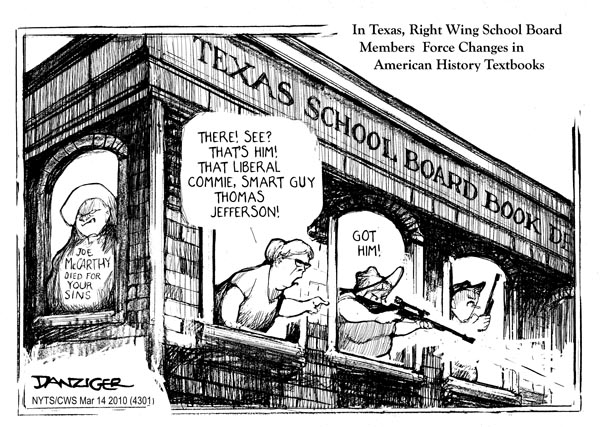
Like I say, religiously backed intolerance of anyone who doesn't join in with its psychoneurotic side affects makes you an ideal candidate for a Texas school board.
Trying to use separate controversial arguments by interpreting what... "Congress shall make no law respecting an establishment of religion" .....might mean , just demonstrates how desperate , dishonest , erroneous religious belief will use any form of guile to deceive. But then that has always been your preferred method. Ill conceived and confused argument.
Fact remains, The Bill of Rights were founding legal documents which effectively removed, by law, from states' action or control, the very thing you are fantasizing the country was founded on.
Just get over it.
Arguing the Bill of Rights was to stop the Fed as you do, is at best a disingenuous smoke screen. But even if it was so, by instigating those Bill of Rights, de facto any religiously motivated states would have brainlessly shot the legality of their childish superstitious motives straight in the head.
Why not make that application for a Texas school job.
Quote from jem:
If only you had an ounce of integrity or a brain... cause something is missing.
I would say the term perverse should be applied to your constant distortions of history and reality.
Do you not understand the establishment clause was incorporated at the constitutional convention so that the Feds could not establish a National Church.
It says it right their in the quote... can't you read.
but if you read another few paragraphs you would see this..
Incorporation of the Establishment Clause in 1947,[4] however, was much more tricky and has been subject to much more critique.[5][6][7][8][9] The controversy surrounding Establishment Clause incorporation primarily stems from the fact that the Establishment Clause was intended to prevent Congress from interfering with state establishments of religion that existed at the time of the founding (at least six states had established religions at the founding[10]) â a fact conceded by even those members of the Court who believe the Establishment Clause was made applicable to the states through incorporation.[11] Critics have also argued that the Due Process Clause of the Fourteenth Amendment is understood to incorporate only individual rights found in the Bill of Rights; the Establishment Clause - unlike the Free Exercise Clause (which critics readily concede protects individual rights)[12][13] - does not purport to protect individual rights.[14]
Let me make clear... go back an read the sentence about preventing congress from interfering with state establishments of religion.
See that... that is plain fricken english for you Stu. How are your atheist whack job revisionists going to deal these facts - facts I always provide for you.
Quote from stu:
The wikipedia link simply confirms the argument you made remains misguided, incorrect and as usual, hopelessly skewed.
Like I say, religiously backed intolerance of anyone who doesn't join in with its psychoneurotic side affects makes you an ideal candidate for a Texas school board.
Trying to use separate controversial arguments by interpreting what... "Congress shall make no law respecting an establishment of religion" .....might mean , just demonstrates how desperate , dishonest , erroneous religious belief will use any form of guile to deceive. But then that has always been your preferred method. Ill conceived and confused argument.
Fact remains, The Bill of Rights were founding legal documents which effectively removed, by law, from states' action or control, the very thing you are fantasizing the country was founded on.
Just get over it.
Arguing the Bill of Rights was to stop the Fed as you do, is at best a disingenuous smoke screen. But even if it was so, by instigating those Bill of Rights, de facto any religiously motivated states would have brainlessly shot the legality of their childish superstitious motives straight in the head.
Why not make that application for a Texas school job.
You pretend to be ignorant.
Are you an American?
Every educated American knows the Bill of Rights was included to throttle the anticipated Federal govt. Your argument is impossible because the 14 th amendment did not come out for about another century.
The establishment clause was not applied to the states for close to 2 centuries.
again from wikipedia... and what every educated american knows.
Prior to the enactment of the Fourteenth Amendment to the United States Constitution in 1868, the Supreme Court generally held that the substantive protections of the Bill of Rights did not apply to state governments. Subsequently, under the Incorporation doctrine, the Bill of Rights have been broadly applied to limit state and local government as well. The process of incorporating the two Religion Clauses in the First Amendment was two-fold. The first step was the Supreme Courtâs conclusion in 1940 that the Free Exercise Clause was made applicable to the states through the Fourteenth Amendment.[1] Conceptually, this raised few difficulties: the Due Process Clause protects those rights in the Bill of Rights âimplicit in the concept of ordered liberty,â[2] and free exercise of religion is a quintessential individual right (and had been recognized as such at the state level from the beginning).[3]
Incorporation of the Establishment Clause in 1947,[4] however, was much more tricky and has been subject to much more critique.[5][6][7][8][9] The controversy surrounding Establishment Clause incorporation primarily stems from the fact that the Establishment Clause was intended to prevent Congress from interfering with state establishments of religion that existed at the time of the founding (at least six states had established religions at the founding[10]) â a fact conceded by even those members of the Court who believe the Establishment Clause was made applicable to the states through incorporation.[11] Critics have also argued that the Due Process Clause of the Fourteenth Amendment is understood to incorporate only individual rights found in the Bill of Rights; the Establishment Clause - unlike the Free Exercise Clause (which critics readily concede protects individual rights)[12][13] - does not purport to protect individual rights.[14]
The incorporation of the Bill of Rights (or incorporation for short) is the process by which American courts have applied portions of the U.S. Bill of Rights to the states. In the past, the Bill of Rights was held only to apply to the federal government. Under the incorporation doctrine, certain provisions of the Bill of Rights now also apply to the states, by virtue of the due process clause of the Fourteenth Amendment of the Constitution.
Prior to the ratification of the Fourteenth Amendment and the development of the incorporation doctrine, in 1833 the Supreme Court held in Barron v. Baltimore that the Bill of Rights applied only to the federal, but not any state, government. Even years after the ratification of the Fourteenth Amendment the Supreme Court in United States v. Cruikshank, still held that the First and Second Amendment did not apply to state governments. However, beginning in the 1890s, a series of United States Supreme Court decisions interpreted the Fourteenth Amendment to "incorporate" most portions of the Bill of Rights, making these portions, for the first time, enforceable against the state governments.
---
Prior to the ratification of the Fourteenth Amendment and the development of the incorporation doctrine, in 1833 the Supreme Court held in Barron v. Baltimore that the Bill of Rights applied only to the federal, but not any state, government. Even years after the ratification of the Fourteenth Amendment the Supreme Court in United States v. Cruikshank, still held that the First and Second Amendment did not apply to state governments. However, beginning in the 1890s, a series of United States Supreme Court decisions interpreted the Fourteenth Amendment to "incorporate" most portions of the Bill of Rights, making these portions, for the first time, enforceable against the state governments.
---