Guess I'm not alone thinking this:
https://electrek.co/2024/05/12/tari...win-the-ev-arms-race-taking-evs-seriously-is/
Ta
riffs on China aren’t the way to win the EV arms race – getting serious on EVs is
 Jameson Dow
 | May 12 2024 - 6:00 am PT
105 Comments
News came out on Friday that President Biden is set to
quadruple tariffs on Chinese EVs to protect the US auto industry from the rapid growth of Chinese EV manufacturing.
But instead of just de facto banning the competition from giving Americans access to affordable hot new EVs, the US should instead try
making affordable hot new EVs itself.
The global auto industry is in a time of flux.
Cars are changing quickly, as is car manufacturing. The leaders of today, and of the last half-century, are not guaranteed to remain the leaders in the face of new entrants and new technology. And most of all, a new powertrain – electric – that will account for roughly 100% of cars on the road within a couple decades, which no serious person disputes.
Further, as one of the most polluting sectors globally and the
most polluting in rich countries, it is necessary that transportation clean up its act, and fast, in order to avoid the worst effects of climate change. The sooner this happens, the easier it will be for all of us.
The new entrants to car manufacturing aren’t just in the form of startups like Tesla or Rivian, but in the form of nations which previously did not have a large presence in international auto manufacturing, but will take advantage of this flux to become more competitive in a changing global market.
The largest of these new entrants is the second most populous country in the world, the world’s largest exporter and its second-largest economy: China. China has heretofore not been a major player in car exports, but that’s changing.
China has been spending the last couple decades building up its manufacturing base, particularly in electronics, and
particularly focusing on securing raw material supplies and partnerships and on building up refining capacity.
The strongest move in this respect has been Xi Jinping’s centerpiece
Belt and Road Initiative, a set of policies intended to secure trade routes and mineral partnerships between China and less-developed, mineral-rich countries, generally in exchange for infrastructure development. It’s not unlike the actions of the West via the IMF and the World Bank, investing in development of poorer countries in order to secure material partnerships.
All of these entities have been credibly accused of exploitative actions towards the developing world – generally utilizing terms like economic imperialism, debt-trap diplomacy, or neocolonialism.
But the point of this is that China has been getting ready for this transition for a long time through concerted national effort, whereas the US is only recently doing so (via the Inflation Reduction Act and its attempts to onshore/”friend-shore” EV manufacturing and sourcing).
Japan and the 1970s as parable
We have, in fact, seen this story before. In the 1970s, the US auto industry was rocked by dual crises, a gas price crisis that left their large, gas-guzzling vehicles less competitive, and a steel crisis which greatly affected US steel manufacturers.
The steel crisis came courtesy of Japan, a country whose manufacturing methods far outstripped America’s, and which was determined to undercut American steel. It could produce steel cheaper and better than the US, and the low prices that Japan was offering were simply unbeatable by American manufacturers. As a result, many American steelworkers lost their jobs.
Here’s
an article about the steel crisis from 2021 from the Alliance for American Manufacturing, which makes parallels to today’s situation between the US and China. In it, former steelworkers are quoted about what happened at the time:
The cost was cheaper, and their quality was better, too. We didn’t care about quality because we were the only game in town forever.
-ED COOK, FORMER PRESIDENT USW LOCAL 3069
The U.S. steelmakers and, as time wore on, the automakers, were being outperformed by Japan and their superior technology advancements. Our employers didn’t invest in new technology until recognizing the concept of foreign competition was here to stay.
-DOUG MAY, RETIRED STEELWORKER
The US tried to stop the bleeding with tariffs after accusing Japan of illegally “dumping” steel at unfairly subsidized below-market rates to gain export market share. But the tariffs didn’t stop the advancement of the technologically-superior Japanese steel industry, which remained strong even after their imposition.
The early-70s steel crisis was soon joined by the mid-to-late-70s oil crisis, where the US (and much of the Western world) saw oil shortages and high gas prices. At the time, American automakers mostly produced giant gas guzzlers, and Japanese automakers exploited this crisis by rapidly introducing smaller, more fuel efficient cars to America, just as the environmental movement was starting to gain steam and emissions regulations were starting to take effect.
Automakers responded by undergoing half-baked attempts to meet the standards while still trying to sell their gas guzzlers, by lobbying governments not to implement regulations, and begging for tariffs against competing Japanese autos. Not by actually rising to the challenge and making better vehicles, but rather by asking for the rules to be changed so they could get a free win by doing nothing new.
Eventually, Japan agreed to voluntary export restrictions and US automakers managed to get in gear and start making better cars. But
as a result of this disruption in the 1970s, Japan is
still considered one of the premier manufacturing industries in the world (automotive and otherwise), and has held the crown of the largest auto-exporting country on the globe for decades.
Between preparation, determination, and opportunity, Japan was able to gain a lasting lead.
Does any of this sound familiar?
China is the new Japan
Well, Japan
was the world’s largest auto exporter… until now. It depends on how you count it, but Japan was
likely dethroned by China as the world’s largest car exporter in the past year.
All of China’s effort to build EV manufacturing bore fruit – while the country was initially slow to adopt EVs, in 2023 it had a whopping 37% EV market share (up from 5% in 2020 and .84% in 2015), leapfrogging several early adopter nations. But EV manufacturing has grown even faster, with Chinese EV production outpacing domestic demand and exports rising rapidly in recent years as well.
Why did this happen? It turns out, Japanese industry is acting similarly to US industry at the moment, in that it is
dragging its feet on electric vehicles (in fact, even moreso than US manufacturers are). European manufacturers, too,
are trying to slow the transition down. Automakers are even cutting production plans in a rapidly growing EV market, possibly in a
cynical move to influence regulations, even though
it’s clear their targets are too low already.
While Biden has pushed for stronger emissions standards, automakers seem determined to lobby against progress, to give themselves a false sense of security that they can take their sweet time in transitioning to EVs.
But regardless of how much automakers kick and scream about needing to build something other than massive gas guzzling land yachts, technology and world industry will continue their inexorable advancement. The industry can catch up, or it can continue dragging its feet and moving slower than its competition, somehow hoping to catch up from the losing position it’s already in.
None of this kicking and screaming is happening in China.
As mentioned above, Chinese government has focused heavily on securing materials and on encouraging upstart EV makers (with a total of either
$29 billion or
$173 billion in subsidies from 2009-2022, depending on whose numbers you accept, either of which are less than the hundreds of billions in subsidy allocated by the US in the Inflation Reduction Act, or the
$7 trillion global subsidy for fossil fuels).
And Chinese EV makers aren’t playing a silly game of
limiting their own commitments in order to push a
myth of falling sales (that said, Chinese dealer associations were granted a mere 6-month pause in regulations responding to a
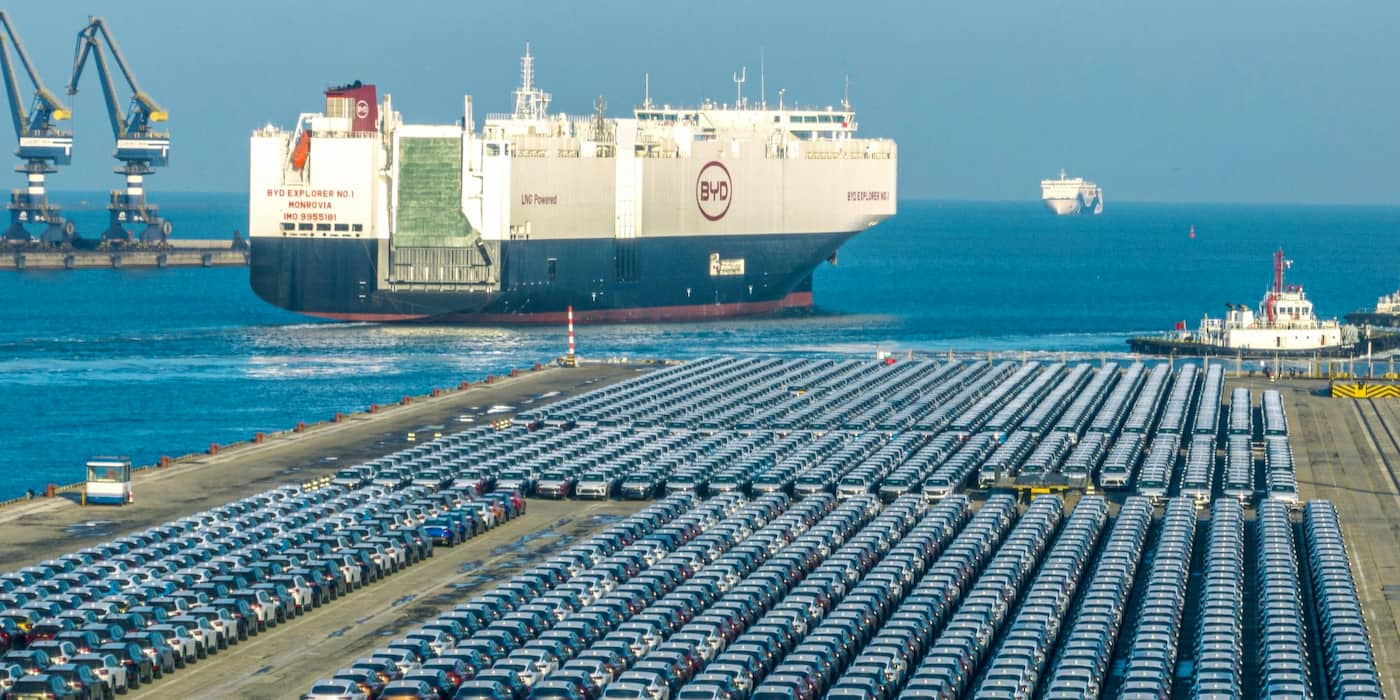
glut of unsellable gas cars – while also demanding that automakers stop building noncompliant vehicles immediately). Instead, they’re building cars as fast as they can, selling them as fast as they can, and exporting them in
as many ships as they can get their hands on – to the point where they’re even
building ships of their own.
This has led to accusations that China is “dumping” EVs on overseas markets, with Europe – which
also subsidizes its own EV industry –
considering retroactive tariffs. The US is also
set to announce a 4x increase in existing tariffs against Chinese EVs. The irony is, if Chinese taxpayers are subsidizing manufacturing before sending those cars overseas, that represents a wealth transfer
from Chinese taxpayers
to American ones. And another irony: China has so often been
criticized for not doing enough on climate change, and now we’re criticizing them of doing
too much, both with EVs
and solar.
This all sounds quite similar to the situation with Japan in the 70s.
But just as with Japan, simply blocking out better options won’t kick the West’s industry into gear. On the contrary, it will make our industry more complacent. And we’re already seeing that happening, as automakers keep
begging governments to let them continue their unsustainable business models even as competition looms.
Do tariffs work?
But that’s just the thing, tariffs don’t generally work. We saw how they failed to forestall Japan, but there are many other examples showing their ineffectiveness or
weird side effects, and economists generally agree that they are a poor measure to help domestic industry. Some company leadership
favors the idea of tariffs, while other (
perhaps more sober) leaders
do not.
On the one hand, it could help domestic auto jobs, because free trade for Chinese EVs could result in a race to the bottom for auto manufacturing. And it could result in Chinese companies trying to set up manufacturing in the US to avoid tariffs – which could help US auto jobs, but these moves would likely spark a whole new round of controversy when announced.
But on the other hand, China is likely to implement retaliatory tariffs which will hurt US workers (for example, soybean tariffs
which ruined the US soybean industry in 2018 – and resulted in more soybean demand from Brazil, which led to
extensive clearcutting and fires in the Amazon). And the nature of today’s globalized economy and complex supplier relationships around the world can result in a lot of chaos when a major player implements a major tariff.
So in the end, US jobs likely won’t benefit
overall, and US consumers will simply be denied a chance to buy cheap new EVs from China – like, for example, the
excellent Volvo EX30. The EX30 is currently made in Geely’s China factory and starts at around $35k even after the 25% tariff.
A 100% tariff would bring it to a starting price of ~$54k instead (unless or until Geely
moves production out of China, something
BYD has also considered). The EX30 also happens to be one of the only small EVs that will be available in the US in the near term, so a tariff would further doom US consumers to the
plague of SUVs that
has befallen us.
By raising prices of vehicles that could undercut US autos, what this means is that inflation – the price of goods for US consumers, which includes autos – will increase. Cars will be more expensive as US manufacturers will have less competition, less reason to bring costs down, and less reason to offer reasonably-sized models. We’ll be stuck with the expensive land yachts that US automakers have been punting at us for so many years. People will continue to accuse EVs of being too expensive – as a result of policy that directly makes them so.
Meanwhile, one of Biden’s signature legislative wins, the Inflation Reduction Act, does include
a different type of protectionist provision that seems to have accomplished its goals. It offers tax credits to EV purchasers, as long as those EVs include domestically-sourced components and are assembled in North America. This lowers the effective price of EVs, helping buyers, and stimulates investment in US manufacturing as well.
As a result of this and Biden’s previous Bipartisan Infrastructure Law,
$209 billion has been invested in new or expanded factory projects, which will create 241,000 EV jobs in America. So it’s not impossible to incentivize domestic production – but smart industrial policy and subsidies will generally work better than unnecessary trade wars.
The politics factor
Of course there is a large short-term factor to this decision: the US election, which is just a few months out.
In this election, President Biden is running against a candidate who has no issue being loudly racist, and channels that racism into protectionist trade measures. The US’ current 25% tariff against China was
implemented by him in 2018, and a centerpiece of his policy promises revolve around
extending these short-sighted measures.
This trade policy is not made out of a consideration of what will be best for the auto industry or the US, but rather is a populist way to seize on Sinophobia, scapegoating the US’ main geopolitical competitor for various social ills happening domestically.
But that sort of sentiment is popular. US sentiment towards China is
at record lows, making it a popular target for scapegoating. The sharp turn downwards in recent years is likely influenced by the loud scapegoating from Mr Trump, though it has affected voters across the party identification spectrum.
So Biden’s decision to increase tariffs on Chinese EVs may end up being popular, regardless of its positive or negative effects – after all, Trump’s previous round
hurt the US economy, but was still popular.
Protectionism is, after all, historically popular with industrial unions. Biden has secured support from the UAW, a group that has been racking up
a lot of impressive wins lately, and wants to
expand union power further (for which it
has the support of the President). UAW has
asked for higher tariffs, and Biden has
taken their advice before.
But it is also good to remember that this election is indeed important. While President Biden’s tariff policy mirrors that of Mr. Trump, Biden’s overall environmental policy does stand out as head and shoulders above the
destructive,
ill-considered nonsense we saw from the EPA under fossil fuel advocates
Scott Pruitt and
Andrew Wheeler.
On EVs specifically, Mr. Trump has already
begged for $1 billion in bribes from oil companies (soon after
scrambling to make bond in his half-billion-dollar fraud case), promising that if they give him these bribes, he would try
again to kill electric vehicles (which he
failed at last time) – in a move that
would actually benefit the Chinese auto industry, and would
harm US consumers’ health and pocketbooks.
So while this EV tariff increase doesn’t seem like a great idea, the alternative is, somehow, much worse. Isn’t that just the story of US politics in a nutshell.
But will the tariff change minds? While tariffs are popular, Trump has associated himself so closely with protectionist trade policy that voters with a thirst for protectionism seem more likely to vote for the candidate that has done more to shout his bombastic racist ideas from the rooftops.
It does seem that, with anti-Chinese sentiment at an all time high, any mention of China short-circuits a certain percentage of the electorate. Despite the demonstrably positive effect that Biden’s EV policy has produced in terms of investment in US EV manufacturing, that very same policy is often ignorantly criticized for helping China – which it does not do. Just have a look in the comments below, we’re sure a number of people who did not get this far into the article will echo exactly this incorrect sentiment.
But that’s a hard thing to explain, which has taken me thousands of words already (sorry) to merely scratch the surface of. The simplicity of “China bad” is a lot more comforting and simple to accept, despite lacking nuance.
How do we beat China? Not by tariffs, but by trying harder
Apologies for taking so long to get around to the point, but I hope that after laying out the actions China has taken to grow its EV industry, the history of foreign entrants into the auto industry, the effectiveness of tariffs, and the effectiveness of other trade policies and the politics behind them, the conclusion of how to go forward is already clear.
In order to beat China, we need to stop messing around with comforting but ill-considered policies that won’t work, and instead commit ourselves to the massive industrial shift that we need in order to catch up with a country that has already been doing so for over a decade.
We cannot do this by moving slower than a target that is already ahead of us. We have to move faster. And the West doesn’t get there by
taking $1 billion in bribes to tank domestic industry, by
softening targets or
backtracking on EV plans. In particular, having one party that actively opposes any attempt to prepare the US auto industry for the future is certainly not helpful. This back-and-forth is not happening in China – they are committed.
The US auto industry has become accustomed to offering huge, expensive gas guzzlers, and to being “the only game in town.” But that didn’t work for the US in the 70s, and it won’t work now.
One of the most common criticisms of EVs is their unaffordability, but the
BYD Seagull will cost under $10k (domestically) and the
sporty Xiaomi SU7 is about $30k. That might be hard to compete with, but the US has already seen a cheap, great EV in the form of
the workmanlike Chevy Bolt, which
cost under $20k new after incentives before
production ended. So it’s possible, and just because it’s hard doesn’t mean we shouldn’t do it.
Even if prices on small Chinese EVs are unattainable, the way to solve that is through smart industrial and materials policy (as China has spent years on and we’ve only just started), through targeted subsidy to a new and important industry (which we’re doing, though
republicans want to eliminate that), and by perhaps redirecting
tax breaks that currently encourage giant vehicles to stop encouraging huge gas guzzlers and instead encourage right-sized EVs (and end other policies like the
EPA footprint rule which EPA is
finally doing something about).
Then there’s the little issue of massive implicit subsidies to fossil fuels,
costing the US economy $700 billion per year. The solution to that is to
put a price on pollution, as supported by
virtually all economists and
a majority of Americans in every state, which would help to incentivize cleaner autos and disincentivize dirtier ones. And all of this is necessary to confront climate change, which we can do alongside taking actions to ensure we are ready for the future of automobiles.
So, if you’ll forgive me for taking this apparently unpopular anti-tariff stance, I think it’s clear that simply doubling the price of the competition isn’t the best way to ensure US auto stays competitive. It won’t help US consumers, it likely won’t have a net positive effect on US jobs (across sectors), it will lull industry into a false sense of security, it doesn’t help the environment, and perhaps least important but still worth mention, it violates the oft-repeated-but-never-honestly-held principle that government should “avoid picking winners and losers.”
Instead, lets focus on encouraging the new tech and discouraging the old tech, and moving quickly to beat China at their own game. If we want to pick winners, then why don’t we pick
us.
This is how we get the American auto industry, a jewel in the crown of America for
more than a century, into competitive shape for the future. We should have been doing more earlier, but as the famous (
possibly Chinese) proverb says: “the best time to plant a tree is 20 years ago, the second best time is today.”