
You are using an out of date browser. It may not display this or other websites correctly.
You should upgrade or use an alternative browser.
You should upgrade or use an alternative browser.
Temp Halt gets overturned?
- Thread starter achilles28
- Start date


http://joshblackman.com/blog/2017/0...ity-of-trumps-executive-order-on-immigration/
I found this very interesting and convincing to me (a non legal expert) that the President CLEARLY has the right to make the Exec Order legal. In fact, anyone who has read the Exec Order will see that these exact codes are quoted in the order as the legal references granting the President these rights.
Whatever you think or feel about HOW the roll out was done (And yes it could have been rolled out better) and whatever you feel about whether we should be including people that acted as translators or support and fight with our troops abroad (and yes I agree it may be a bit insensitive to them) it does not change the fact that its LEGAL as far as I can tell after reading all this.
Our President may be insensitive and I may even agree he is often an asshole but he seems to be doing what he thinks is right and best for our country whether you agree with it or not. I think the same could be said of Obama. I didnt agree with him often and I considered him an asshole often but I do think he did what he thought was best for our country no matter how much I disagreed with him.
My 0.02
I found this very interesting and convincing to me (a non legal expert) that the President CLEARLY has the right to make the Exec Order legal. In fact, anyone who has read the Exec Order will see that these exact codes are quoted in the order as the legal references granting the President these rights.
Whatever you think or feel about HOW the roll out was done (And yes it could have been rolled out better) and whatever you feel about whether we should be including people that acted as translators or support and fight with our troops abroad (and yes I agree it may be a bit insensitive to them) it does not change the fact that its LEGAL as far as I can tell after reading all this.
Our President may be insensitive and I may even agree he is often an asshole but he seems to be doing what he thinks is right and best for our country whether you agree with it or not. I think the same could be said of Obama. I didnt agree with him often and I considered him an asshole often but I do think he did what he thought was best for our country no matter how much I disagreed with him.
My 0.02
Majority in Leading EU Nations Support Trump-Style Travel Ban: Poll
A majority of Europeans would support a Trump-style ban on further migration from mainly Muslim countries, according to a poll of more than 10,000 people in 10 countries.
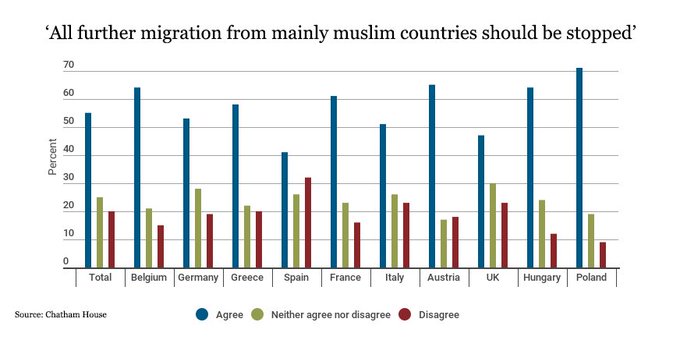
An average of 55 percent of those surveyed for London-based think tank, Chatham House, agreed that immigration from Muslim-majority countries should be halted.
The poll released Tuesday comes after a bruising 18 months that have seen a string of terrorist massacres linked to radical Islam as well as record-setting levels of migration that have created social tensions across the continent.

Migrants wait to receive free food during a snowfall outside a derelict customs warehouse in Belgrade, Serbia on Jan. 9, 2017. Marko Djurica / Reuters, file
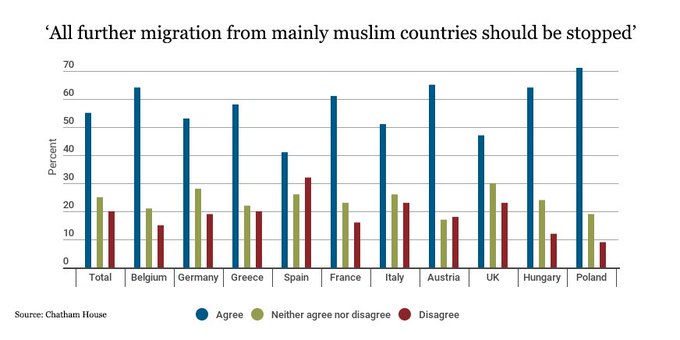
Majorities in all but two of the 10 countries polled supported a ban, ranging from 71 percent in Poland, to 53 percent in Germany, 47 percent in the United Kingdom and 41 percent in Spain. In no country did the percentage that disagreed surpass 32 percent.
Chatham House called the findings "striking and sobering" and said in a news release that the figures "suggest that public opposition to further migration from predominantly Muslim states is by no means confined to Trump's electorate."
The poll, carried out before President Trump took office and implemented his executive order on immigration, also found that the issue crossed the political spectrum — three-quarters of respondents in support of a ban self-classified as right-wing and more than a third said they were left-leaning.
View image on Twitter
Follow
 Chatham House
✔@ChathamHouse
Across 10 European countries an average of 55% agreed with the below statementhttp://cht.hm/2kNOOsn
10:53 AM - 7 Feb 2017
View image on Twitter
Follow
Chatham House
✔@ChathamHouse
'All further migration from mainly Muslim countries should be stopped'
Agree:
Poland 71%
France 61%
UK 47%http://cht.hm/2kNOOsn
4:52 AM - 8 Feb 2017
Support for a ban is also higher among older Europeans than younger ones, and there's an educational divide: less than half of all college graduates supported further migration curbs.
The Chatham House poll, conducted with Kantar Public, surveyed samples of over-18s in Austria, Belgium, France, Germany, Greece, Hungary, Italy, Poland, Spain and the U.K. Fieldwork was carried out between Dec. 12, 2016, and Jan. 11, 2017, and involved 10,195 respondents
A majority of Europeans would support a Trump-style ban on further migration from mainly Muslim countries, according to a poll of more than 10,000 people in 10 countries.
An average of 55 percent of those surveyed for London-based think tank, Chatham House, agreed that immigration from Muslim-majority countries should be halted.
The poll released Tuesday comes after a bruising 18 months that have seen a string of terrorist massacres linked to radical Islam as well as record-setting levels of migration that have created social tensions across the continent.
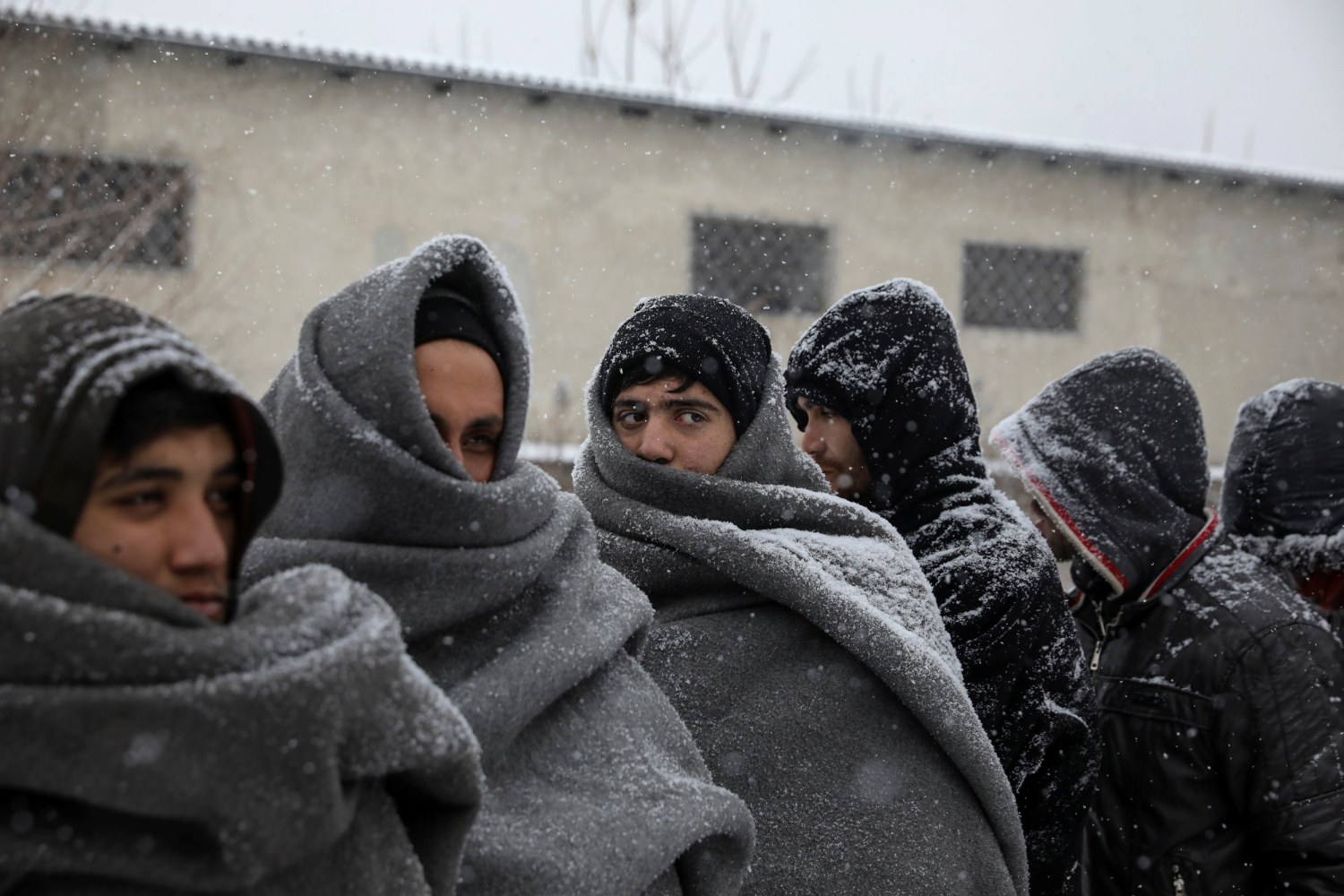
Migrants wait to receive free food during a snowfall outside a derelict customs warehouse in Belgrade, Serbia on Jan. 9, 2017. Marko Djurica / Reuters, file
Majorities in all but two of the 10 countries polled supported a ban, ranging from 71 percent in Poland, to 53 percent in Germany, 47 percent in the United Kingdom and 41 percent in Spain. In no country did the percentage that disagreed surpass 32 percent.
Chatham House called the findings "striking and sobering" and said in a news release that the figures "suggest that public opposition to further migration from predominantly Muslim states is by no means confined to Trump's electorate."
The poll, carried out before President Trump took office and implemented his executive order on immigration, also found that the issue crossed the political spectrum — three-quarters of respondents in support of a ban self-classified as right-wing and more than a third said they were left-leaning.
View image on Twitter
Follow
Chatham House ✔@ChathamHouse
Across 10 European countries an average of 55% agreed with the below statementhttp://cht.hm/2kNOOsn
10:53 AM - 7 Feb 2017
View image on Twitter
Follow
Chatham House ✔@ChathamHouse
'All further migration from mainly Muslim countries should be stopped'
Agree:
Poland 71%
France 61%
UK 47%http://cht.hm/2kNOOsn
4:52 AM - 8 Feb 2017
Support for a ban is also higher among older Europeans than younger ones, and there's an educational divide: less than half of all college graduates supported further migration curbs.
The Chatham House poll, conducted with Kantar Public, surveyed samples of over-18s in Austria, Belgium, France, Germany, Greece, Hungary, Italy, Poland, Spain and the U.K. Fieldwork was carried out between Dec. 12, 2016, and Jan. 11, 2017, and involved 10,195 respondents
Majority in Leading EU Nations Support Trump-Style Travel Ban: Poll
A majority of Europeans would support a Trump-style ban on further migration from mainly Muslim countries, according to a poll of more than 10,000 people in 10 countries.
An average of 55 percent of those surveyed for London-based think tank, Chatham House, agreed that immigration from Muslim-majority countries should be halted.
The poll released Tuesday comes after a bruising 18 months that have seen a string of terrorist massacres linked to radical Islam as well as record-setting levels of migration that have created social tensions across the continent.
Migrants wait to receive free food during a snowfall outside a derelict customs warehouse in Belgrade, Serbia on Jan. 9, 2017. Marko Djurica / Reuters, file
Majorities in all but two of the 10 countries polled supported a ban, ranging from 71 percent in Poland, to 53 percent in Germany, 47 percent in the United Kingdom and 41 percent in Spain. In no country did the percentage that disagreed surpass 32 percent.
Chatham House called the findings "striking and sobering" and said in a news release that the figures "suggest that public opposition to further migration from predominantly Muslim states is by no means confined to Trump's electorate."
The poll, carried out before President Trump took office and implemented his executive order on immigration, also found that the issue crossed the political spectrum — three-quarters of respondents in support of a ban self-classified as right-wing and more than a third said they were left-leaning.
View image on Twitter
https://twitter.com/ChathamHouse
Follow
https://twitter.com/ChathamHouse
✔@ChathamHouse
Across 10 European countries an average of 55% agreed with the below statementhttp://cht.hm/2kNOOsn
10:53 AM - 7 Feb 2017
View image on Twitter
https://twitter.com/ChathamHouse
Follow
https://twitter.com/ChathamHouse
✔@ChathamHouse
'All further migration from mainly Muslim countries should be stopped'
Agree:
Poland 71%
France 61%
UK 47%http://cht.hm/2kNOOsn
4:52 AM - 8 Feb 2017
Support for a ban is also higher among older Europeans than younger ones, and there's an educational divide: less than half of all college graduates supported further migration curbs.
The Chatham House poll, conducted with Kantar Public, surveyed samples of over-18s in Austria, Belgium, France, Germany, Greece, Hungary, Italy, Poland, Spain and the U.K. Fieldwork was carried out between Dec. 12, 2016, and Jan. 11, 2017, and involved 10,195 respondents
This. People are DONE with this shit.
They want a Civil War and they'll be the first ones held to account.
has to. It's lawful. Irreparable harm defined by that loser cock sucking Judge Robarts, is loss of tax revenue for local universities, and some guy can't visit his family in Somalia.My people,..... of who I am merely a court jester....tell me, that the travel ban is going to stand.
Loss of tax revenue, and a few hurt feelings do not take precedence over national security for 300 million americans.
Lets hear what tripleA has to say.has to. It's lawful. Irreparable harm defined by that loser cock sucking Judge Robarts, is loss of tax revenue for local universities, and some guy can't visit his family in Somalia.
Loss of tax revenue, and a few hurt feelings do not take precedence over national security for 300 million americans.
I'm merely speaking from a constitutional interpretation from a bunch of drunk lawyers. But they are smart, I'll give em that.
http://joshblackman.com/blog/2017/0...ity-of-trumps-executive-order-on-immigration/
I found this very interesting and convincing to me (a non legal expert) that the President CLEARLY has the right to make the Exec Order legal. In fact, anyone who has read the Exec Order will see that these exact codes are quoted in the order as the legal references granting the President these rights.
"In closing, I’ll reiterate that as a matter of policy, the order is absolutely awful, and the manner in which it was implemented was a debacle. But that does not resolve the question of whether it is legal."
"I will also defer, for now at least, discussion of whether the order is constitutional. ...whether the executive action violates the Due Process Clause, the Equal Protection Clause, the Free Exercise Clause, or the Establishment Clause."
I do solemnly swear that I will faithfully execute the office of President of the United States, and will to the best of my ability, preserve, protect, and defend the Constitution of the United States.
"When the president does it that means it is not illegal"
Richard Nixon

I think the same could be said of Obama... I do think he did what he thought was best for our country...
You obviously weren't paying attention.
Lets hear what tripleA has to say.
Any reasonable reading of law and precedent will support Trump's order. There is a long history of presidential orders limiting immigration.
Congressional Research Service: "Executive Authority to Exclude Aliens: In Brief" by Conservative Review on Scribd.
According to the report, here are the number of times each president, since Reagan, has limited immigration to specific groups of people:
Ronald Reagan - Five times
George H. W Bush - One time
Bill Clinton - 12 times
George W. Bush - Six times
Barack Obama - 19 times
Not included in the CRS report is that Hillary Clinton's State Department, without a presidential action, suspended all refugee applications from Iraq for six months in 2011. ABC News reported, on the de facto ban of Iraqis in 2013: As a result of the Kentucky case, the State Department stopped processing Iraq refugees for six months in 2011, federal officials told ABC News – even for many who had heroically helped U.S. forces as interpreters and intelligence assets. One Iraqi who had aided American troops was assassinated before his refugee application could be processed, because of the immigration delays, two U.S. officials said. In 2011, fewer than 10,000 Iraqis were resettled as refugees in the U.S., half the number from the year before, State Department statistics show. - See more at: https://www.conservativereview.com/...the-last-five-presidents#sthash.aPcbhucE.dpuf
The legal situation is somewhat muddled because what is under appeal is not the president's order but the TRO issued by the district court judge. Federal judges have pretty wide discretion in issuing such temporary relief, and the standard of review is along the lines of "abuse of discretion" or "clear error." Given the notoriety of the case, the appellate panel may try to shortcircuit matters and get to the merits however. They could do so because the likelihood of success on the merits is the first factor in the test for issuing preliminary injunctions.
Here success on the merits seems very remote for the plaintiffs. The letter of the law and historical practice both support the president. The fact that national security is involved is another important factor that should give any prudent court reason for pause. Public outrage against the judiciary would be immense if someone admitted under injunction committed a terrorist act.
Standing is an even bigger obstacle. The plaintiffs are two states. Traditionally, states have not had standing to raise such amorphous issues as stand-ins for their residents or would-be residents. The states' claims are clearly a backdoor attempt to litigate claims, ie constitutional violations, that the would-be immigrants cannot bring themselves.