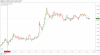
Since you are trading 1 contract and can’t average and have your risk tolerance you are forced to wait for the PB to enter so you can stay within your risk tolerance. The downside is if there is no PB after your FT bar then you just miss the trade.Thank you very much volpri for my chart review. You summed up my analysis well.
I am working on the PB entry methods and being careful of those breakouts and WAITING for following through and then entry as I know and have heard 80% of breakout fails. Those PB was beautiful setups, I am learning those as well.
Yes, I would love to enter on Sell Stop Below that FT bar, but too much risk for me per trade, I have to wait and be patient.
Since my risk tolerance is different than yours I would have been short a couple of contracts on the close of that bar you labeled as a FT bar. That way I am poised for the trade. If there is no PB from my entry then right away I am in the money. If there is a PB and there was (as you entered on it) then I would have been averaging down during the PB building my short position. Why would I average down short on the PB? Wouldn’t that be risky? Well I would consider the facts that:
1) price has been in a range over 100 bars. It is likely time that a BO succeeds as 9 or 10 times in the range a BO attempt has failed. It is probably due one.
2) because of the 7 weak PB’s (I labeled them) DURING the last leg down in the range were all weak PB’s ...that means selling pressure. Those weak PB’s are what are called MINOR reversals attempts that failed. After each one the subsequent PB will probably just be a minor reversal also. Therefore, any reversal attempt up from your FT bar will likely also be minor even if it is a deeper one. Understanding this, I would not be afraid to average down short more contracts as priced move against me, after my initial entry at the bottom of your FT bar. So, while you are waiting to enter I am averaging down.
I mention the 7 weak PB’s not as tradeable setups in themselves (although they are) but to point out the inertia factor in the market. I would not be afraid to average down short BECAUSE every previous reversal attempt ended up being a minor PB and price kept going south and then breaks out south of the range. So, ANY PB after that range BO ...well odds are...it will be minor too and not be a reversal because of the previous inertia and in addition, we have a FT bar outside the bottom of the range.
My initial SL would have been about in the middle of the range above the high of that labeled 5th PB. And I would keep shorting adding to my initial short up into, and as high as the top part of the bottom 1/3 of the range. Then I hold. If my stops gets taken on my averaged down position then I double up or even triple up LONG on the first PB into that bottom 1/3 of the range. Then as price moves up towards the top of the middle third of the range I exit after I get my loss back and back in the money or at least BE.
Anyways, this is just a look at how I would have been looking at playing this trade. But you did just fine and exactly what you needed to do taking into consideration your risk tolerance and the fact you aren’t averaging down but trading a single contract.
This said it is harder to trade a single contract than to average down. Why? Because a trader has to be precise in his entries and just take his loss at his SL. And he will have to run tighter SL’s. It is difficult to be precise in entries every time because of the UNCERTAINTY of the markets. If your stop, by needs, has to be close you will get stopped out very often. And win rate will be low so to make it work out you are gonna have to play for bigger moves that give a larger R:R to make up for all those losses suffered from SL’s being hit. In other words, for scalping or as I put it manual HFT, averaging down becomes a PLUS not a negative and has the potential of rendering a higher win rate because every time you average down THE PRICE MOVEMENT to your new profit point becomes smaller in terms of getting back in the money. Of course, that assumes you are averaging down in the correct scenarios. If a trader is trading 1 contract, even if he has a very wide SL, it becomes more difficult to be profitable scalping. Say price goes against you and trades within a few ticks of your very wide SL but does not take you out and begins to go back a little in your favor. The trader still find himself in a predicament because price now has to travel a long ways to get him back in the money. And because it has traveled so far against you the odds are now that perhaps a trend AGAINST your position has actually started, and the little movement back in your favor is just a PB that WILL be followed by price resuming against you again, stopping you out anyway, despite the fact you had a very wide SL.
Averaging down puts price inertia IN YOUR FAVOR. I WILL REPEAT THAT AGAIN as I have never heard any trader state that concept. So, you might say I have coined it. ”Averaging down puts price inertia in your favor to reach a profit level after taking a position.” In all my years of trading I have never heard any guru or trader say what I just said. Most just bellyache about and deride averaging down. Then tell you never move your SL yet maintain a good R:R and a high expectancy and a slew of other mathematical ivory armchair platitudes that are difficult, if not nigh impossible, for the average trader to pull off. So, the trader after 10 years of trying throws his arms up in exasperation resigning himself to be in the majority company of failed day traders per the stats everyone loves to throw around. Oh well...
There is one caveat to my coined phrase. Don’t average down unless previous inertia is already in your favor and the context backs doing so. Then once a trader is averaged in and the market then begins to move in his favor the “second inertia” will likely take price right down thru his latest BE point from his last averaged down position, because momentum has started and now price has less distance that price needs to travel to get thru BE and get him in the money. TO analyze the phenomena just look at my trades on my charts I post. Do I have a high win rate in spite of averaging down? Gurus are now dropping dead like chickens..LOL. Do I usually get at least one point profit on my trades and most of the time much more? Do I get perfect precise entries? I’ll answer that one. NO! Do I need to get perfect precise entries to be profitable? NO! Now I will ask you. Do you? (and I am taking about any trader that reads this) Do I always have a high R:R to be consistently profitable? No! But often I do. Look at my trades.
Again I when I say you in this discourse I am speaking in generic terms alot of the time not to you personally, simplemelike. I ain’t telling or advising anyone to trade this way. I am just telling you folks how I trade. You do what you want to do. May be best to not even listen to me. On the other hand you might want to try Simming the concepts .....just for the fun of it ROFLMAO. I ain’t telling you to do it with your real money. I am saying you might want to try it on a SIM.
Last edited: