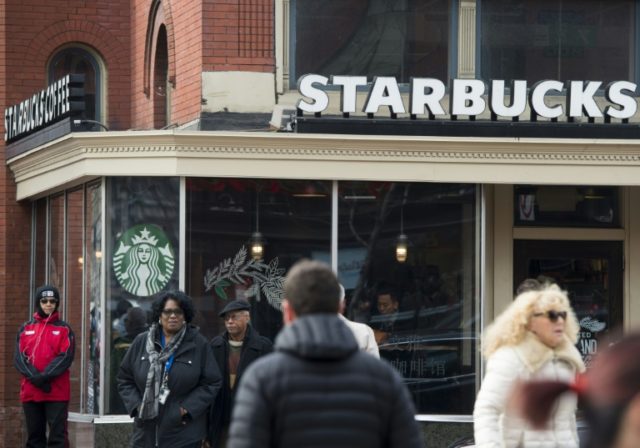
Starbucks Brand Crashes After Announcement of Plan to Hire 10,000 Muslim ‘Refugees’

Starbucks' image "suffered" in my book, but I don't buy coffee there. I'm sure lots of people will keep buying their daily fix at SBUX even though they might be annoyed at Schultz' spew. (Some people show their principles only "momentarily".)

Isn't there a diff between someone "saying" a brand suffered than it actually doing so? And if people keep buying there, what diff does it make?

U&A studies are perception based, not necessarily behavioral. So essentially people might say they hate Starbucks, and then leave the polling to go get a coffee there. It's not conclusive. But there might be some who decide to never buy coffee there again.

My point is, even if one person stops buying your product, it's not worth it. Big risk in speaking out politically - regardless of the side you take. No reward.

That's not the job of a CEO.
 
U&A studies are perception based, not necessarily behavioral. So essentially people might say they hate Starbucks, and then leave the polling to go get a coffee there. It's not conclusive. But there might be some who decide to never buy coffee there again.

My point is, even if one person stops buying your product, it's not worth it. Big risk in speaking out politically - regardless of the side you take. No reward.

That's not the job of a CEO.

A publically held company taking political position is up there among the dumbest things ever. The shareholders should be furious.
 
A publically held company taking political position is up there among the dumbest things ever. The shareholders should be furious.

I will normally say this is true for most political positions.

However there are instances in which taking a position on policy may drive economic success of the company. For example, Cisco supporting rural broadband taxes & initiatives as a policy in DC leads to the company getting more carrier router business.
 
I will normally say this is true for most political positions.

However there are instances in which taking a position on policy may drive economic success of the company. For example, Cisco supporting rural broadband taxes & initiatives as a policy in DC leads to the company getting more carrier router business.

The Cisco example supporting rural broadband taxes through lobbying or political pressure is not in the same league as a CEO wading into the publicly charged topic of muslim refugees.
 
The Cisco example supporting rural broadband taxes through lobbying or political pressure is not in the same league as a CEO wading into the publicly charged topic of muslim refugees.

Of course. Companies should stick with political policy statements that are aligned with the business of their companies; these usually are non-controversial.

Unless you run a company that makes private prisons for illegal immigrants or you run a company that provides legal services for illegal immigrants --- then you probably should stay away from making announcements about this hot button issue.
 
see the thing about facts is that they're on record:
http://www.nasdaq.com/article/starb...-impress-markets-future-outlook-weak-cm739682

upload_2017-2-27_20-26-9.png
 
This is what I refer to when I say that CEOs need to stay the hell out of politics, as there is no upside, and a whole lot of downside risk. Stupidity.
2g5re5r-640x448.jpg


by WARNER TODD HUSTON24 Feb 201712975

The Starbucks Coffee brand has taken a major hit since the company’s announcement that it would hire 10,000 Muslim “refugees” in response to President Donald Trump’s temporary travel moratorium in January.

But since the company issued its anti-Trump statement its brand name has lost its luster with customers. Perception levels of the Starbucks brand name fell by an incredible two-thirds since its January announcement, according to a YouGov survey, as reported by Yahoo Finance.

The survey measures how potential customers feel about a company’s brand and asks if they have “heard anything about the brand in the last two weeks, through advertising, news or word of mouth, was it positive or negative.”

In the week before the company’s January refugees announcement, 30% of respondents said they would consider spending money at Starbucks. But after the statement that number fell to 24 percent, the survey discovered.

The company’s announcement immediately sparked a #BoycottStarbucks movement on Twitter and brought condemnation from coast to coast.

Not long after Starbucks issued its anti-Trump refugee statement, many Americans began to wonder why Starbucks is slighting the hiring of Americans — especially U.S. military veterans — in favor of refugees.

Ultimately, on the heels of its refugees announcement, the company felt enough pressure to issue a second statement to explain to America’s military veterans that the company doesn’t actually hate them.
From the Yahoo Finance link:

Some of this resentment seemed to be rooted in a belief that Starbucks was hiring refugees instead of veterans. Starbucks, however, does have a program in place to support veterans and their families, hiring 8,000 veterans and military spouses since 2014 — an initiative the chain has attempted to highlight in recent days and weeks online and on social media.

I'm still amazed (amazed, I tell you!) that they survived the perception score drop after they changed their loyalty program, as reported by YouGov:

https://today.yougov.com/news/2016/03/02/starbucks-perception-scores-drop-after-loyalty-pro/

:wtf:
 
Back
Top