<iframe width="640" height="360" src="http://www.youtube.com/embed/DOHcGyfYxVM?feature=player_detailpage" frameborder="0" allowfullscreen></iframe>

You are using an out of date browser. It may not display this or other websites correctly.
You should upgrade or use an alternative browser.
You should upgrade or use an alternative browser.
"spirituality" videos
- Thread starter smallStops
- Start date
- Status
- Not open for further replies.
neuroscience perspective on empathy, compassion.
compassion and brain neurons!
<iframe width="640" height="360" src="https://www.youtube.com/embed/g4kElWIAN0s?feature=player_detailpage" frameborder="0" allowfullscreen></iframe>
compassion and brain neurons!
<iframe width="640" height="360" src="https://www.youtube.com/embed/g4kElWIAN0s?feature=player_detailpage" frameborder="0" allowfullscreen></iframe>
Still learning on how my brain works.
compassion & neuroscience
<iframe width="640" height="360" src="http://www.youtube.com/embed/vszi2A5y_XE?feature=player_detailpage" frameborder="0" allowfullscreen></iframe>
http://www.fetzer.org/resources/neuroscience-compassion-love-and-forgiveness-fetzer-initiative ( key tools and insights into the mechanisms of human emotions and actions)
compassion & neuroscience
<iframe width="640" height="360" src="http://www.youtube.com/embed/vszi2A5y_XE?feature=player_detailpage" frameborder="0" allowfullscreen></iframe>
http://www.fetzer.org/resources/neuroscience-compassion-love-and-forgiveness-fetzer-initiative ( key tools and insights into the mechanisms of human emotions and actions)
brain scan of a monk actively extending compassion shows activity in the striatum, an area of the brain associated with reward processing
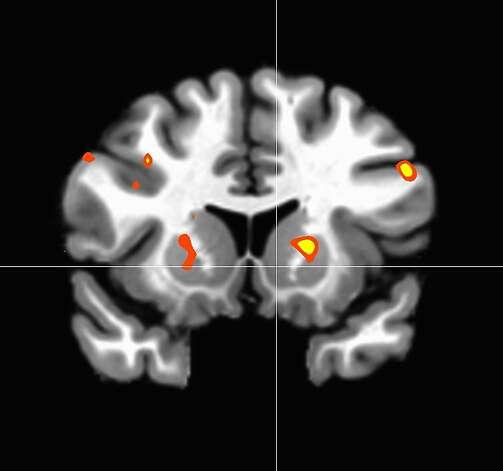
http://www.sfgate.com/health/articl...ditation-compassion-3689748.php#photo-3165600
Stanford neuroeconomist Brian Knutson is an expert in the pleasure center of the brain that works in tandem with our financial decisions - the biology behind why we bypass the kitchen coffeemaker to buy the $4 Starbucks coffee every day.
He can hook you up to a brain scanner, take you on a simulated shopping spree and tell by looking at your nucleus accumbens - an area deep inside your brain associated with fight, flight, eating and fornicating - how you process risk and reward, whether you're a spendthrift or a tightwad.
...
"The Buddhist view of the world can provide some potentially interesting information about the subcortical reward circuits involved in motivation."
...
stress reduction
...
People who meditate show more left-brain hemisphere dominance, according to meditation studies done at the Center for Investigating Healthy Minds at the University of Wisconsin-Madison.
"Essentially when you spend a lot of time meditating, the brain shows a pattern of feeling safe in the world and more comfortable in approaching people and situations, and less vigilant and afraid, which is more associated with the right hemisphere.
...
improved perception
Volunteers who spent an average of 500 hours in focused-attention meditation during a three-month retreat in 2007 were better than the control group at detecting slight differences in the length of lines flashed on a screen.
http://www.sfgate.com/health/articl...ditation-compassion-3689748.php#photo-3165600
Stanford neuroeconomist Brian Knutson is an expert in the pleasure center of the brain that works in tandem with our financial decisions - the biology behind why we bypass the kitchen coffeemaker to buy the $4 Starbucks coffee every day.
He can hook you up to a brain scanner, take you on a simulated shopping spree and tell by looking at your nucleus accumbens - an area deep inside your brain associated with fight, flight, eating and fornicating - how you process risk and reward, whether you're a spendthrift or a tightwad.
...
"The Buddhist view of the world can provide some potentially interesting information about the subcortical reward circuits involved in motivation."
...
stress reduction
...
People who meditate show more left-brain hemisphere dominance, according to meditation studies done at the Center for Investigating Healthy Minds at the University of Wisconsin-Madison.
"Essentially when you spend a lot of time meditating, the brain shows a pattern of feeling safe in the world and more comfortable in approaching people and situations, and less vigilant and afraid, which is more associated with the right hemisphere.
...
improved perception
Volunteers who spent an average of 500 hours in focused-attention meditation during a three-month retreat in 2007 were better than the control group at detecting slight differences in the length of lines flashed on a screen.
I wonder what parts of the brain get activated when listening to forgiveness.
<iframe width="640" height="360" src="https://www.youtube.com/embed/57PpA856AaE?feature=player_detailpage" frameborder="0" allowfullscreen></iframe>
<iframe width="640" height="360" src="https://www.youtube.com/embed/57PpA856AaE?feature=player_detailpage" frameborder="0" allowfullscreen></iframe>
now, going into trust. Trust and believing  ) ) go together.
Believing.
<iframe width="640" height="360" src="https://www.youtube.com/embed/fDSoep_3pF0?feature=player_detailpage" frameborder="0" allowfullscreen></iframe>
) ) go together. Believing.
<iframe width="640" height="360" src="https://www.youtube.com/embed/fDSoep_3pF0?feature=player_detailpage" frameborder="0" allowfullscreen></iframe>
<iframe width="640" height="360" src="https://www.youtube.com/embed/iwKf62UQvgo?feature=player_detailpage" frameborder="0" allowfullscreen></iframe>
<iframe width="640" height="360" src="https://www.youtube.com/embed/O_Y7Qncdt_Y?feature=player_detailpage" frameborder="0" allowfullscreen></iframe>
- Status
- Not open for further replies.