Spendingâs ascending â with or without a budget sequester
By George F. Will, Thursday, November 17, 8:23 AM
Born during what is mistakenly called the debt-ceiling âdebacleâ last summer, the congressional supercommittee may die without agreeing to a 10-year, $1.2 trillion (at least) deficit-reduction plan. This is not properly labeled a failure. Committee Democrats demanded more revenue; Republicans offered $500 billion; Democrats responded with the one-syllable distillation of liberalism: âMore!â So the committeeâs work has been a clarifying event that presages a larger one â next Novemberâs elections.
The messiness surrounding the debt-ceiling increase was what democracy looks like when belatedly confronting big problems. Remember, Barack Obama demanded, until doing so became politically untenable, a âcleanâ ceiling increase â no supercommittee or other threat to his spending torrent.
The supercommittee should by now have sent its plan to the Congressional Budget Office for âscoringâ â calculation of the fiscal consequences of its proposals. The law establishing the committee requires any proposal to be published in legislative language 48 hours before Nov. 23. Not that law has much to do with fiscal matters: The Democratic-controlled Senate has not produced a budget in more than 930 days. This is just one way existing budget law is ignored.
Regarding the supercommittee, Harry Reidâs and Obamaâs interests diverge. Imitation is the sincerest form of politics, and Obama needs congressional failure as he seeks reelection by emulating Harry Truman in 1948, running against a âdo-nothingâ Congress. Reid, however, wants to remain Senate majority leader. In 2012, Democrats will be defending 23 seats, Republicans only 10. Republicans need to gain just four seats to control the Senate. Reidâs members cannot relish running while Obama is denouncing the âRepublican Congress.â As if the Democratic-controlled Senate has been temporarily disassociated from Congress.
Sensible people who remember the last grand budget bargain will be dry-eyed about not having another now. Although only 21 of the 242 Republicans in the House and eight of 47 Republicans in the Senate were on Capitol Hill in 1990, everyone there should remember the results of that yearâs budget agreement, wherein President George H.W. Bush jettisoned his âno new taxesâ pledge: Taxes increased. So did spending. And the deficit. Economic growth decreased.
Congressional failure to approve a supercommittee proposal supposedly will trigger a $1.2 trillion sequester, half from national security budgets. But the trigger will not be pulled until 2013. No Congress can bind another, and any trigger Congress creates Congress can disable. Obama, who may not be president then, hints that he might veto legislation that alters the sequester. But suppose the sequester occurs. Ignore loose talk about âdraconianâ spending cuts. Veronique de Rugy of George Mason Universityâs Mercatus Center has a graph (http://bit.ly/uKZAUd) you should see.
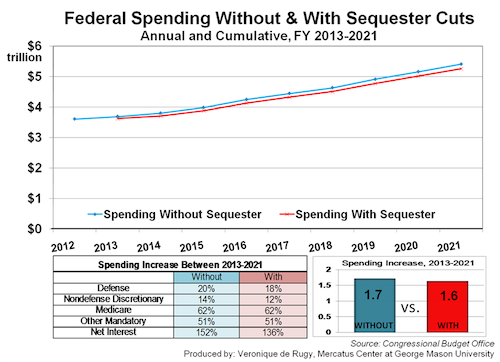
It shows two lines. The top one charts spending, 2013-2021, without the sequester; the other shows spending with the sequester. Both lines are ascending. Both show annual spending rising from less than $4 trillion to more than $5 trillion. The space between them is so narrow that it is difficult to see that there are two lines. Without the sequester, spending will increase $1.7 trillion; with the sequester, spending will increase $1.6 trillion. Here are categories of spending:

The supercommitteeâs difficulties are not shocking. This is shocking: Amid a darkening fiscal crisis, Energy Secretary Steven Chu, whose department has become a huge and incompetent venture capital fund, has not resigned as penance for complicity in the administrationâs âgreen graftâ and crony capitalism.
Equally incomprehensible: As the supercommittee seems about to leave governmentâs spending curve unbent, Transportation Secretary Ray LaHood, who should take a high-speed train into retirement, continues his multibillion-dollar mania for Californiaâs San Francisco-to-Anaheim high-speed-rail project. In just three years, the projected price of it has tripled to $98.5 billion, and only ludicrous assumptions about passenger traffic present the project as profitable enough to attract private investors, who are supposed to pay most of the costs.
âThe first lesson of economics is scarcity,â writes economist Thomas Sowell. âThere is never enough of anything to fully satisfy all those who want it. The first lesson of politics is to disregard the first lesson of economics.â Next November we will learn whether the second lesson of politics is that adhering to the first lesson is eventually dangerous to incumbents.
http://www.washingtonpost.com/opini...et-sequester/2011/11/15/gIQALpWXSN_story.html
By George F. Will, Thursday, November 17, 8:23 AM
Born during what is mistakenly called the debt-ceiling âdebacleâ last summer, the congressional supercommittee may die without agreeing to a 10-year, $1.2 trillion (at least) deficit-reduction plan. This is not properly labeled a failure. Committee Democrats demanded more revenue; Republicans offered $500 billion; Democrats responded with the one-syllable distillation of liberalism: âMore!â So the committeeâs work has been a clarifying event that presages a larger one â next Novemberâs elections.
The messiness surrounding the debt-ceiling increase was what democracy looks like when belatedly confronting big problems. Remember, Barack Obama demanded, until doing so became politically untenable, a âcleanâ ceiling increase â no supercommittee or other threat to his spending torrent.
The supercommittee should by now have sent its plan to the Congressional Budget Office for âscoringâ â calculation of the fiscal consequences of its proposals. The law establishing the committee requires any proposal to be published in legislative language 48 hours before Nov. 23. Not that law has much to do with fiscal matters: The Democratic-controlled Senate has not produced a budget in more than 930 days. This is just one way existing budget law is ignored.
Regarding the supercommittee, Harry Reidâs and Obamaâs interests diverge. Imitation is the sincerest form of politics, and Obama needs congressional failure as he seeks reelection by emulating Harry Truman in 1948, running against a âdo-nothingâ Congress. Reid, however, wants to remain Senate majority leader. In 2012, Democrats will be defending 23 seats, Republicans only 10. Republicans need to gain just four seats to control the Senate. Reidâs members cannot relish running while Obama is denouncing the âRepublican Congress.â As if the Democratic-controlled Senate has been temporarily disassociated from Congress.
Sensible people who remember the last grand budget bargain will be dry-eyed about not having another now. Although only 21 of the 242 Republicans in the House and eight of 47 Republicans in the Senate were on Capitol Hill in 1990, everyone there should remember the results of that yearâs budget agreement, wherein President George H.W. Bush jettisoned his âno new taxesâ pledge: Taxes increased. So did spending. And the deficit. Economic growth decreased.
Congressional failure to approve a supercommittee proposal supposedly will trigger a $1.2 trillion sequester, half from national security budgets. But the trigger will not be pulled until 2013. No Congress can bind another, and any trigger Congress creates Congress can disable. Obama, who may not be president then, hints that he might veto legislation that alters the sequester. But suppose the sequester occurs. Ignore loose talk about âdraconianâ spending cuts. Veronique de Rugy of George Mason Universityâs Mercatus Center has a graph (http://bit.ly/uKZAUd) you should see.
It shows two lines. The top one charts spending, 2013-2021, without the sequester; the other shows spending with the sequester. Both lines are ascending. Both show annual spending rising from less than $4 trillion to more than $5 trillion. The space between them is so narrow that it is difficult to see that there are two lines. Without the sequester, spending will increase $1.7 trillion; with the sequester, spending will increase $1.6 trillion. Here are categories of spending:
The supercommitteeâs difficulties are not shocking. This is shocking: Amid a darkening fiscal crisis, Energy Secretary Steven Chu, whose department has become a huge and incompetent venture capital fund, has not resigned as penance for complicity in the administrationâs âgreen graftâ and crony capitalism.
Equally incomprehensible: As the supercommittee seems about to leave governmentâs spending curve unbent, Transportation Secretary Ray LaHood, who should take a high-speed train into retirement, continues his multibillion-dollar mania for Californiaâs San Francisco-to-Anaheim high-speed-rail project. In just three years, the projected price of it has tripled to $98.5 billion, and only ludicrous assumptions about passenger traffic present the project as profitable enough to attract private investors, who are supposed to pay most of the costs.
âThe first lesson of economics is scarcity,â writes economist Thomas Sowell. âThere is never enough of anything to fully satisfy all those who want it. The first lesson of politics is to disregard the first lesson of economics.â Next November we will learn whether the second lesson of politics is that adhering to the first lesson is eventually dangerous to incumbents.
http://www.washingtonpost.com/opini...et-sequester/2011/11/15/gIQALpWXSN_story.html