
You are using an out of date browser. It may not display this or other websites correctly.
You should upgrade or use an alternative browser.
You should upgrade or use an alternative browser.
Sorry, another Covid thread :-)
- Thread starter BKR88
- Start date

It's amazing the bullshiat that demented anti-vaxxers spew. Here is the reality...
COVID-19 Vaccines Reduce, Not Increase, Risk of Stillbirth
https://www.factcheck.org/2022/11/scicheck-covid-19-vaccines-reduce-not-increase-risk-of-stillbirth/


How many flu shots do people take? Just like Covid when the targeted variants changes, a new shot comes out.
BTW - Robert Kennedy is an anti-vax idiot.

10 shots are for amateurs.
https://www.bbc.com/news/health-68477735
German patient vaccinated against Covid 217 times
8 hours ago
By Michelle Roberts,Digital health editor
PA Media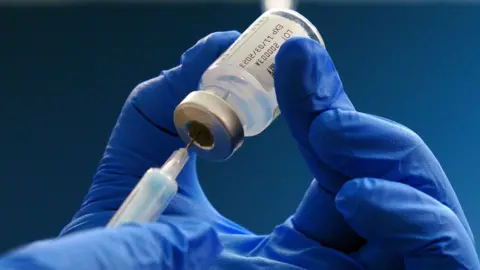
A 62-year-old man from Germany has, against medical advice, been vaccinated 217 times against Covid, doctors report.
The bizarre case is documented in The Lancet Infectious Diseases journal.
The shots were bought and given privately within the space of 29 months.
The man appears to have suffered no ill effects, researchers from the University of Erlangen-Nuremberg say.
'Very interested'
"We learned about his case via newspaper articles," Dr Kilian Schober, from the university's microbiology department, said.
"We then contacted him and invited him to undergo various tests in Erlangen. He was very interested in doing so."
The man provided fresh blood and saliva samples.
The researchers also tested some frozen blood samples of his that had been stored in recent years.
Dr Schober said: "We were able to take blood samples ourselves when the man received a further vaccination during the study at his own insistence.
"We were able to use these samples to determine exactly how the immune system reacts to the vaccination."
Evidence for 130 of the jabs was collected by the public prosecutor of the city of Magdeburg, who opened an investigation with the allegation of fraud, but no criminal charges were brought.
Covid vaccines cannot cause infection but can teach the body how to fight the disease.
Immune system
Messenger ribonucleic acid (mRNA) vaccines work by showing the body's cells a bit of genetic code from the virus.
The immune system should then recognise and know how to fight Covid should they encounter it for real.
Dr Schober worried hyper-stimulating the immune system with repeated doses might have fatigued certain cells.
But the researchers found no evidence of this in the 62-year-old.
And there was no sign that he had ever been infected with Covid.
'Favoured approach'
The researchers said: "Importantly, we do not endorse hyper-vaccination as a strategy to enhance adaptive immunity."
And the results of their tests on the 62-year-old were insufficient for making far-reaching conclusions, let alone recommendations for the general public.
"Current research indicates that a three-dose vaccination, coupled with regular top-up vaccines for vulnerable groups, remains the favoured approach," they say on the university's website.
"There is no indication that more vaccines are required."
The NHS says Covid vaccines are normally given seasonally but some people with a severely weakened immune system may need additional protection at other times - and it will contact those whose NHS record suggests may be eligible.
Covid vaccines can have side effects. A common one is a sore arm from the injection.
Yes, but ...The man appears to have suffered no ill effects, researchers from the University of Erlangen-Nuremberg say.


Germany's Increasing Sick Leave...
They are not the only country but they are an early warning sign about this FLU / RSV / Covid-19 season picking up steam (cough, cough, cough) for the not vaccinated and those with mental health problems.
----------
Mental health problems and respiratory viruses are contributing to a record number of sick days taken in Germany, new data reveals.
Absences from work have hit an all-time high in Germany, according to a new report on sick leave by statutory insurer AOK.
In its AOK Absenteeism Report 2023, the health insurer revealed that there had been 216.6 cases of sick leave per 100 employed insured persons last year.
This marks a significant jump from the years 2012-2021, when the average stood as 159.7 cases per 100 employees.
The proportion of employees unable to work - a value known as the 'incapacity to work rate' - also crept up to 6.7 last year. In the two years prior to that, it was 5.4 percent.
Presenting the results of the survey, Johanna Baumgardt from the Scientific Institute of the AOK (WIdO), expressed uncertainty over how the situation would develop.
https://www.thelocal.de/20231019/why-are-a-record-number-of-people-taking-sick-leave-in-germany
Flu cases on the rise in Germany: When (and how) should you take sick leave?
According to a report by the Robert Koch Institute, which collects data on flu incidents in Germany, acute respiratory disease incidence is up this week compared with the week before. Last week the incidence of respiratory illness was around 7,300 per 100,000 people, as opposed to 6,700 in the previous week.
The report suggests that respiratory illness “has been increasing since mid-2023,” peaking in December, with an incidence rate that has lingered above pre-pandemic levels for a few weeks.
Similar to previous years, the current spike in infections followed a short dip near the turn of the year. This trend is likely related to a person's level of contact increasing as they return to work after the winter holidays.
Is illness to blame for Germany becoming Europe’s ‘sick man’?
Starting last autumn, headlines began referring to Germany as a ‘sick man,’ due to its poor economic performance in 2023.
‘Sick man of Europe’ is a term, dating back to the early 1800s, given to countries that experience economic difficulties and related social unrest. But in this case, the label can be applied somewhat literally.
According to a report by VFA, Germany’s association of research-based pharmaceutical companies, a record level of sick leave taken by German workers last year played a significant role in the country slipping into an economic recession.
“Without the above-average sick days, the German economy would have grown by almost 0.5 per cent,” VFA said in a report released in January.
However, the report also explains that Germany’s economic performance may be more immediately linked to its dependence on exports, elevated energy costs, and a global slump in investment...
https://www.thelocal.de/20240208/fl...rmany-when-and-how-should-you-take-sick-leave
Disclaimer - The above message contains a link(s) to a tweet/article, that’s not ME making a claim. I may or may not share the same opinion even though I posted comments with the above facts from others about diseases/infections/vaccines.
wrbtrader
They are not the only country but they are an early warning sign about this FLU / RSV / Covid-19 season picking up steam (cough, cough, cough) for the not vaccinated and those with mental health problems.
----------
Mental health problems and respiratory viruses are contributing to a record number of sick days taken in Germany, new data reveals.
Absences from work have hit an all-time high in Germany, according to a new report on sick leave by statutory insurer AOK.
In its AOK Absenteeism Report 2023, the health insurer revealed that there had been 216.6 cases of sick leave per 100 employed insured persons last year.
This marks a significant jump from the years 2012-2021, when the average stood as 159.7 cases per 100 employees.
This increase of more than 30 percent was mainly caused by respiratory illnesses, including Covid-19. In 2022, this type of illness accounted for 86.5 periods of sick leave per 100 insured persons, compared to 36.3 cases the year before.
Home office was largely phased out in 2022, meaning far more employees were asked to come into their place of work even as the Covid virus remained prevalent during the colder months.
The proportion of employees unable to work - a value known as the 'incapacity to work rate' - also crept up to 6.7 last year. In the two years prior to that, it was 5.4 percent.
Presenting the results of the survey, Johanna Baumgardt from the Scientific Institute of the AOK (WIdO), expressed uncertainty over how the situation would develop.
"It remains to be seen how absenteeism will develop in the further course of the year against the background of increasing Covid 19 infections and the usual seasonal peak in respiratory illnesses," she said.
https://www.thelocal.de/20231019/why-are-a-record-number-of-people-taking-sick-leave-in-germany
Flu cases on the rise in Germany: When (and how) should you take sick leave?
Following a dip in infections around the turn of the year, flu and respiratory illness rates are spiking again. Thankfully German labour laws ensure that workers have plenty of opportunity to take time off when they are sick.
If it feels like everyone is falling ill around you, it may be because the FLU is on the rise again in Germany this week.
According to a report by the Robert Koch Institute, which collects data on flu incidents in Germany, acute respiratory disease incidence is up this week compared with the week before. Last week the incidence of respiratory illness was around 7,300 per 100,000 people, as opposed to 6,700 in the previous week.
The report suggests that respiratory illness “has been increasing since mid-2023,” peaking in December, with an incidence rate that has lingered above pre-pandemic levels for a few weeks.
The estimated incidence of Covid-19 has been trending downward compared to previous years, with the recent spike in illness attributed mainly to influenza viruses, RSV, and rhinoviruses.
Similar to previous years, the current spike in infections followed a short dip near the turn of the year. This trend is likely related to a person's level of contact increasing as they return to work after the winter holidays.
Is illness to blame for Germany becoming Europe’s ‘sick man’?
Starting last autumn, headlines began referring to Germany as a ‘sick man,’ due to its poor economic performance in 2023.
‘Sick man of Europe’ is a term, dating back to the early 1800s, given to countries that experience economic difficulties and related social unrest. But in this case, the label can be applied somewhat literally.
According to a report by VFA, Germany’s association of research-based pharmaceutical companies, a record level of sick leave taken by German workers last year played a significant role in the country slipping into an economic recession.
“Without the above-average sick days, the German economy would have grown by almost 0.5 per cent,” VFA said in a report released in January.
However, the report also explains that Germany’s economic performance may be more immediately linked to its dependence on exports, elevated energy costs, and a global slump in investment...
https://www.thelocal.de/20240208/fl...rmany-when-and-how-should-you-take-sick-leave
Disclaimer - The above message contains a link(s) to a tweet/article, that’s not ME making a claim. I may or may not share the same opinion even though I posted comments with the above facts from others about diseases/infections/vaccines.
wrbtrader
Last edited:
You do realize this is completely fake news and the CDC never released a 148 page study on Covid-19 and myocardiitis with every single page redacted.
The nonsense shoveled by Zachary Stieber from The Epoch Times is quite amazing bullshiat. Zachary is the clown who placed a fake document on documentcloud and claimed it was a redacted CDC document on Covid-19 and myocarditis.