For whatever reason I got cold feet and did not want to hold through NFP, so I closed out yesterday morning right after Draghi's press conference. It'll be unfortunate if price ends somewhere between 1.364-1.37, because my returns would be 2-3x in a few hours

Oh well.
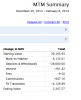
There isn't a good way to get a good summary off of IB for this trade for a few reasons: I put in a withdrawal request yesterday right after closing out and it was already processed. Second, I don't realize positions in one go, throughout the course of the trade I was taking profits/losses in eur/usd as I was putting hedges back on and off. And lastly, the Mark-to-market columns on IB statements don't include FX trades, they are a separate category. Which makes sense I guess, not many idiots are hedging in spot, lol. Nonetheless, the NAV column does the best job, so:
Mark-to-Market : + 6,132.01
FX Translation : - 4,129.89
Commissions : - 687.16
Interest: - 261.82
Fees: - 9.50
Net = +1,043.64
My starting cash value says $29,000 but I withdrew a few thousand during the course of the trade, so really I was trading on $23,000 cash. My margin varied anywhere from $11,000-$21,000 (north of $20k I was fully hedged).
So, $1,043.64 / $23,000 = 4.5% return on account over 7 weeks.
The real question, does the premium earned overcome the delta hedging costs? Yes, but eur/usd was very quite, except for around ECB/Fed/NFP. With a larger average true range at the same premium (I sold 7% volatility, my God), certainly returns would have been smaller. That said, part of my mark to market returns are a bunch of OTM verticals that lost money because price made no substantial moves. So with a larger ATR I could assume some of those verticals would have made money, increasing my mark-to-market gains, while my FX losses would have been larger.
Interest is from being short eur/usd most of the time. Commissions would be a smaller percentage at larger size (for example, if I traded double the size, my FX commissions would have been cut in half). Fees were negligible (IB data subscriptions).
In conclusion, I don't think 'edge' could be perceived without a better delta-hedge cost assumption ahead of time. If the costs were higher, are there 'reactionary' measures that would reduce them going forward in the life of the trade (without increasing risk substantially) ?
It was an interesting trade. For now I need to focus on the rest of the semester. Thanks for reading.

 good luck to anyone net short vola, especially in the equity indices.